
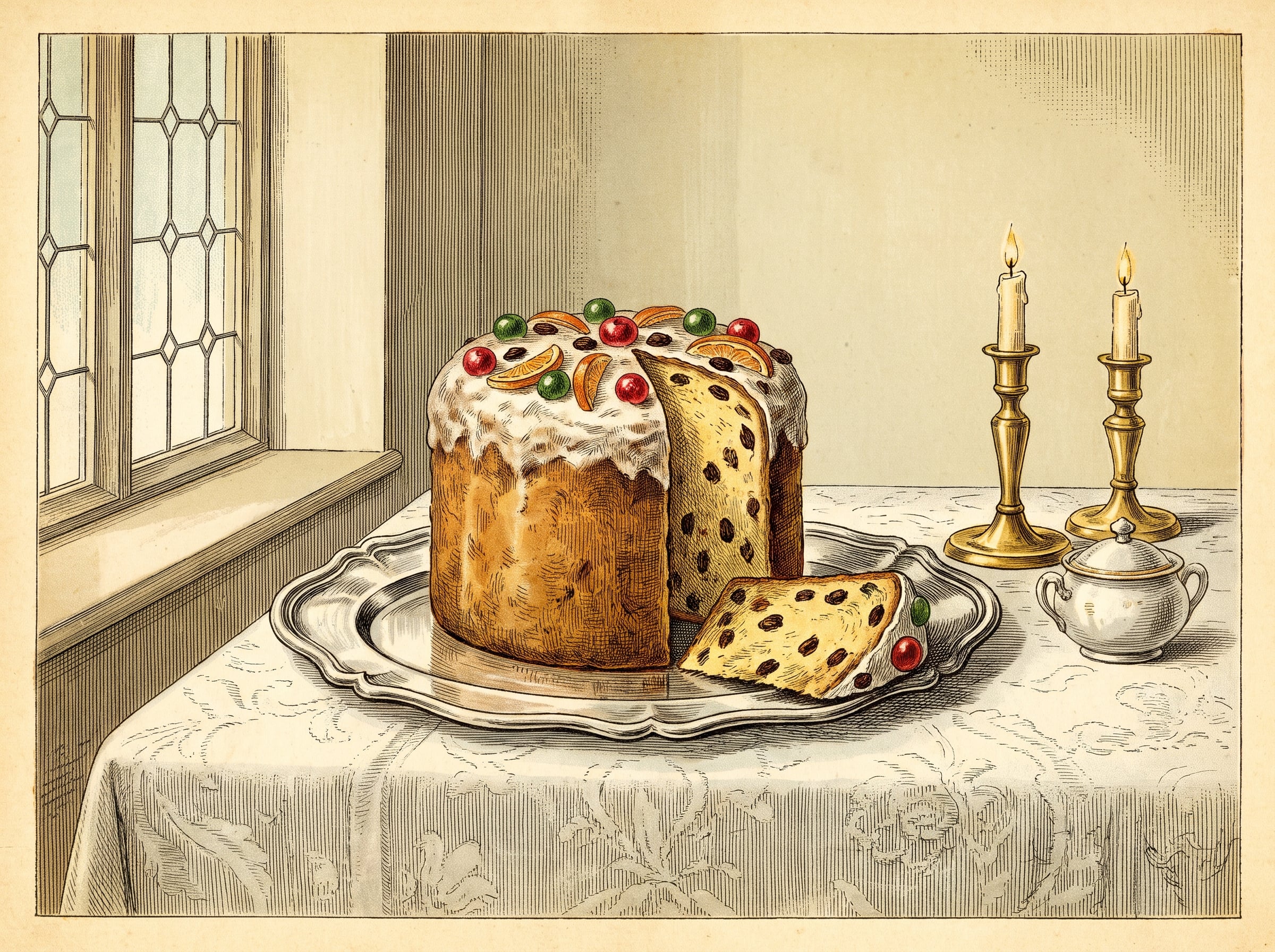
In 1889 a Swiss-born cook who had spent more than two decades in Delmonico’s kitchens wrote down how New York’s grandest restaurant made its baba, and printed it for home cooks. It is not the little rum-soaked cake most of us picture. It is a tall, buttery centerpiece with Madeira in the dough and candied fruit scattered across the plate.
Please note that some of the images in this article were created with the assistance of AI.
From The Table: How to Buy Food, How to Cook It, and How to Serve It, 1889
The Story Behind This Recipe
The boy from Airolo
Alessandro Filippini reached New York on June 5, 1866, a few months short of his seventeenth birthday, and went straight to work at Delmonico’s on 14th Street. He had been born on New Year’s Eve 1849 in Airolo, a small village in Switzerland, and he would spend more than 25 years cooking in Delmonico’s restaurants. By 1891 the New-York Tribune was calling him a "power of strength" in the establishment. The wording is a little tangled, but the meaning is clear.
In 1889 he published The Table: How to Buy Food, How to Cook It, and How to Serve It, the very first Delmonico’s cookbook. The title promised the whole job, from market to dining room, and the book carried restaurant methods into private homes. Filippini died in 1917, and his name has faded since. Charles Ranhofer, Delmonico’s more famous chef, has mostly eclipsed him. This baba is a good excuse to bring him back into view.
A grandmother, a king and a pastry cook
Start with the name. In most Slavic languages baba means "old woman" or "grandmother," and babka is the diminutive. The original was a tall, cylindrical yeast cake like the Polish one traditionally baked for Easter Sunday. That cake is often made in a bundt-type pan, often studded with raisins or candied peel, and sometimes iced on top.
The cake reached France in the 18th century by way of Lorraine. The credit usually goes to Stanislaus I, the exiled king of Poland. One story has his pastry cook, Nicolas Stohrer, rescuing a dried-out baba with Malaga wine, saffron and raisins. Stohrer followed the king’s daughter to Versailles in 1725 and opened a pastry shop in Paris in 1730. Rum came later, in 1835 by one account, and was eventually stirred into a flavored sugar syrup. That is the road to the small soaked baba of today.
A big cake and a new kind of yeast
Filippini’s baba takes the older road. It is a large cake, baked in a copper or tin cylinder that holds three pints, with no rum and no syrup anywhere. Half a gill of Madeira goes straight into the dough along with cream, four eggs and five ounces of butter. Sultanas, raisins and citron follow, which puts the cake closer to Stohrer’s wine and raisins than to anything soaked. Once baked, it is turned out onto a round dish, glazed, and decked with candied fruit on top and around the plate. It belongs to a long line of yeast cakes kept for special occasions.
One fairly new thing in the bowl is the yeast. Charles and Maximilian Fleischmann began making yeast in Cincinnati in 1868 and patented a compressed yeast cake. They showed it to big crowds at Philadelphia’s Centennial Exposition in 1876. It kept only a few days, so fast delivery mattered, and refrigerated railcars helped in the 1880s. The heat, though, is left to kitchen judgment: a towel over the bowl, "the warmest place in the kitchen (not on the stove)," a "moderate oven," and a cake that is done at "a good golden color."
1880s
Notes From the Era
The recipe · 1889
Baba
From The Table: How to Buy Food, How to Cook It, and How to Serve It by Alessandro Filippini (1889). Every word of the recipe below is as printed.
Ingredients
- half a pound of the best flour
- one drachm of compressed yeast
- half a gill of warm water
- an ounce of powdered sugar
- four raw eggs
- a gill of cream
- half a gill of good Madeira wine
- a drachm of very fine salt
- five ounces of good, fresh, soft butter
- two ounces of cleaned Sultana currants (No. 1080)
- two ounces of cleaned raisins (No. 1081)
- one ounce of finely chopped citron
- cold butter
- a glace à l’eau (No. 1197)
- candied fruits
Method
-
Make the yeast sponge
Have ready half a pound of the best flour, one drachm of compressed yeast, and half a gill of warm water. Put three ounces of the flour into a vessel, make a hollow in the centre, and in it lay the yeast and water; with the hands mix the yeast gently with the water for three minutes, then mix all together gradually for three minutes more. Cover the vessel with a towel, and leave it in the warmest place in the kitchen (not on the stove), and after thirty minutes it will rise to twice the size.
-
Mix sugar, eggs, cream and wine into the flour
Lay the remainder of the flour on the table, make a hollow in the centre, putting in it an ounce of powdered sugar and four raw eggs. Mix the sugar and eggs with the hands; then add a gill of cream and half a gill of good Madeira wine. Season with a drachm of very fine salt, and mix all with the flour for five minutes.
-
Add the butter and combine the pastes
Make a hollow in the centre again, and into this put five ounces of good, fresh, soft butter; mix well again for two minutes. If the prepared yeast-dough be now raised to its proper height, mix the two pastes together for at least five minutes; return it to the vessel, leave it in the same warm place, covering it as before.
-
Prepare the fruit and the mold
When rested one hour, have ready two ounces of cleaned Sultana currants (No. 1080), two ounces of cleaned raisins (No. 1081), and one ounce of finely chopped citron. Grease with cold butter the inside of a cylindrical copper or tin form large enough to hold three pints.
-
Add the fruit and rise in the mold
If the paste be now raised to twice the size, mix in the raisins, currents, and citron, stirring for five minutes; put it in the mold, and lay it in a warm place (not on the stove) for another twenty minutes.
-
Bake
Then place it in a moderate oven for one hour. When a good golden color, remove, and let it cool slightly.
-
Unmold, glaze and decorate
Place a round dish over the mold, turn upside down, lift off the form, and glaze the cake with a glace à l’eau (No. 1197). Decorate the top and dish with candied fruits, and send to the table.
Our notes
Reading It Today
Gills and drachms. A gill is 4 fluid ounces, or half a cup. That makes the warm water and the Madeira a quarter cup each, and the cream half a cup. A drachm (dram) is one-sixteenth of an ounce, about 1.8 grams, so the yeast and the salt are small pinches by weight. Half a pound of flour is about 227 grams, and the five ounces of butter (about 140 grams) is more than half the flour’s weight.
Compressed yeast. This is fresh cake yeast, the moist block form that is still sold today. The recipe builds a small starter first: three ounces of flour, the yeast and the water, left to double. That starter is then worked into the rich egg, cream and butter dough. Bakers call this a sponge method.
What the cake would be like. Judging from the ingredients, this is a very rich dough, close to brioche: eggy, buttery and soft, with a tender crumb. The Madeira would likely add a gentle winey note. The Sultanas, raisins and citron would give sweetness and chew, and the plain sugar glaze and candied fruit would sweeten the outside. Because nothing is poured over it, it would be far less moist than a syrup-soaked rum baba.
Size, shape and heat. A three-pint mold holds about six cups, so this is a tall, family-sized cake, much bigger than a modern individual baba. A "moderate oven" is conventionally taken to mean about 350°F. Unlike an everyday loaf of bread today, which uses little fat or sugar, this one is built as a dessert from the start.
Source: Alessandro Filippini, The Table: How to Buy Food, How to Cook It, and How to Serve It (New York, 1889). Read the 1889 book at Project Gutenberg.
Sources for the history
- Alessandro Filippini, The Table: How to Buy Food, How to Cook It, and How to Serve It (New York, 1889), recipe No. 1216, Baba
- The Forgotten Chef at Delmonico’s: Alessandro Filippini (1849-1917), Digest: A Journal of Foodways and Culture (Champlain College)
- Rum baba (Wikipedia)
- Easter bread (Wikipedia; reached via Baba (cake))
- History of Fleischmann’s Yeast, Breadworld (Fleischmann’s)
- Charles Fleischmann, Baking Hall of Fame, American Society of Baking
- How Fleischmann’s Yeast Built the Jewish Catskills, My Jewish Learning (The Nosher; also published by The Forward/JTA)
The original recipe text is from a work published in 1889 and is in the public domain in the United States. The history, notes and illustrations are Digstalk’s own. Brand names that appear in historic recipes are mentioned as historical fact only. Illustrations are AI-generated in a vintage style. The recipe is shown exactly as it was published in 1889; we have not photographed a test batch.