
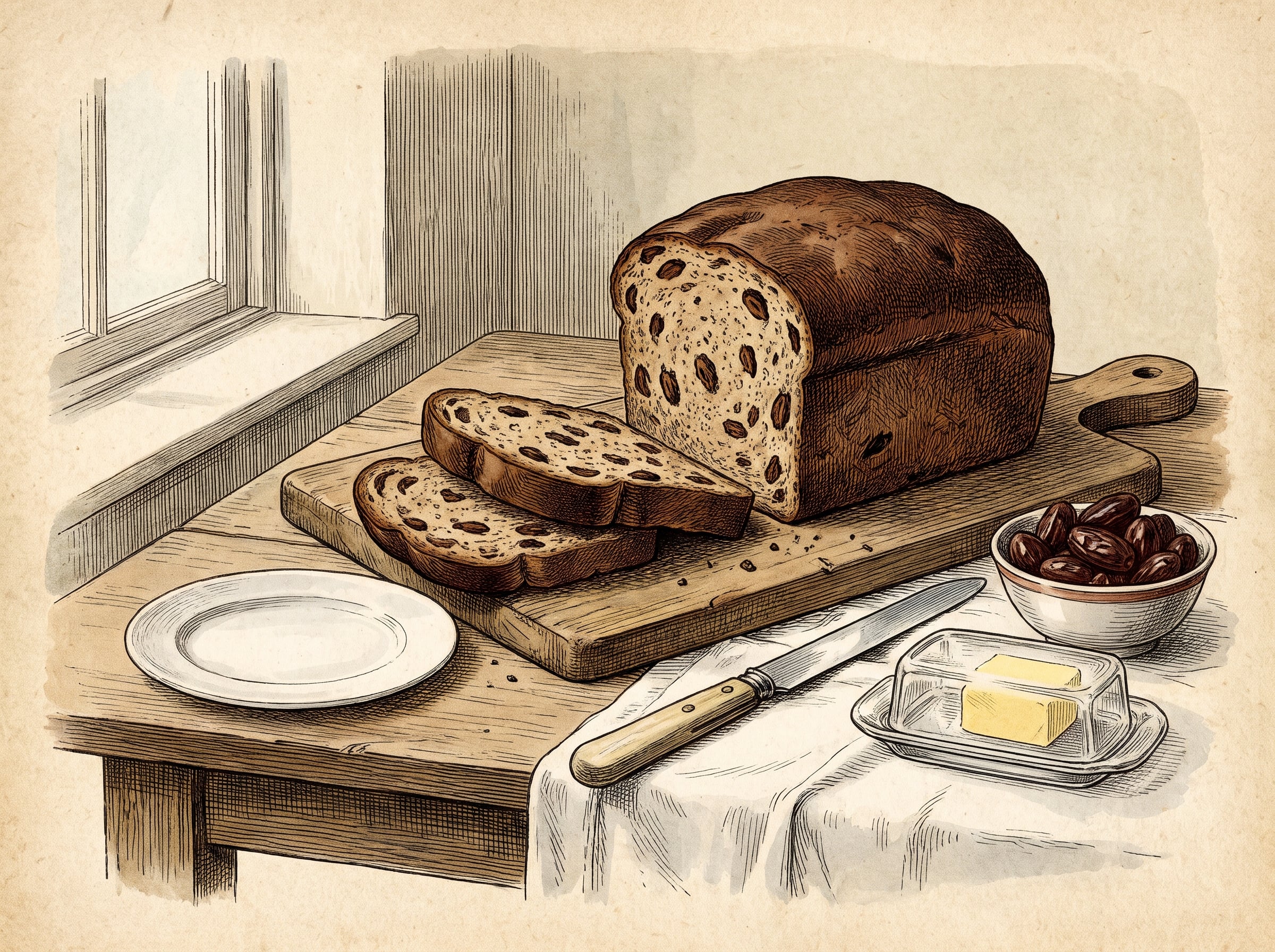
Ella Eaton Kellogg’s recipe for date bread runs just four sentences. In that space she combines coarse Graham flour from the health-reform movement, a pint of sponge from the ordinary home bread routine, and a cupful of dates that had come all the way from the Middle East. Each of those ingredients carries a story about how Americans ate in the 1890s.
Please note that some of the images in this article were created with the assistance of AI.
From Science in the Kitchen, 1893
The Story Behind This Recipe
A kitchen turned laboratory
Ella Eaton finished college at nineteen. She graduated from Alfred in 1872, in the New York town where she was born in 1853, and the Michigan Women’s Hall of Fame records her as the youngest person to earn a bachelor’s degree there. Nursing typhoid patients during a stay in Battle Creek drew her into hygiene work, and in February 1879 she married Dr. John Harvey Kellogg, who ran the Battle Creek Sanitarium. His patients often balked at the meatless diet, so she turned a kitchen into a laboratory. The Sanitarium Experimental Kitchen dates to 1884. It grew into a School of Domestic Economy, and its cooking students went on to teach others.
Her work reached the public as Science in the Kitchen. Some sources date it to 1892, while the Culinary Institute of America’s library describes the 1893 edition and says she wrote it to guide housewives toward food that was ‘morally correct’ as well as nutritionally sound. The Paris Review calls it less a cookbook than a manual for feeding the body. Digestion and kitchen order come first, then several hundred pages of grains, nuts, legumes and vegetables. Her husband later wrote that hundreds of her dishes had made their way into everyday cookbooks and newspaper household columns.
Three threads in one loaf
Start with the flour. Graham flour is whole wheat ground coarse and left unsifted. It is named for Sylvester Graham (1794–1851), a diet reformer who objected to millers stripping away the bran and germ, so it was the obvious choice for a health-reform kitchen. Then comes the method. Kellogg begins with a pint of ‘light white bread sponge prepared with milk,’ the first half of the old two-step sponge-and-dough process, and stiffens it with Graham flour and a sparing two tablespoons of sugar. Last come the dates. According to a University of Texas history doctoral candidate, Americans took to them in the last quarter of the nineteenth century. Nobody in the United States grew them commercially yet, so they were shipped in from the Middle East.
Food historian David S. Shields places the better-known American date nut bread in 1917–1918, as a wartime novelty. One newspaper promoted a half-Graham, half-white version as good for the war effort. Kellogg’s yeast-raised loaf is a different bread, and it appeared in print a full generation earlier.
Dates by the boxful
A cook following this recipe in the 1890s had a chore to do first: stoning the dates. Shields notes that the Dromedary company’s pitted, packaged dates arrived only in 1910, at 10 cents a package. Before that, many dates sat loose in great open boxes, where, as the company’s ads put it, they ‘dried and hardened and shriveled.’ The flour also called for a careful shopper. Both before and after the 1906 Pure Food and Drug Act, sellers often passed off white flour mixed with wheat middlings as Graham.
Dates also followed the calendar. Shields writes that many grocers stocked them only from about October through March, and that the date nut bar was a holiday-season treat for much of the twentieth century. None of our sources ties this particular loaf to Christmas. Still, a fruit bread made with a cold-season import fits well on a holiday baking table. In the 1890s every date in it still arrived by ship, since Southern California’s Coachella Valley became the leading growing region only in the early twentieth century.
1890s
Notes From the Era
The recipe · 1893
Date Bread
From Science in the Kitchen by Ella Eaton Kellogg (1893). Every word of the recipe below is as printed.
Ingredients
- a pint of light white bread sponge prepared with milk
- two tablespoons of sugar
- Graham flour to make a very stiff batter
- a cupful of stoned dates
Method
-
Make the stiff batter
Take a pint of light white bread sponge prepared with milk, add two tablespoons of sugar, and Graham flour to make a very stiff batter.
-
Add the dates
And last a cupful of stoned dates.
-
Pan, rise and bake
Turn into a bread pan. Let it rise, and bake.
Our notes
Reading It Today
What ‘sponge’ means. A sponge is a loose, fermented mixture of yeast, liquid and some of the flour, made before the rest of the dough. Kellogg assumes you already have a pint of it, about 2 cups, made with milk and white flour. The recipe skips that first stage entirely, so a modern reader has to supply it.
Stoned dates and a cupful. ‘Stoned’ simply means pitted. A cupful is roughly a standard cup. In the 1890s the cook usually pitted the dates by hand, since Dromedary’s packaged pitted dates did not arrive until 1910.
What the loaf would be like. Judging from the ingredients, this would be a fairly dense, wheaty loaf. It is mixed to a ‘very stiff batter’ and built largely on coarse Graham flour. The milk sponge would soften the crumb a little. With only two tablespoons of sugar, most of the sweetness would come from pockets of date scattered through the slices.
What the recipe leaves out. This loaf is yeast-raised and lists no butter, eggs or nuts. It gives no oven temperature or baking time either, so judging the bake is left entirely to the cook.
Source: Ella Eaton Kellogg, Science in the Kitchen (Health Publishing Company, Battle Creek, 1893). Read the 1893 book at Project Gutenberg.
Sources for the history
- Science in the Kitchen (Ella Eaton Kellogg, 1893), Project Gutenberg
- Ella Eaton Kellogg, Wikipedia
- Ella Eaton Kellogg, Michigan Women’s Hall of Fame
- Science in the Kitchen: Kellogg, Meat & Morality, Conrad N. Hilton Library, Culinary Institute of America
- The Other Kellogg: Ella Eaton, by Edward White, The Paris Review
- Graham flour, Wikipedia
- Fear and Lust in the Desert, by Atar David, Not Even Past (University of Texas at Austin)
- ISSUE 73, 20th-Century Creations, Part 1: The Date-Nut Conjunction, by David S. Shields, Foodlore & More
- Sponge and dough, Wikipedia
The original recipe text is from a work published in 1893 and is in the public domain in the United States. The history, notes and illustrations are Digstalk’s own. Brand names that appear in historic recipes are mentioned as historical fact only. Illustrations are AI-generated in a vintage style. The recipe is shown exactly as it was published in 1893; we have not photographed a test batch.