
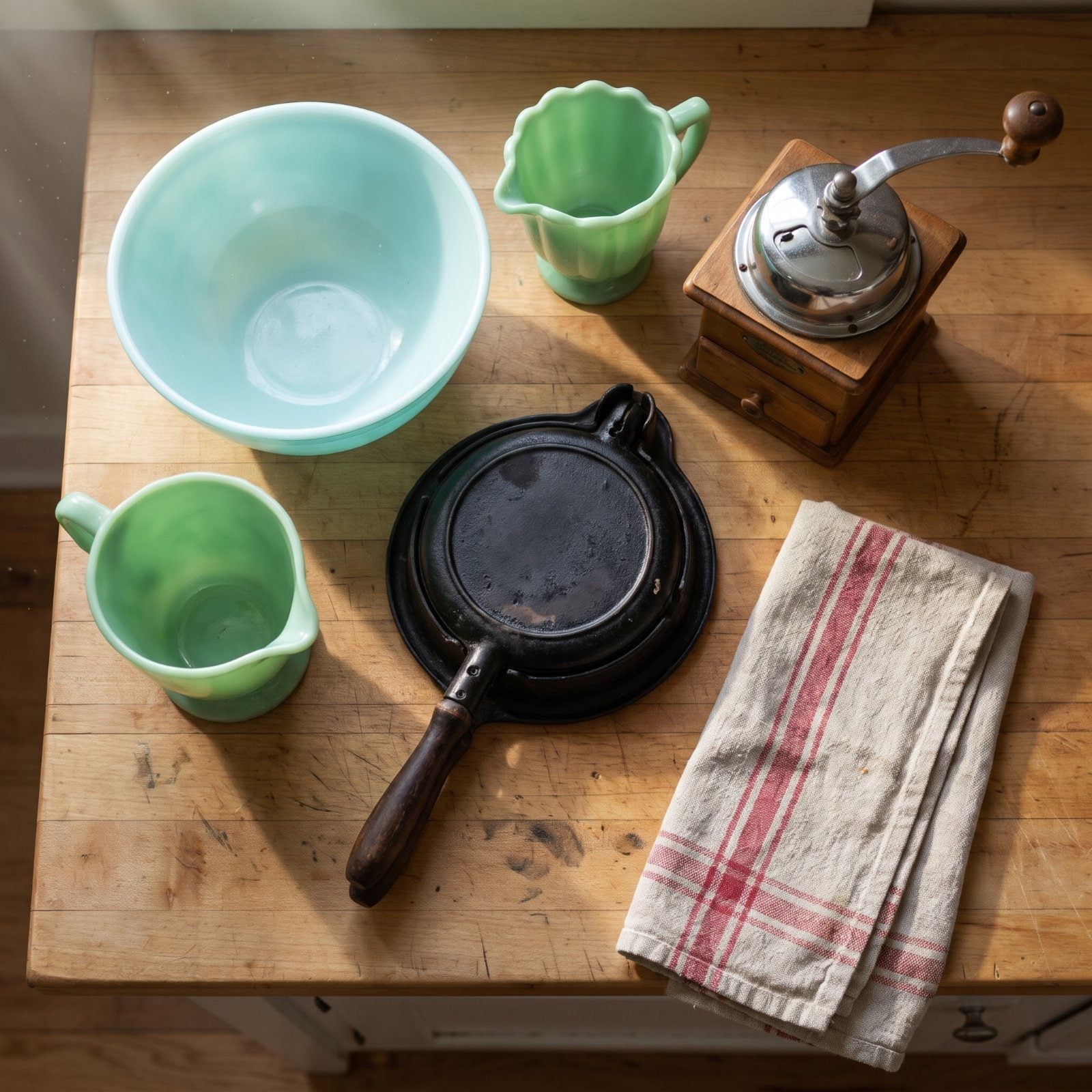
A chipped casserole dish once sold for more than a used car. Not because anyone needed it to hold leftovers, but because it was the right pattern, the right year, and some collector had been hunting it for a decade. Old kitchen tools are quietly one of the hottest corners of the resale world right now. The details that separate a $4 thrift find from a grail are maddeningly specific: a single letter stamped on cast iron, a particular shade of green glass, a color made for one short run and never again. We dug into what the hunters actually want, and why.
Please note that some of the images in this article were created with the assistance of AI.
32. Pyrex ‘Lucky in Love’ Casserole Dish: The One That Broke the Internet
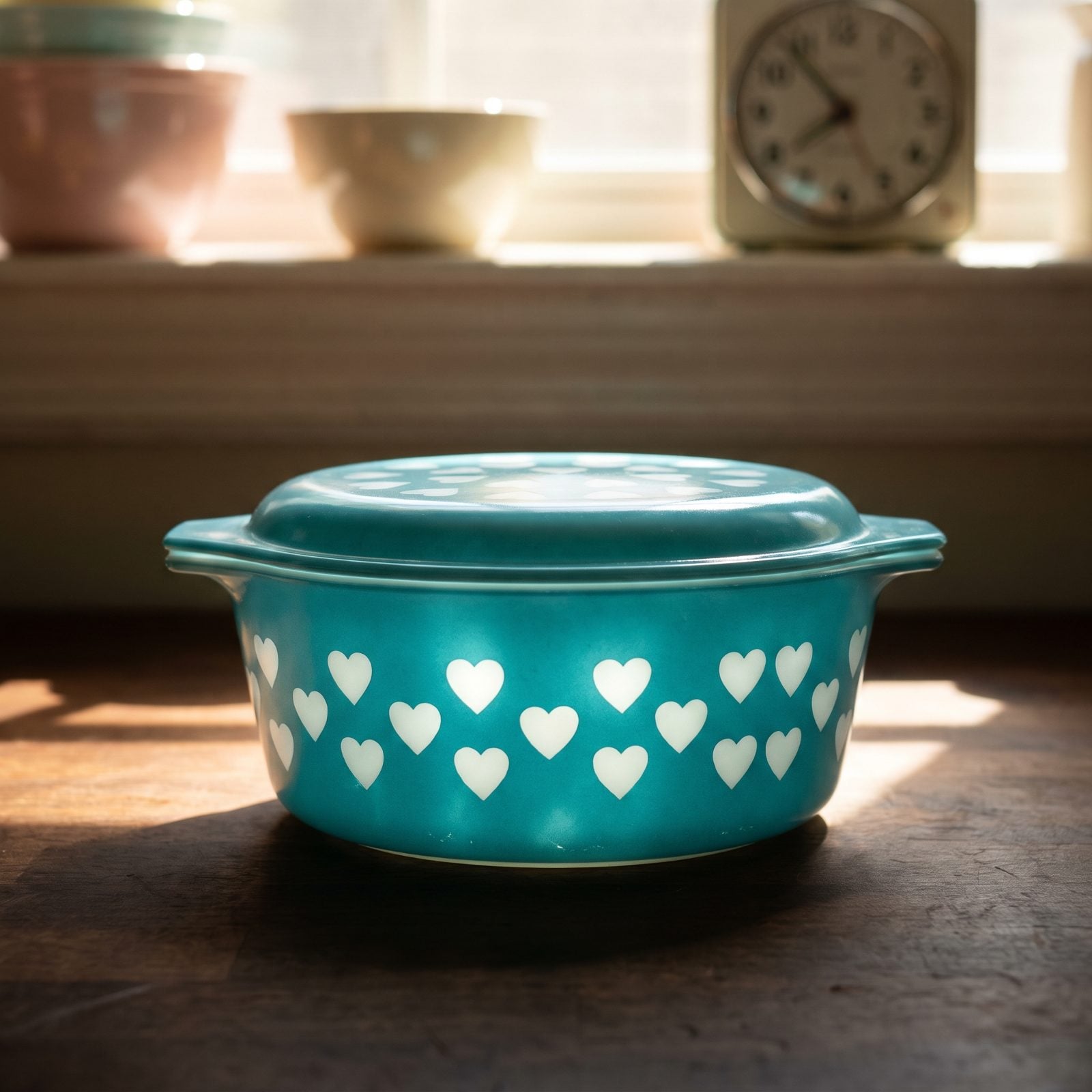
This is the one that started the whole frenzy. A 1959 promotional Pyrex that almost nobody saved, decorated with white hearts on a turquoise body, it surfaced at a thrift store years ago and sold online for a number that made the news.
Here is what collectors look for. The pattern has to be genuine, not faded Butterprint someone mistook in bad lighting. Original examples were produced in tiny quantities and most got tossed. Condition matters less than you’d think with something this scarce — but a bright, unfaded turquoise pushes the value well above a washed-out one.
31. KitchenAid Model K Stand Mixer: The Workhorse That Refuses to Die
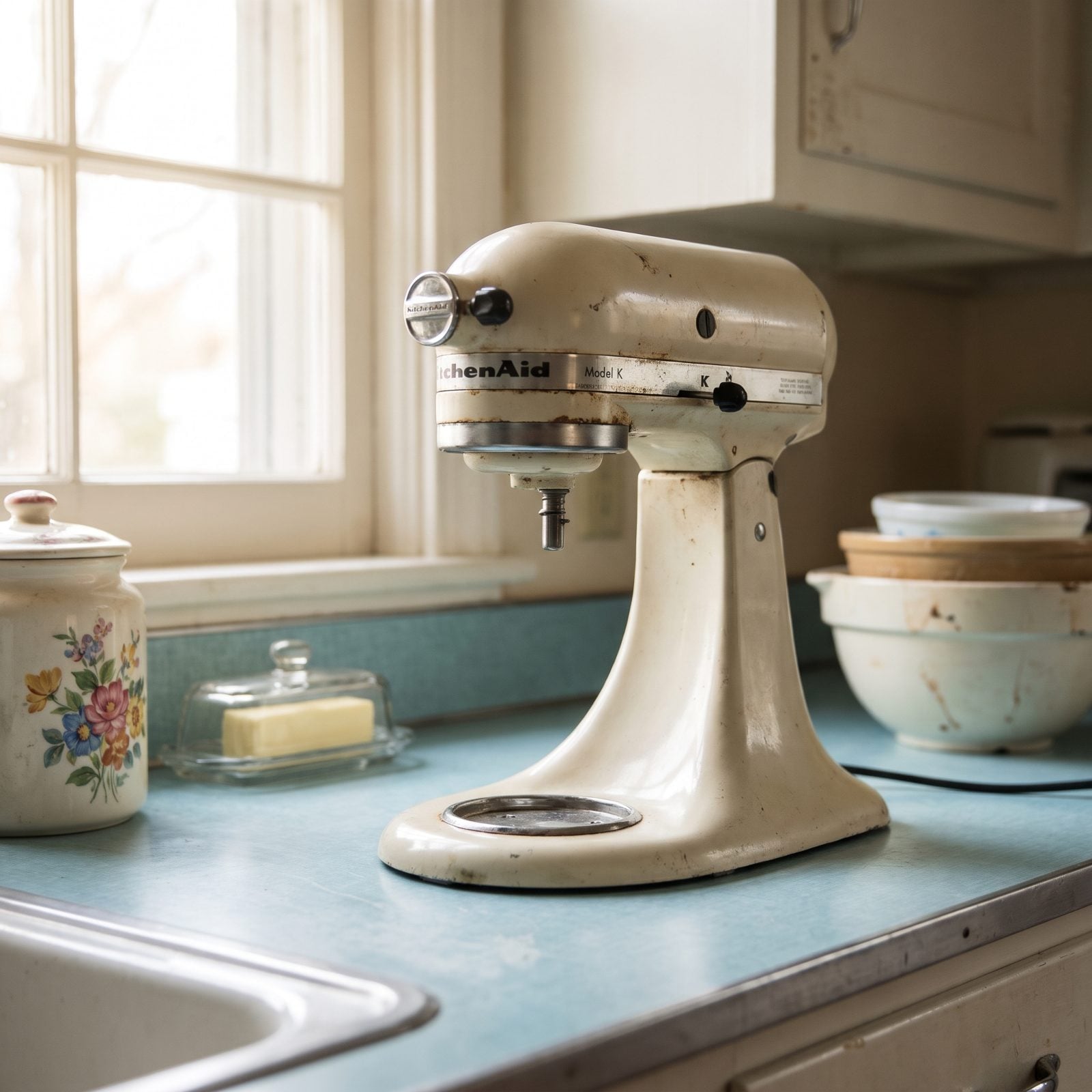
Your grandmother’s mixer might outlast your marriage. The Model K, built mostly through the 1950s and 60s, has a reputation for running decades with nothing more than an occasional grease change.
Collectors chase the enameled finishes, and color is king. Standard white is common. Petal pink, a soft butter yellow, or any factory color beyond the usual pushes the price up fast, and original attachments in the box — the juicer, the grinder, the slicer — add real money. Check that the motor hums smoothly and the planetary gear still swings the beater in that figure-eight. A frozen gearbox is a project, not a bargain.
30. Fire-King Jadeite Ball Jug: Green Glass That Glows
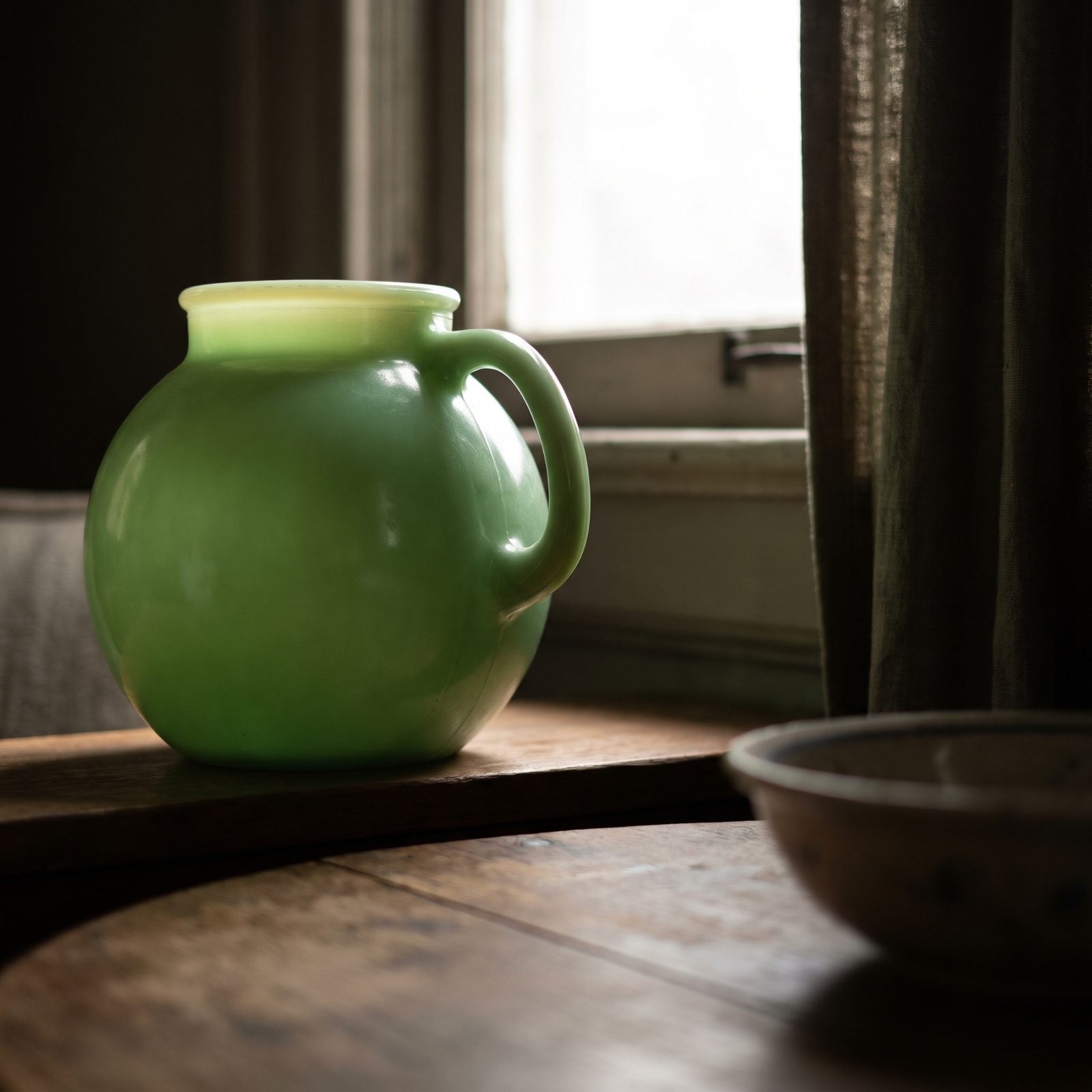
Hold jadeite up to a window and you understand the obsession. The green glows.
Fire-King, made by Anchor Hocking, turned out this jade glassware by the truckload in the mid-century, but the ball jug is one of the shapes that got used hard and broke easily. Survivors with no cracks are what people want. Run your thumb around the rim and the base, where chips hide. Genuine Fire-King carries a maker’s mark on the bottom, and knowing the mark saves you from the wave of modern reproductions flooding the market. The repros look close. They don’t glow the same way under real light.
29. Pyrex Primary Colors Mixing Bowl Set: The Rainbow Everyone Wants Complete
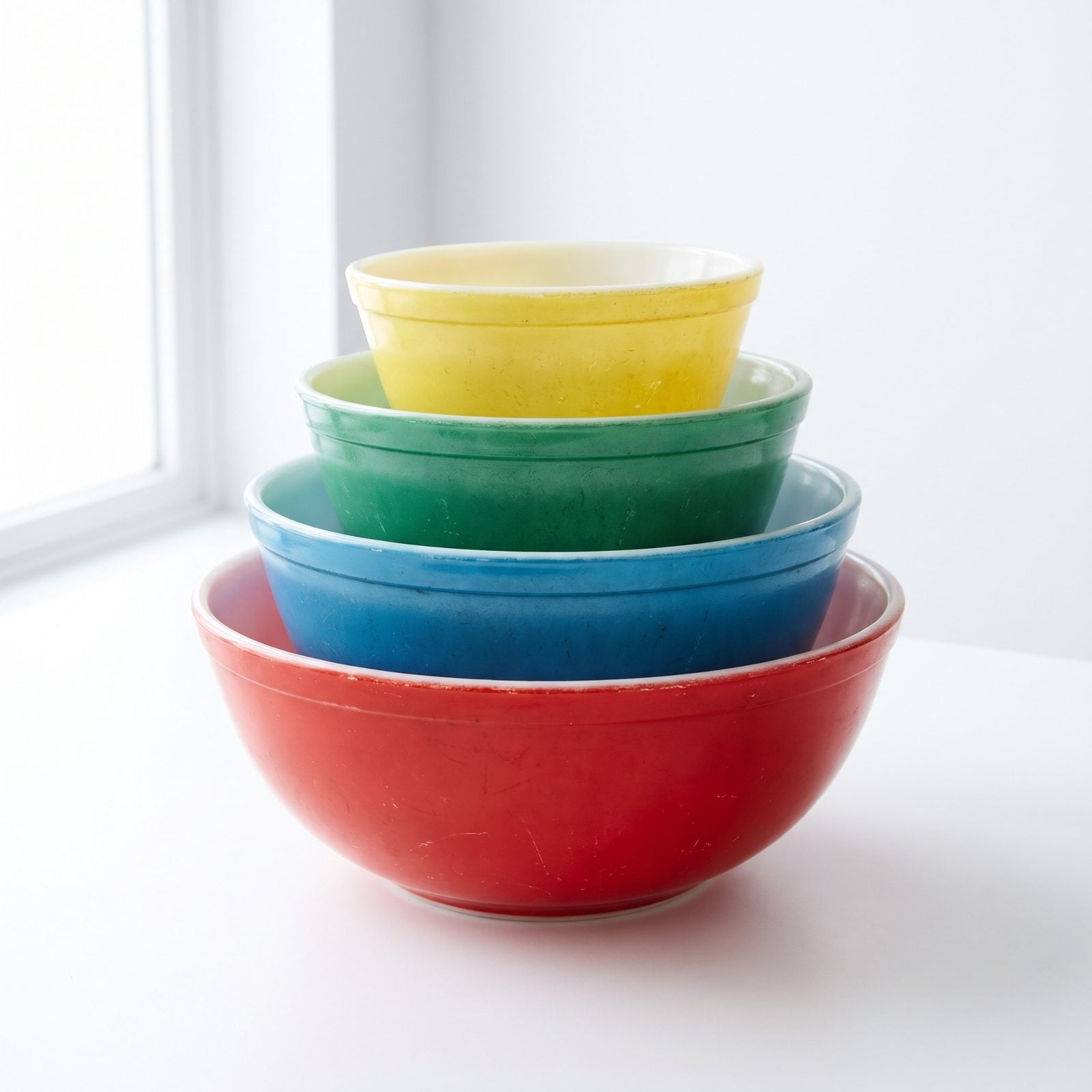
A complete set of four — yellow, green, red, and blue — is the thing. One stray bowl is a cheap find. All four together, colors bright and unfaded, and you’re in a different conversation entirely.
These nest together, which is how they survived, but decades of dishwashers murdered the enamel on most of them. Collectors want the color saturated, not chalked out to a pastel ghost. The blue, the smallest bowl, tends to go missing first, so sets with the blue intact are the hard ones to assemble.
28. Arcade Crystal Wall-Mounted Coffee Grinder: Glass Hopper, Cast-Iron Soul
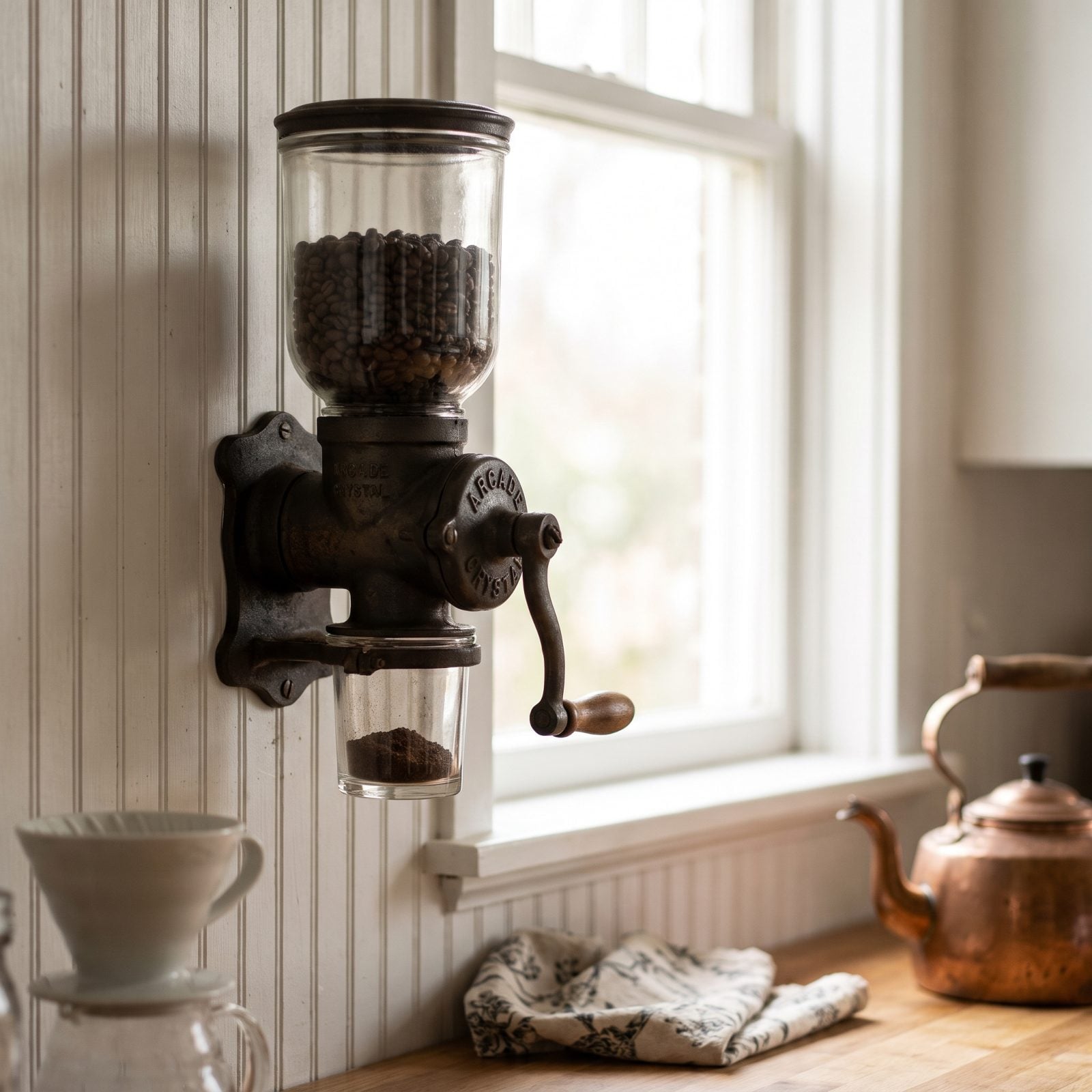
Before you ground beans with a button, you bolted a grinder to the wall. The Arcade Crystal, a fixture in American kitchens around the turn of the last century, paired a cast-iron grinding head with a clear glass hopper on top and a clear glass catch cup hanging below.
The glass is the vulnerable part. The hopper cracks, chips, and gets separated from the iron body, so an all-original grinder with its glass present and the embossing intact is what hunters pay for. Rust on the iron is forgivable and honestly expected. An unbroken original glass hopper is the rare part.
27. McKee Jadeite Roman Arch Shaker: Small, Square, and Fiercely Collected
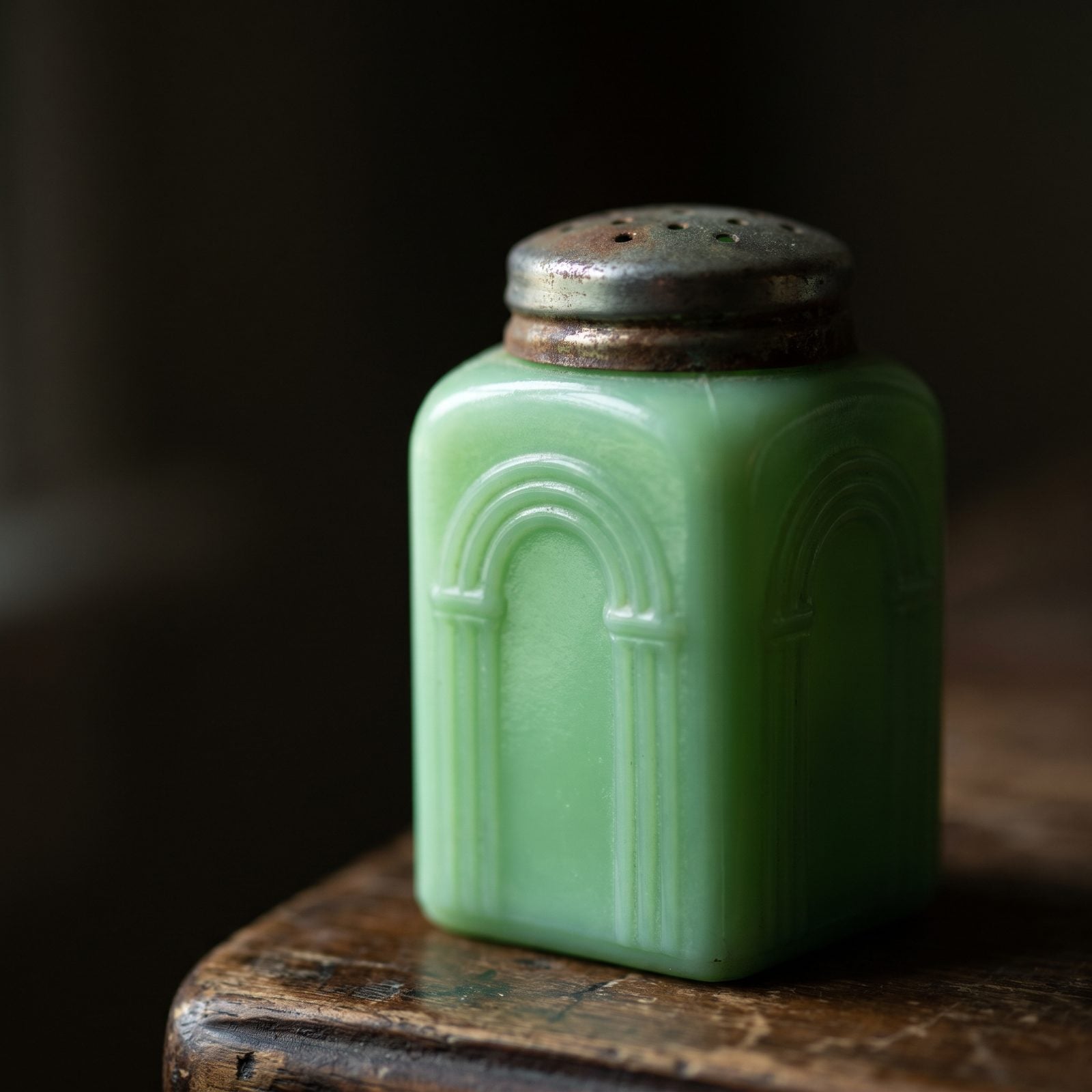
Tiny thing, big following. McKee’s Roman Arch shakers — square jadeite with those little arched panels on each side — are the pieces jadeite devotees quietly fight over.
The catch is the original stenciled label. These were lettered on the glass for salt, pepper, flour, sugar, and that black stenciling wore off with every wipe of a damp cloth. A shaker with crisp, legible original lettering is worth a real multiple of a blank one, and the matching metal lid helps too. McKee’s mark on the base separates the genuine article from the copycats, and the jade color should read deep and even, not thin or streaky.
26. Chemex Handblown Coffee Maker: A Gadget That Lives in a Museum
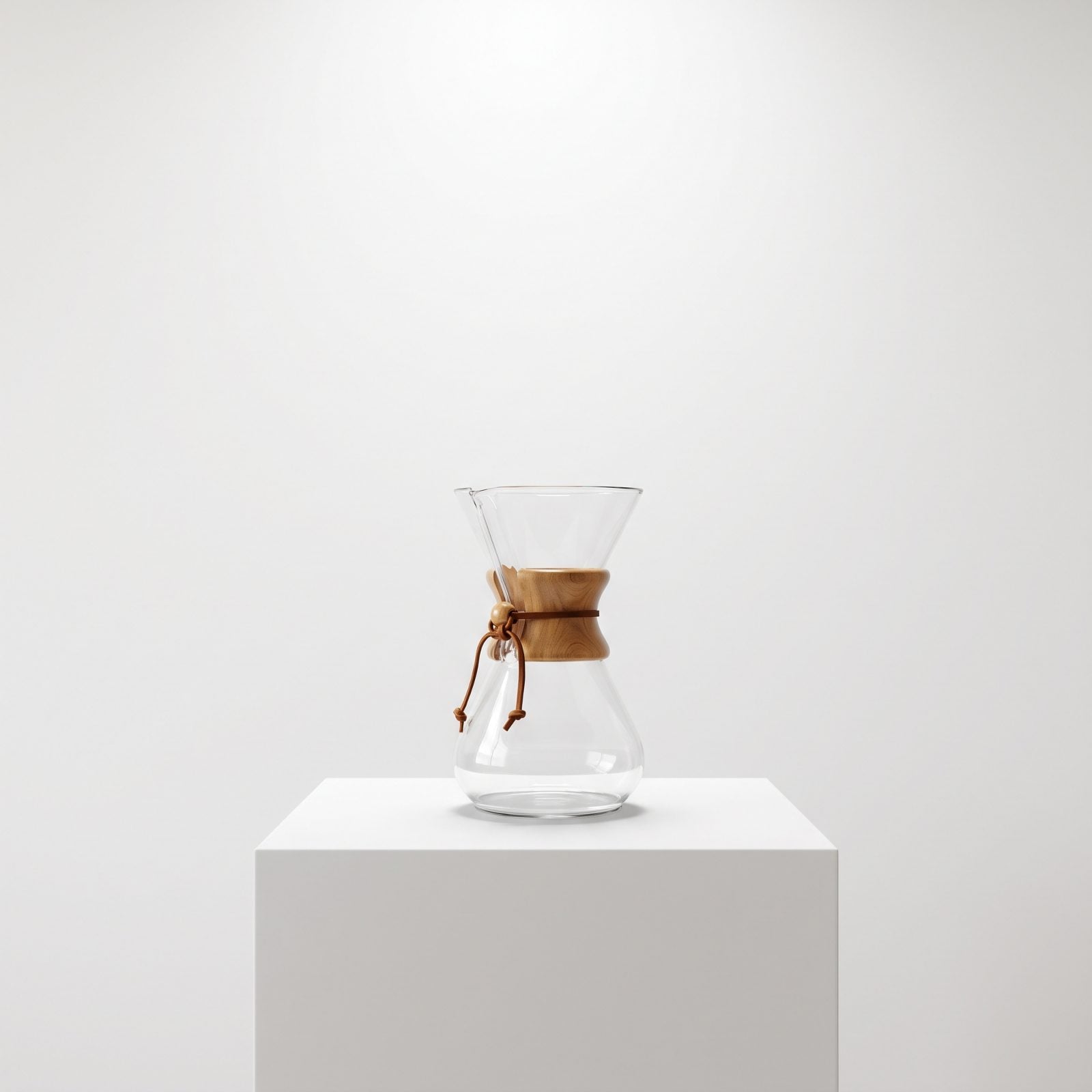
Here is a kitchen gadget that sits in the permanent collection of the Museum of Modern Art. The Chemex, an hourglass of handblown glass with a wooden collar and a leather tie, has barely changed since its 1941 debut, which makes dating the early ones a careful business.
Collectors chase the earliest handblown examples over the later machine-made ones. Tells include the glass quality, the style of the wooden collar, and the maker’s crest etched into the flask. What you want is a piece with its original wood collar and leather cord intact, no cracks around the pour spout. Pretty object, genuinely good coffee, surprisingly collectible. Rare to get all three in one thing.
25. Dazey No. 40 Glass Butter Churn With Red Metal Crank Lid
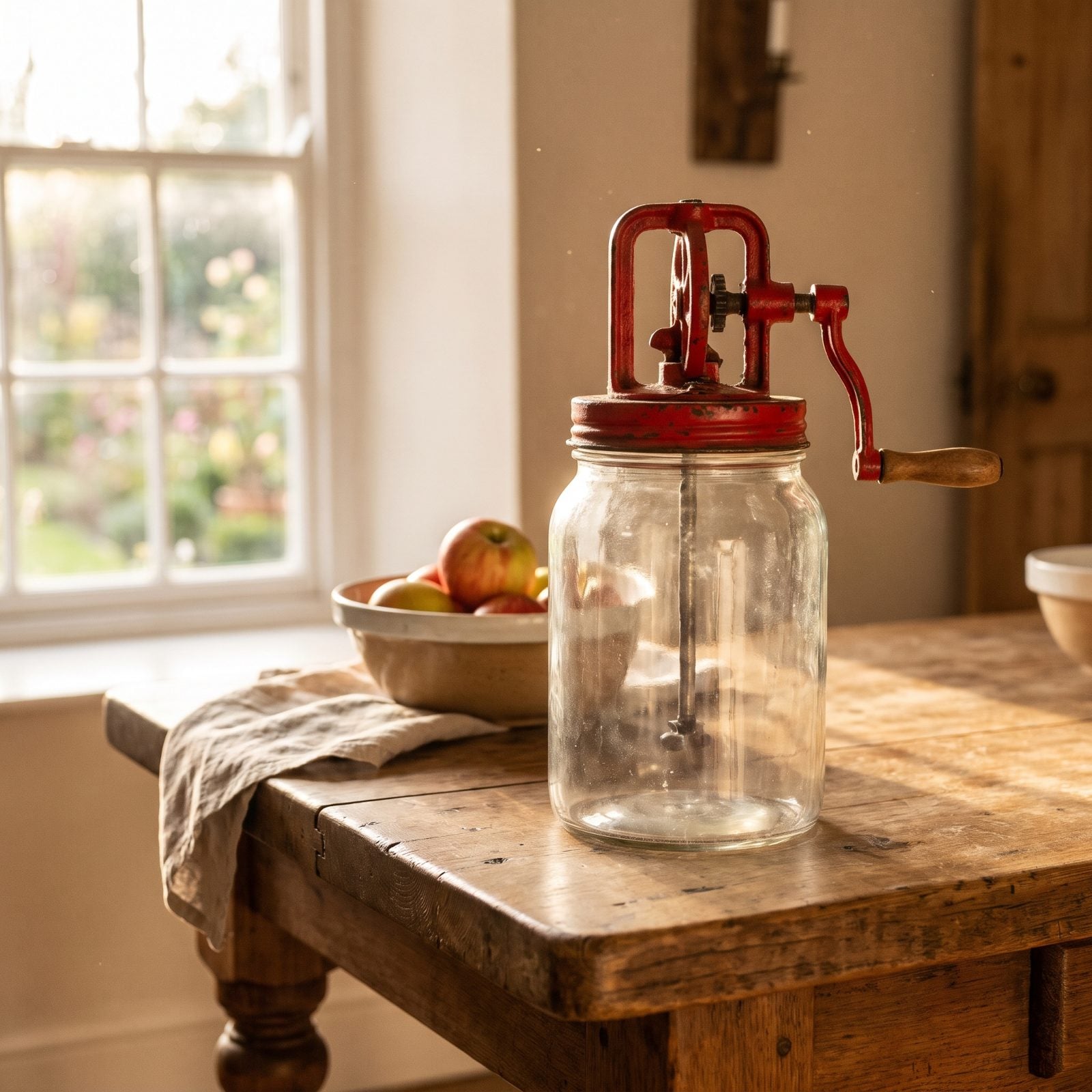
Collectors want the crank lid, not the jar alone — a bare jar is just old glass. What people actually chase is the whole piece: red metal lid intact, original metal dasher turning, plain glass jar still clear and uncracked.
Watch the number. Smaller churns, the half-pint and pint sizes, pull more interest than the common quart because fewer survived with the mechanism still working. And reproduction crank tops exist — they fool people. A genuine lid has crisp cast lettering and a paddle shaft that seats snug rather than wobbling around.
24. Wagner Ware Magnalite Roaster With the Original Domed Lid
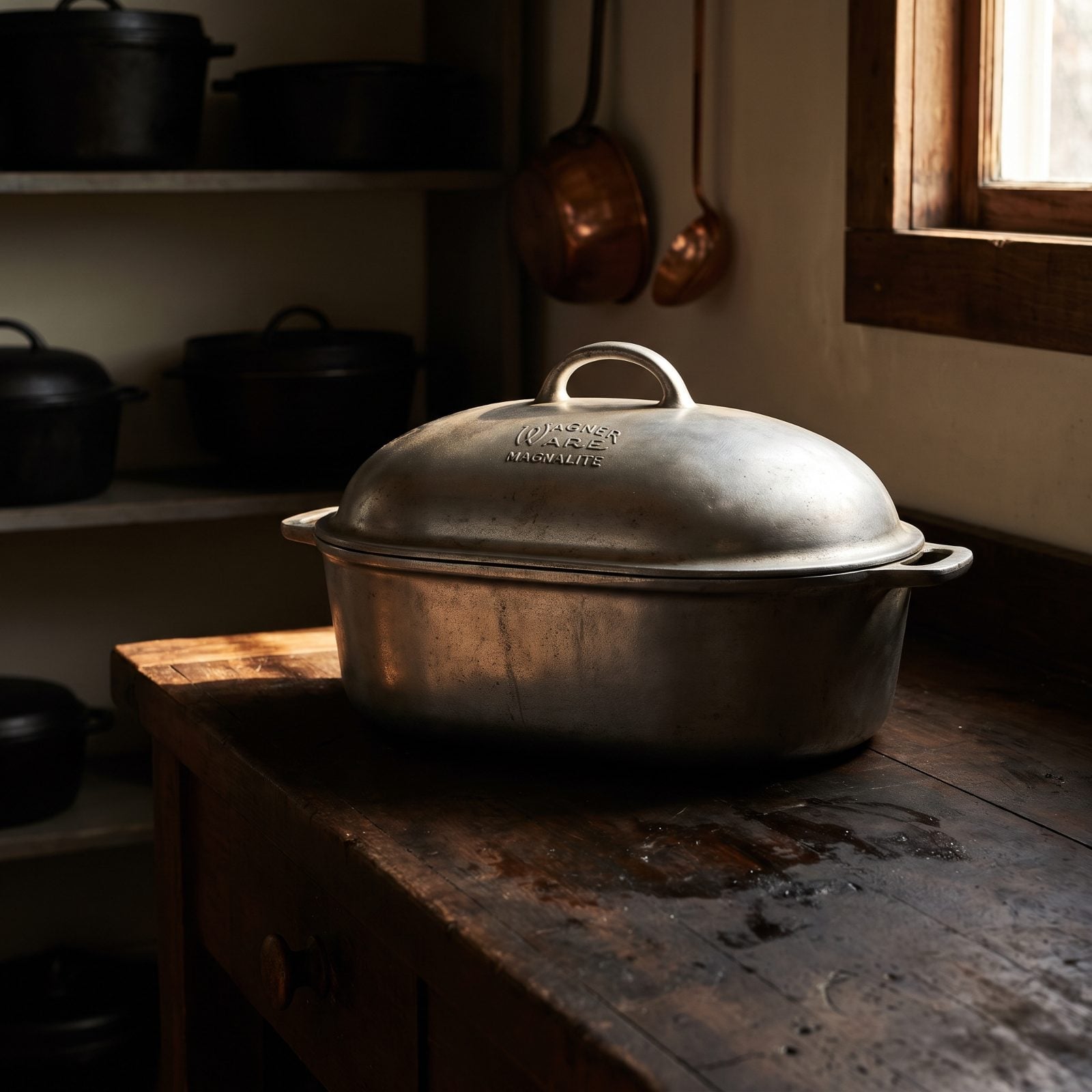
The weight gives it away. Pick up a real Magnalite and your wrist knows it right away — thick cast aluminum that spreads heat like nothing you’ll buy new, built across the 1930s through the 1950s, and plenty of them still cook beautifully today.
Value lives in the matching domed lid and the inner rack. Roasters turn up at estate sales all the time missing both, and a bare base is worth a fraction of a complete set. Look for the crisp Wagner Ware Magnalite mark on the bottom. Later Magnalite pieces dropped the Wagner name, and collectors pay more for the older Sidney, Ohio foundry marks.
23. Vita-Mix 3600 Stainless Blender With the Action Dome Plunger
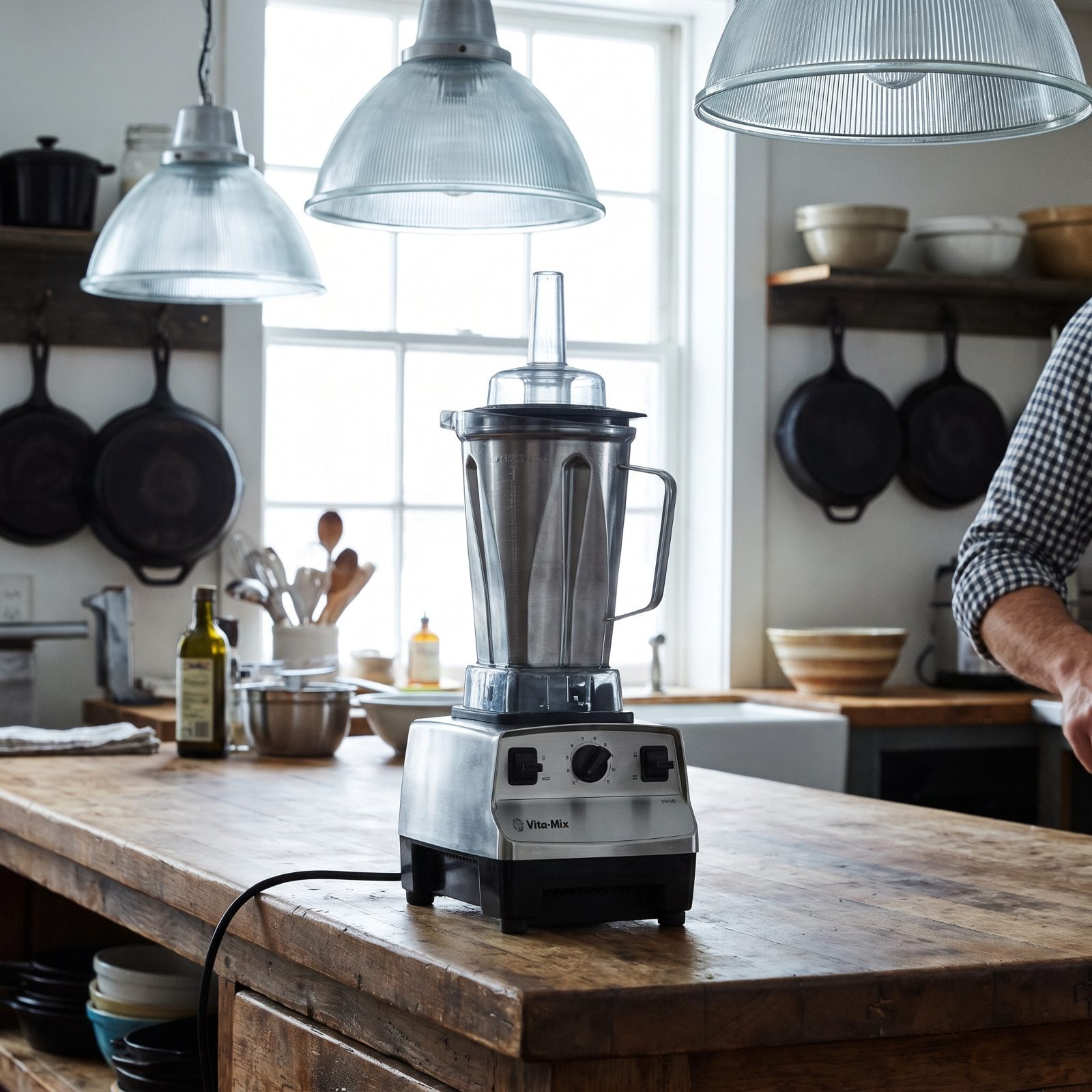
Old Vita-Mix machines refuse to die, and collectors know it. The 3600 from the 1970s was the one that could blend, grind grain, even heat soup by friction alone, and working units still sell to people who distrust everything newer.
The detail that matters is the Action Dome, that clear domed lid with the tamper plunger built right in. They crack, they go missing, they get swapped for the wrong size. A complete 3600 with its original stainless container and an uncracked dome is the configuration people actually want. The motor base on its own? A doorstop.
22. Pyrex Butterprint Refrigerator Dish Set in Turquoise and White
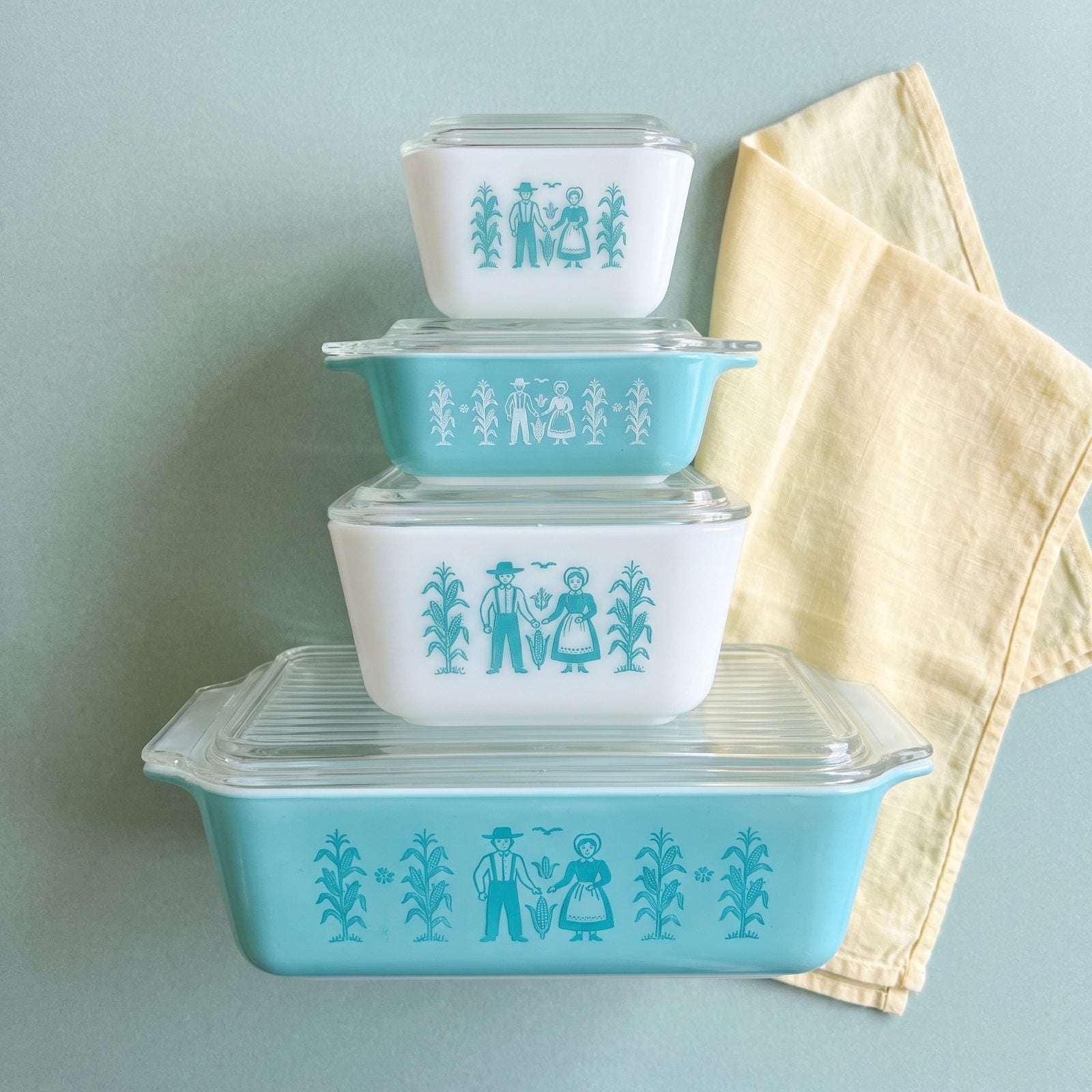
The Amish couple, the corn, the rooster. Butterprint is one of the most recognized Pyrex patterns going, and the full four-piece fridge set with every clear lid is the grail version.
Here’s what people get wrong: the lids are where the money hides. Those glass covers crack and cloud over, and a dish without its matching lid loses a lot in a hurry. The 501 and 502 small squares show up constantly, but the large 503 and 504 with pristine lids are the hard ones to run down. Turquoise reads warmer and friendlier than the later all-white printings, and that’s the shade collectors favor.
21. Hoosier Cabinet Glass Spice Jar Set With Original Lettered Labels
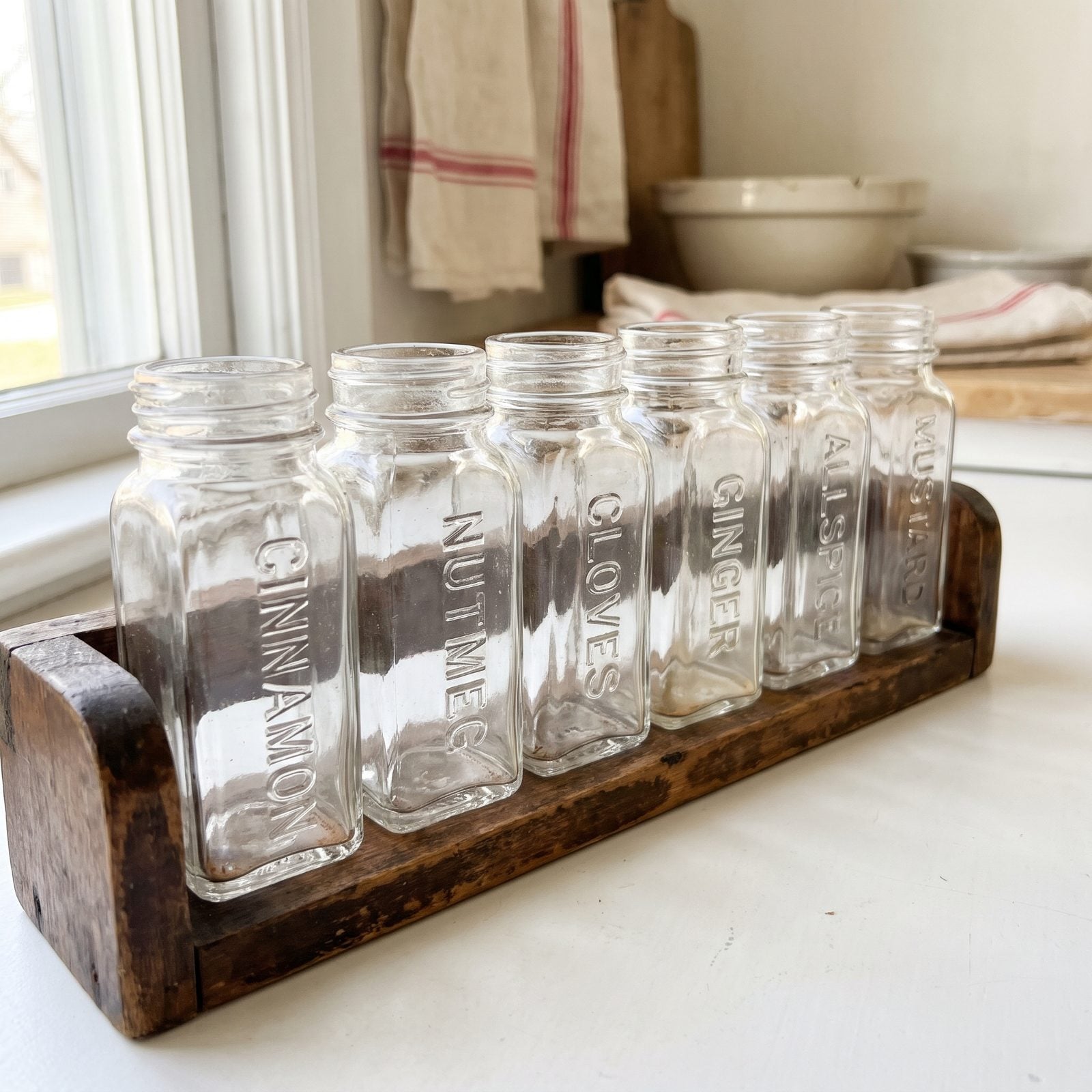
Freestanding Hoosier cabinets came with a built-in rack of matching spice jars, and those little jars have outlived most of the cabinets they rode in. A complete set with undamaged threaded necks and legible lettering is genuinely scarce.
The lettering is everything. Spice names embossed into the glass can wear soft or blur over a century of handling and scrubbing, and faint or half-gone letters drop the value hard. Jars with crisp, sharply molded CINNAMON, NUTMEG, CLOVES lettering and no chips to the threaded rims are what dealers price up.
20. Toas-Tite Cast-Aluminum Sandwich Maker With the Wooden Handles
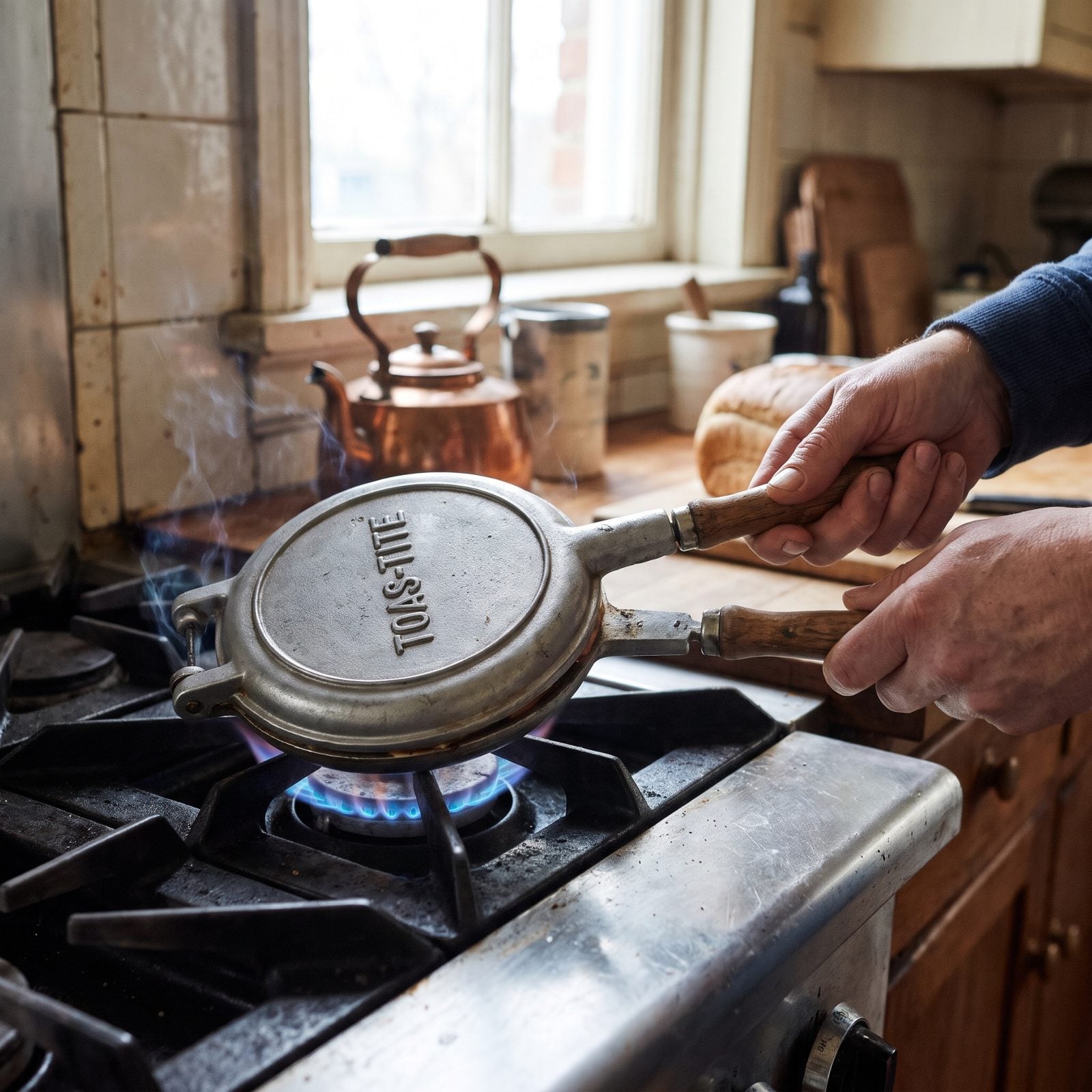
Before electric sandwich presses, you held this thing over a gas burner. The Toas-Tite sealed two slices of bread into a toasted pocket, and the round cast-aluminum heads swinging on long wooden handles are instantly collectible.
The handles are the fragile part. Decades of heat split and scorch the wood, so many turn up with one grip missing or crudely replaced. A pair with both original handles, intact varnish, and clear embossed Toas-Tite lettering reads as the real 1940s article. The design has a cult following, and people still cook with them.
19. Silex Vacuum Coffee Brewer With the Glass Upper Globe

Watching coffee climb up into the top globe and sink back down is half the appeal. Silex vacuum brewers from the 1920s through the 1940s turned the morning cup into a little science demonstration right there on the stove.
Both glass globes need to be intact and the same pattern, and that’s the catch. These were thin glass, they chipped at the rim, and the rubber gaskets perished — so mismatched or cracked halves are everywhere. A complete brewer with a Bakelite-handled stand, uncracked globes, and the original cloth filter ring is the one collectors want. Heat-shock cracks are the quiet killer here.
18. Nordic Ware Original Bundt Pan in Heavy Cast Aluminum
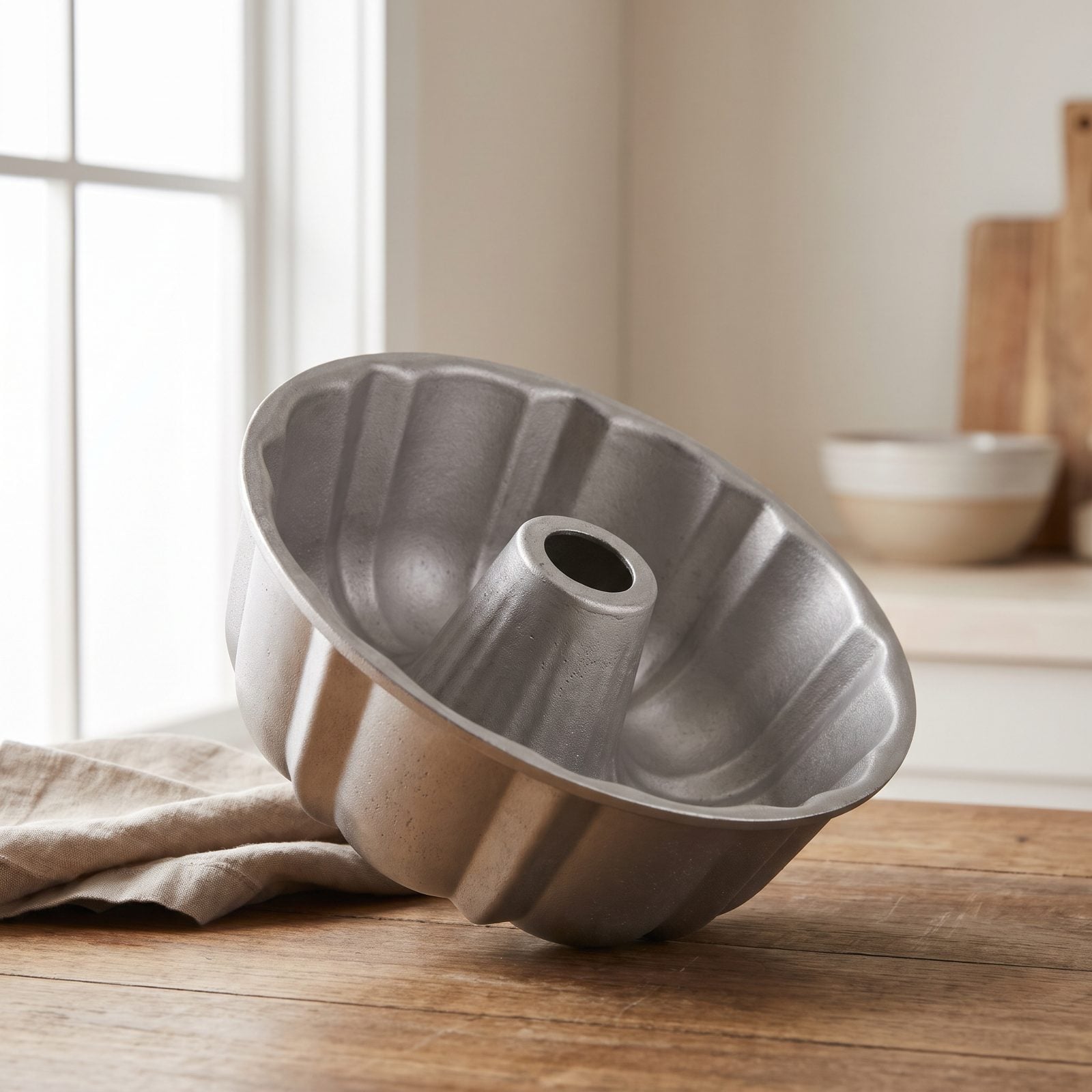
A cake pan became one of the most collected pieces of American kitchenware, which still surprises people. Nordic Ware introduced the Bundt in the 1950s, and the early heavy cast-aluminum versions are the ones worth hunting down.
Weight and the embossed mark separate the originals from later thin-stamped and nonstick-coated pans. Genuine early ones are dense, raw aluminum with crisp fluting and a clear Nordic Ware stamp on the base. Unusual early shapes pull real interest — the ornate rose and crown molds especially. A smooth, well-seasoned surface with no coating flaking is the sign of a good one.
17. Fire-King Sapphire Blue Philbe Mug With the Ribbed Bottom
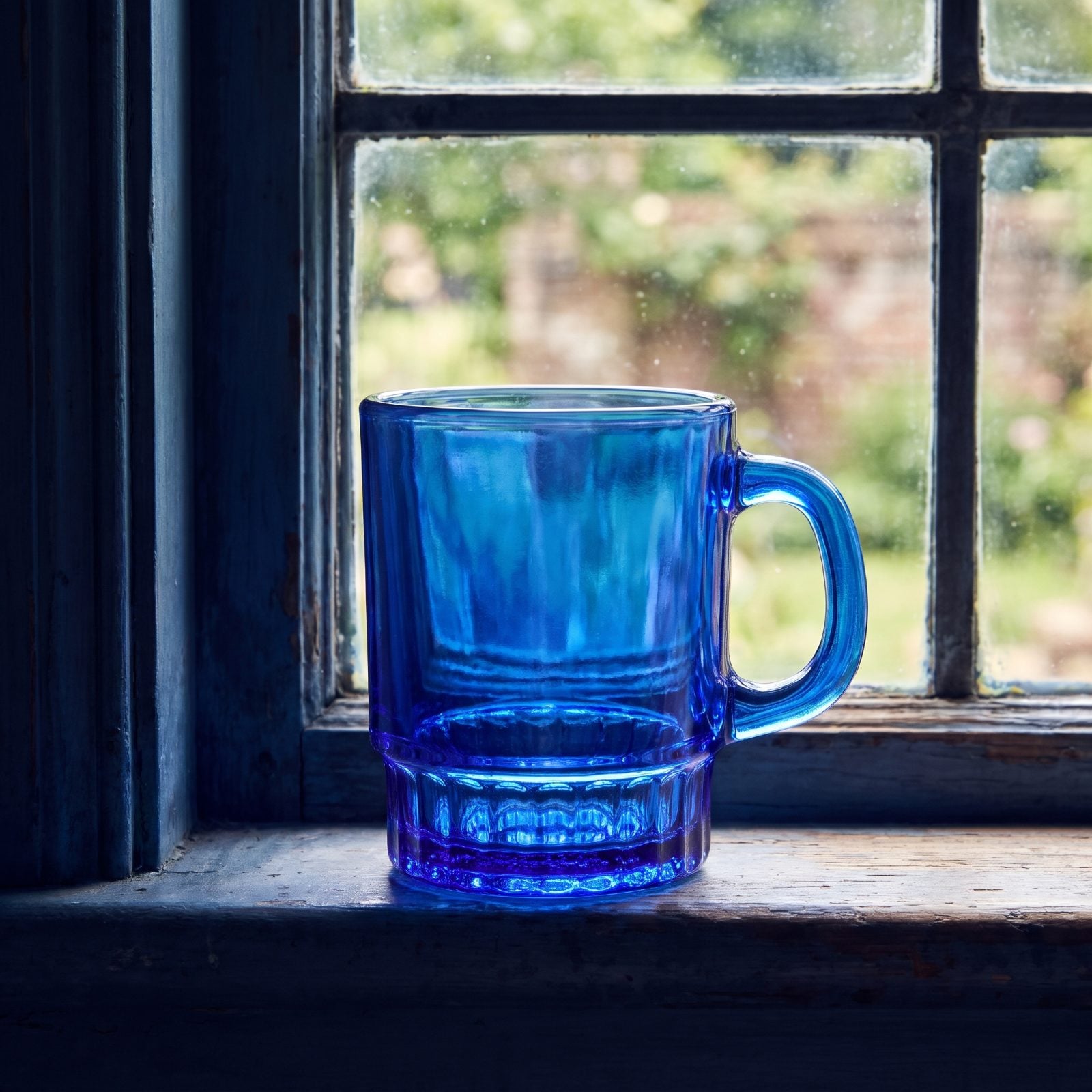
Hold a Sapphire Blue Fire-King mug up to a window and it lights up like stained glass. That transparent pale-blue ovenware from the 1940s is some of the most sought-after Depression-era kitchen glass going.
The Philbe pattern — that geometric ribbing running around the base — adds value over the plain heavy mugs. Look for strong even color, no chips on the rim or handle, and the raised anchor-over-H Fire-King mark underneath. Reproductions and modern cobalt glass circulate, so the maker’s mark and the correct thick, slightly hazy vintage glass both matter.
16. Corning Ware Blue Cornflower Percolator, Spout and All
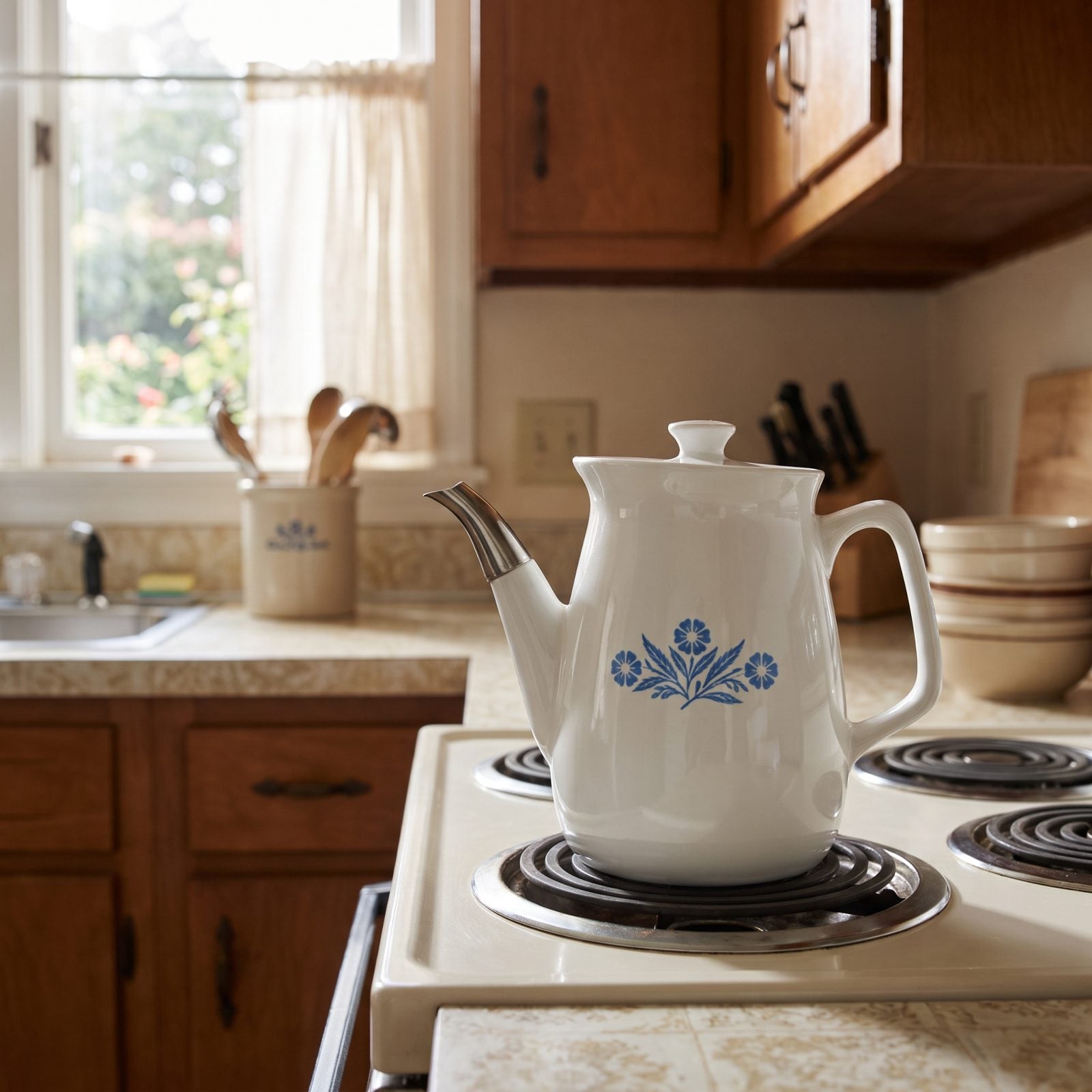
The glass-ceramic body with that eight-petal Blue Cornflower mark is the one collectors chase. Corning made coffee percolators in the same Pyroceram that went from stove to table without cracking, and the electric version — original cord, basket, all of it — turns up far less often than the casseroles sitting in everyone’s cupboard.
Check the bottom for the backstamp and the letter-number code. Early pieces read “CORNING WARE” in block type, and the pattern should sit crisp and slightly raised, never faded or decal-thin. A percolator with its lid, stem, basket and a working element is worth far more than a bare body.
15. Kromex Spun-Aluminum Canister Set With the Copper Lids
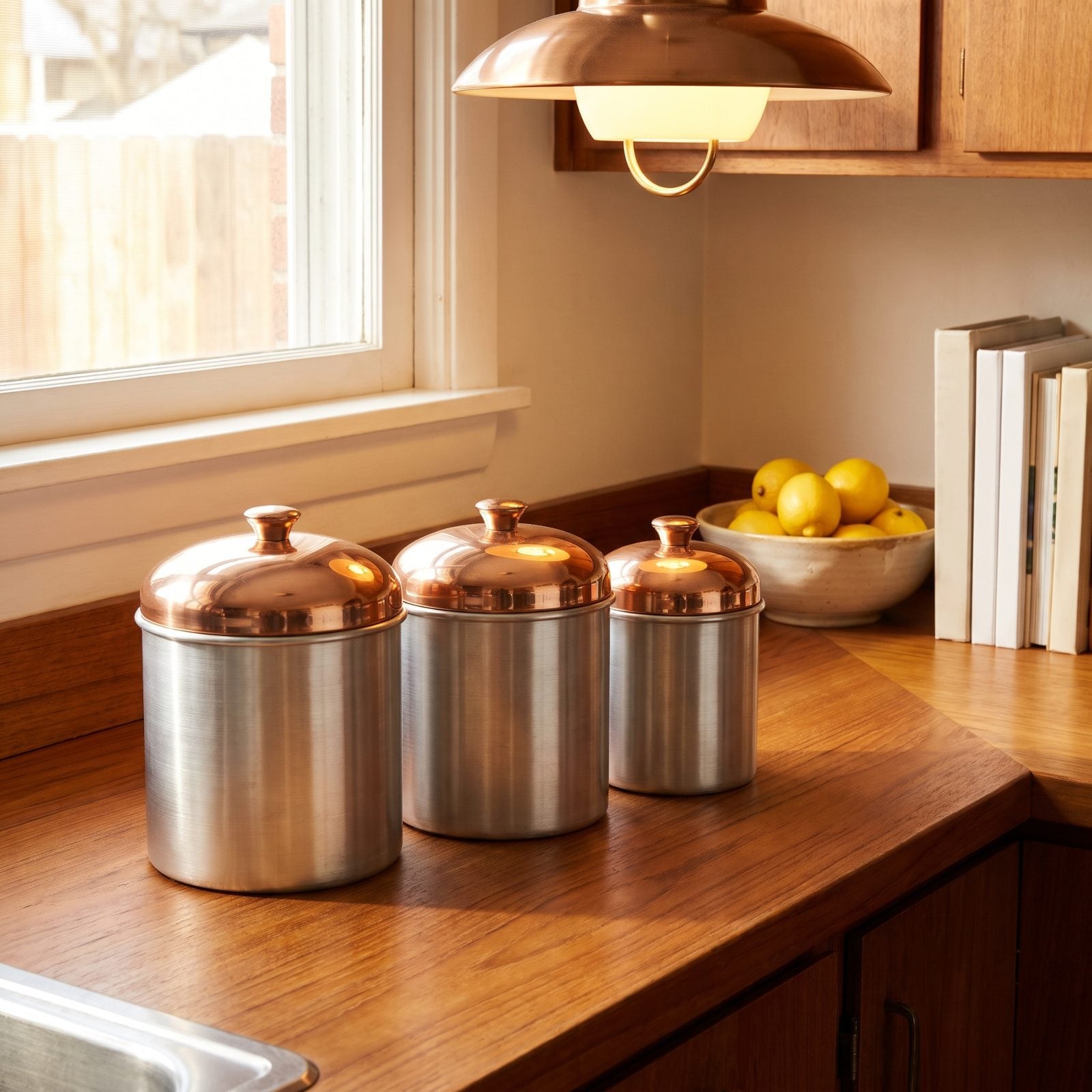
Shiny, light, and nearly indestructible. Kromex built its name on spun aluminum, and the graduated canister sets — Flour, Sugar, Coffee, Tea — with warm copper or brushed lids are the ones that vanish fast at estate sales. A complete nesting set with every label legible and no deep dents beats a mismatched pile every single time.
Look for the Kromex stamp on the base, and lids that still seat flush. Pitting, cloudy oxidation and bent rims all drag the value down. A set in the original box? Rare. Set that one aside.
14. The Knapp-Monarch Red Popcorn Popper on the Hot Plate
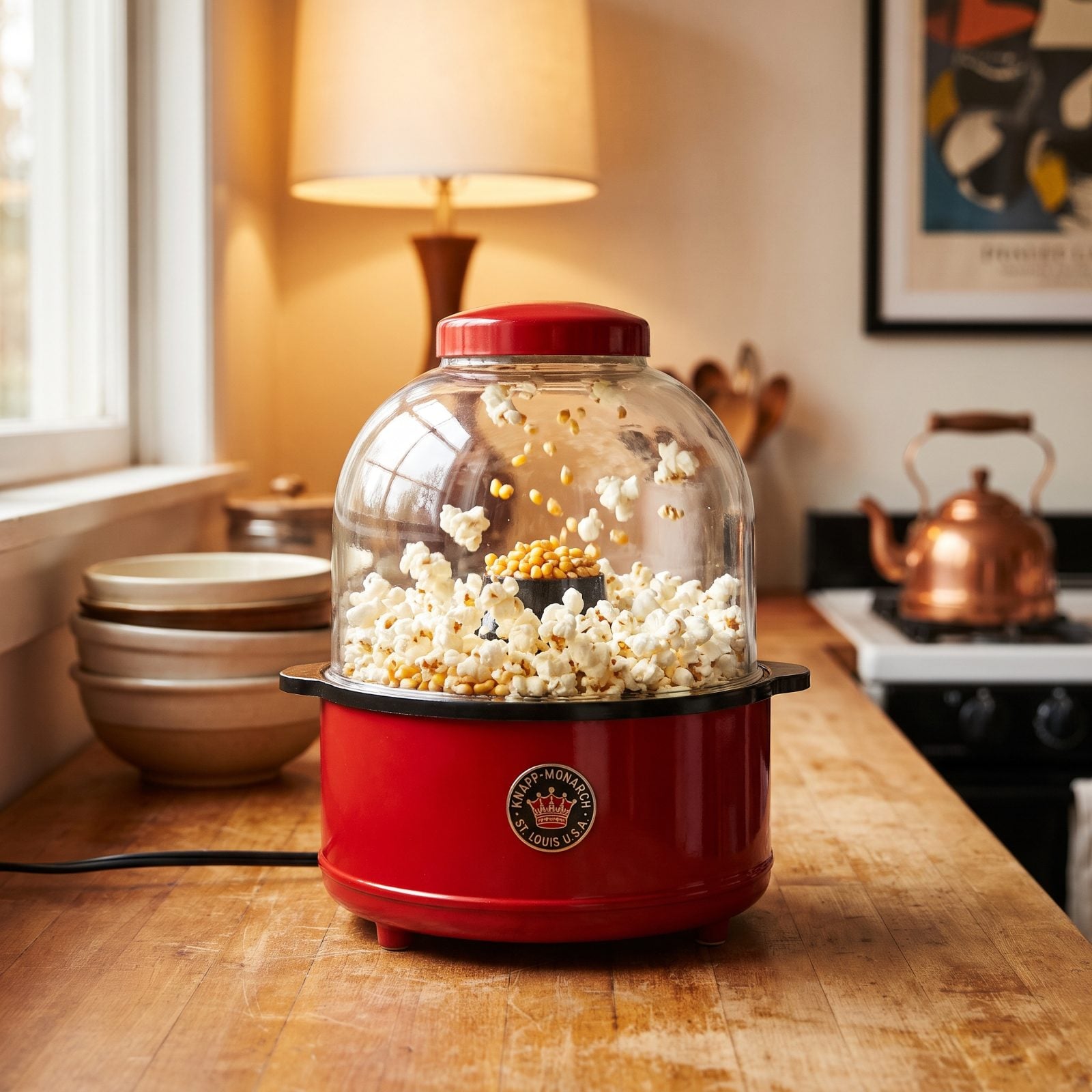
Before microwave bags, you stood and watched the kernels fly against the glass dome. Knapp-Monarch made countertop poppers with a heated base and a clear top, and the versions in fire-engine red — or chrome with a red Bakelite handle — are the collector’s pick.
Honest age actually helps here, because a little crazing on the Bakelite reads as real. What hurts: a cracked dome, a corroded element, a missing lid. Working condition counts for more on these than on display-only pieces. Half the appeal is that it still pops.
13. The Sellers Hoosier Cabinet Flour Sifter You Can Still Crank
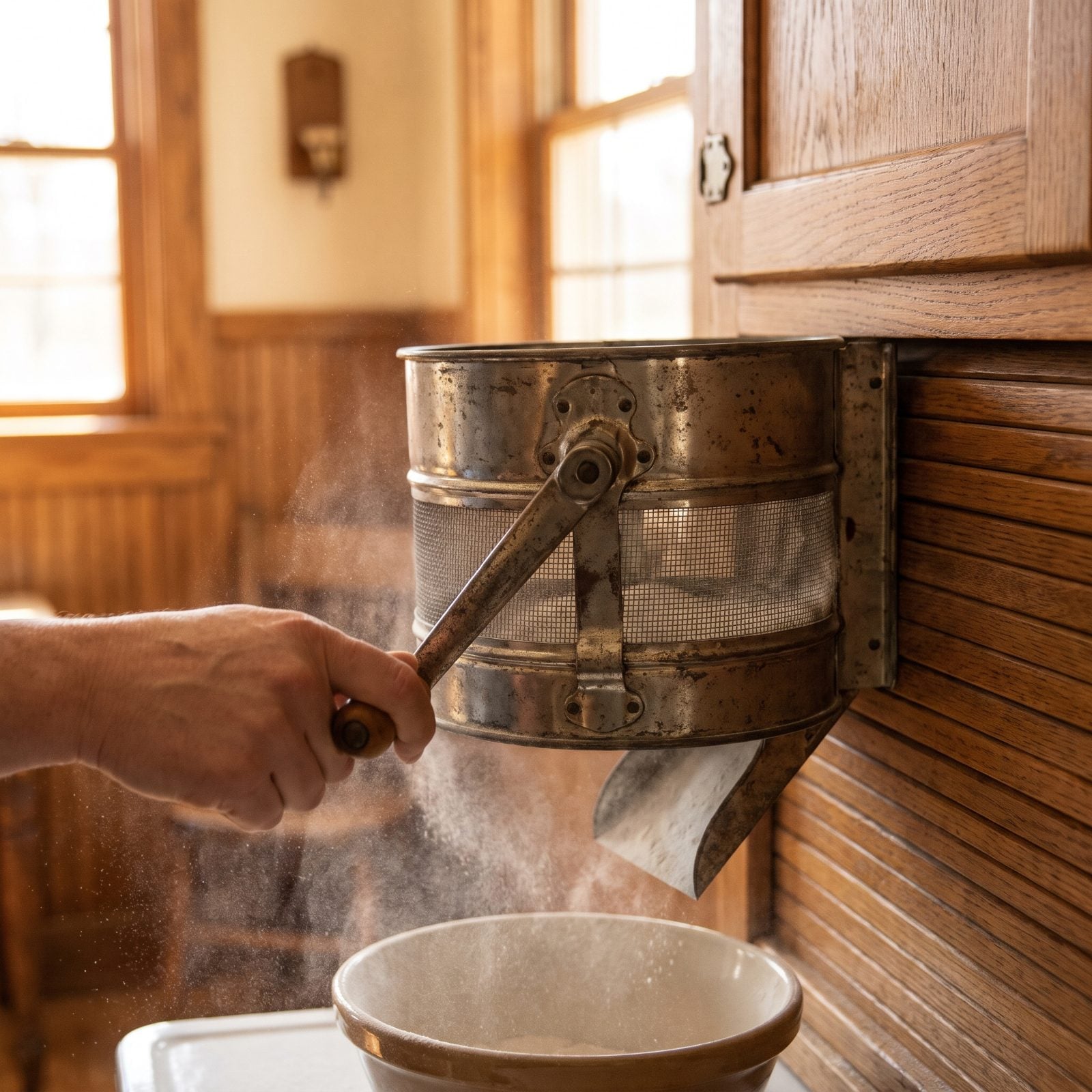
This is the mechanical heart of an old Hoosier-style cabinet. Sellers, along with rivals like Hoosier and Napanee, built tin-lined flour bins with a built-in sifter and a hand crank — fill the bin, turn the handle, and fresh flour dropped straight into your bowl.
Collectors separate the whole cabinets from the loose bins, and an original Sellers sifter bin on its own can be a satisfying find: tin intact, the glass sugar jar sitting nearby, a crank that still turns smoothly. Rust-through, a seized mechanism, or a replaced bottom tank are the usual value-killers.
12. Rival Crock-Pot Model 3100, the One That Started It
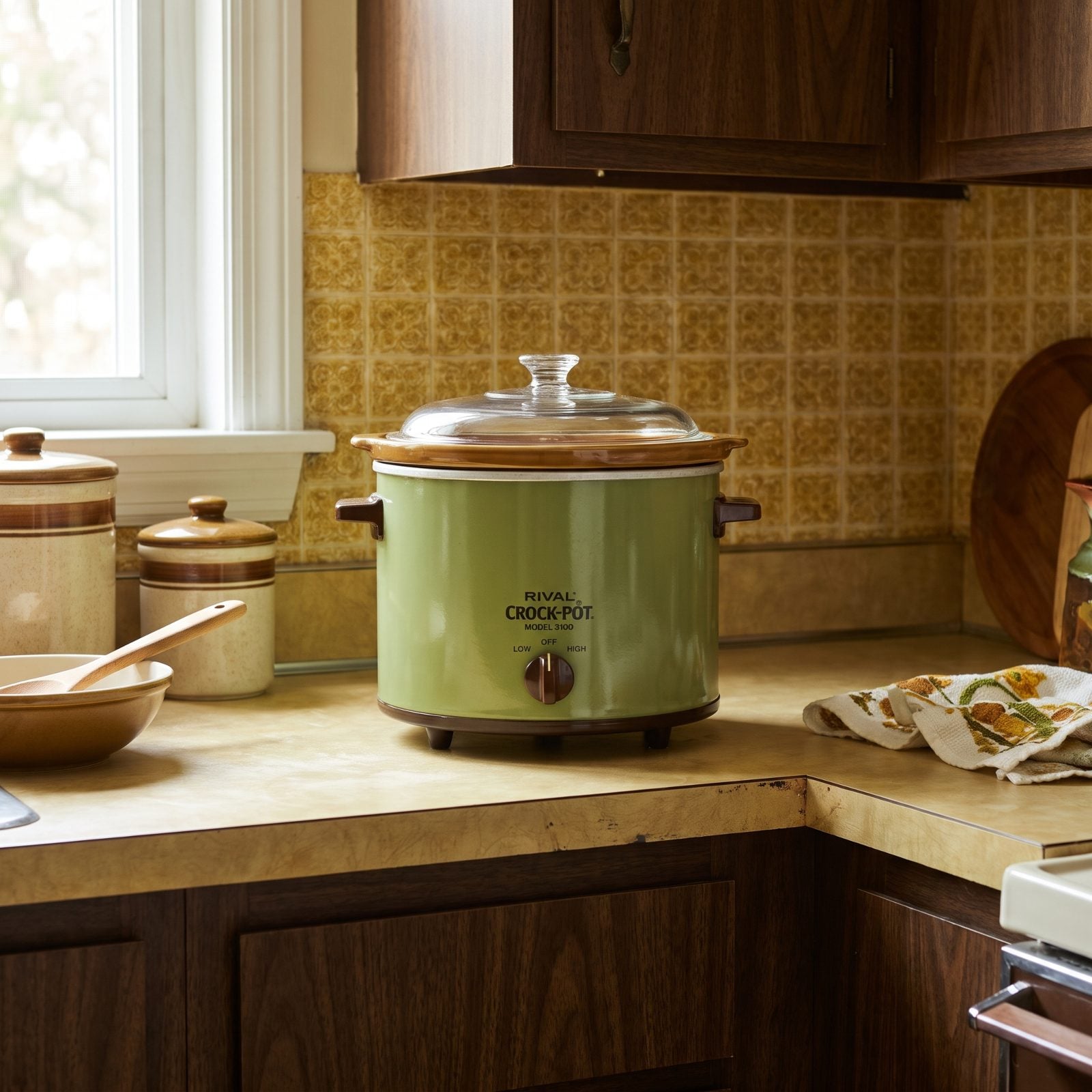
Rival turned a bean cooker into a household name in 1971, and the early Model 3100 is the one collectors actually hunt. The brown stoneware crock is built into the base, and the single LOW / OFF / HIGH dial on a bare-bones design reads as the true origin of a kitchen workhorse.
What raises value: the harvest-gold or avocado exterior intact, the original lid without chips, and that early mottled-brown stoneware pattern. A legible model number on the base confirms it. Removable-crock versions turn up everywhere — it’s the ones with the original crock still matched to its base worth grabbing.
The Crock-Pot sold on a single promise: leave in the morning, dinner’s ready at night.
11. The Juice-O-Mat Chrome Lever Juicer by Rival
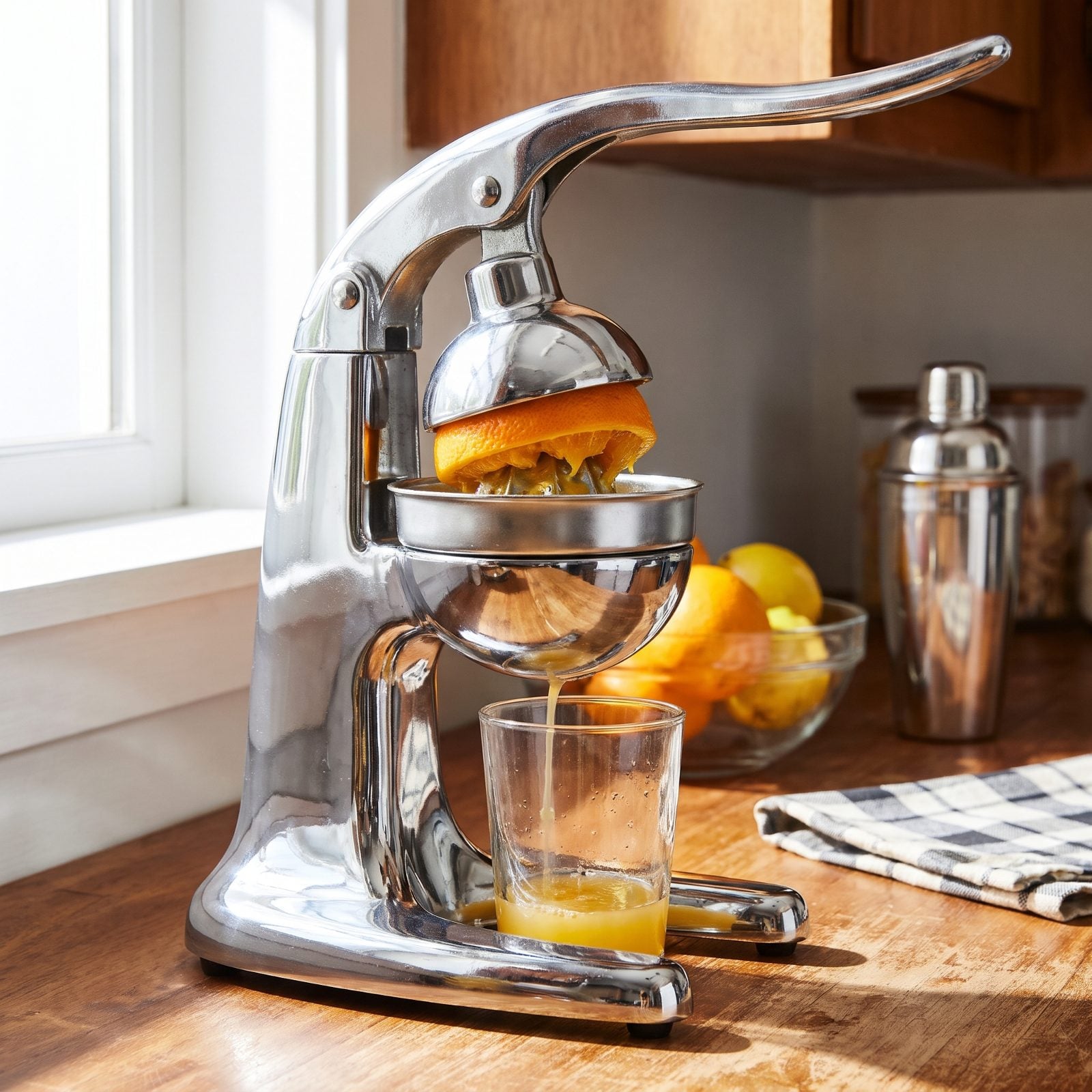
Pull the lever, crush the orange, done. Rival’s Juice-O-Mat is a hunk of cast metal and chrome with a long pull handle, and the color-accented versions — red, yellow, jadeite-trimmed — outrun the plain chrome ones on the collector table.
Weight gives it away. A real Juice-O-Mat is heavy, built to clamp a counter and take abuse for years. Look for intact rubber feet, a smooth lever action, and the embossed Juice-O-Mat name on the front. Repainted bases and seized levers knock the price right down.
10. The Vitantonio Pizzelle Iron That Pressed the Patterns
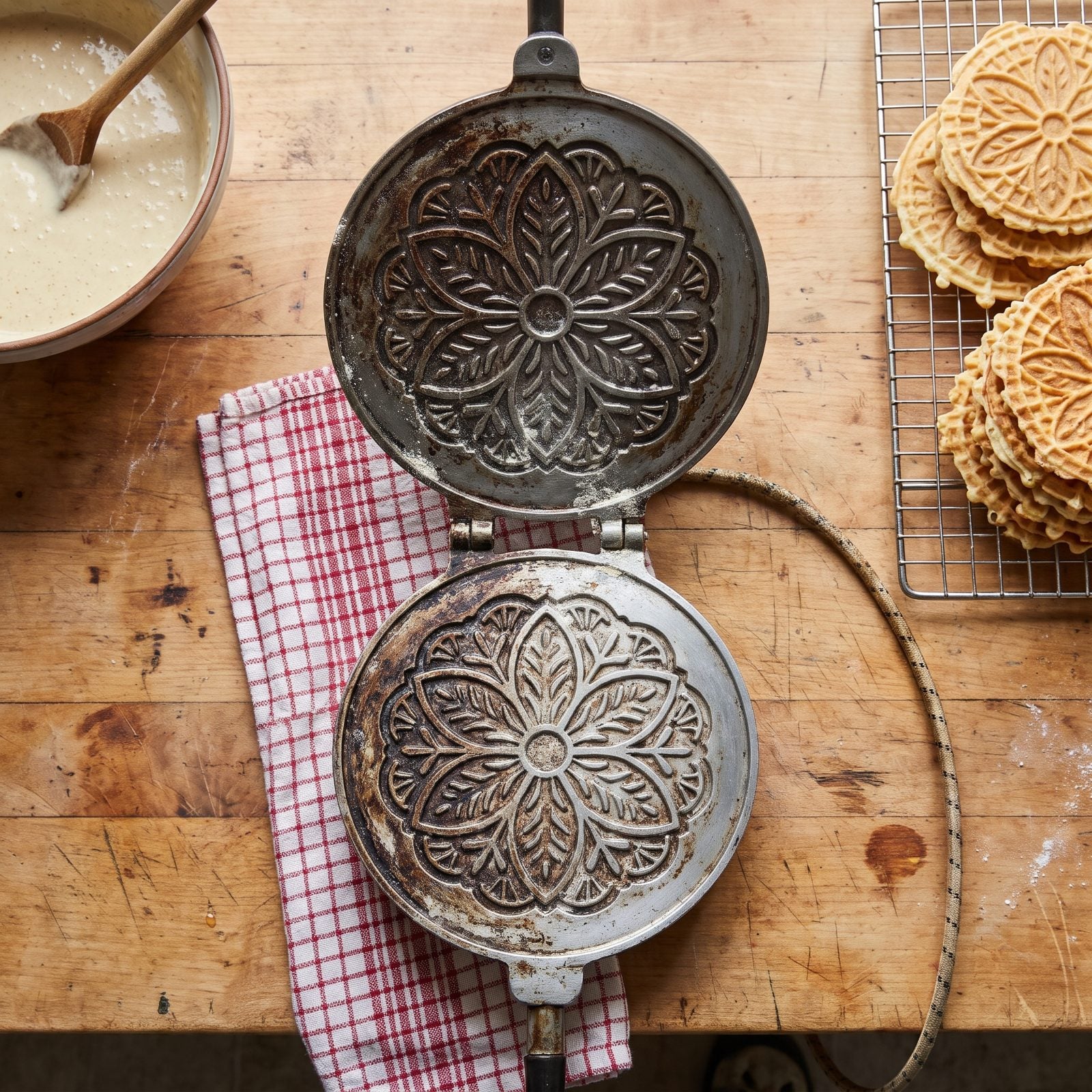
Thin, crisp, snowflake-patterned cookies came off this one. Vitantonio, an Italian-American maker, built cast and electric pizzelle irons, and the vintage ones with ornate embossed plates — anise, snowflake, intricate floral — draw collectors who care about the pattern as much as the machine itself.
The older stovetop cast-iron models with a wooden handle have a following all their own. On electric versions, make sure both plates heat and the pattern stays sharp rather than worn smooth. You want the Vitantonio name cast into the plate. And a seasoned, well-kept iron still turns out wafers that snap.
9. Saladmaster Food Processor With Its Full Set of Cutting Cones
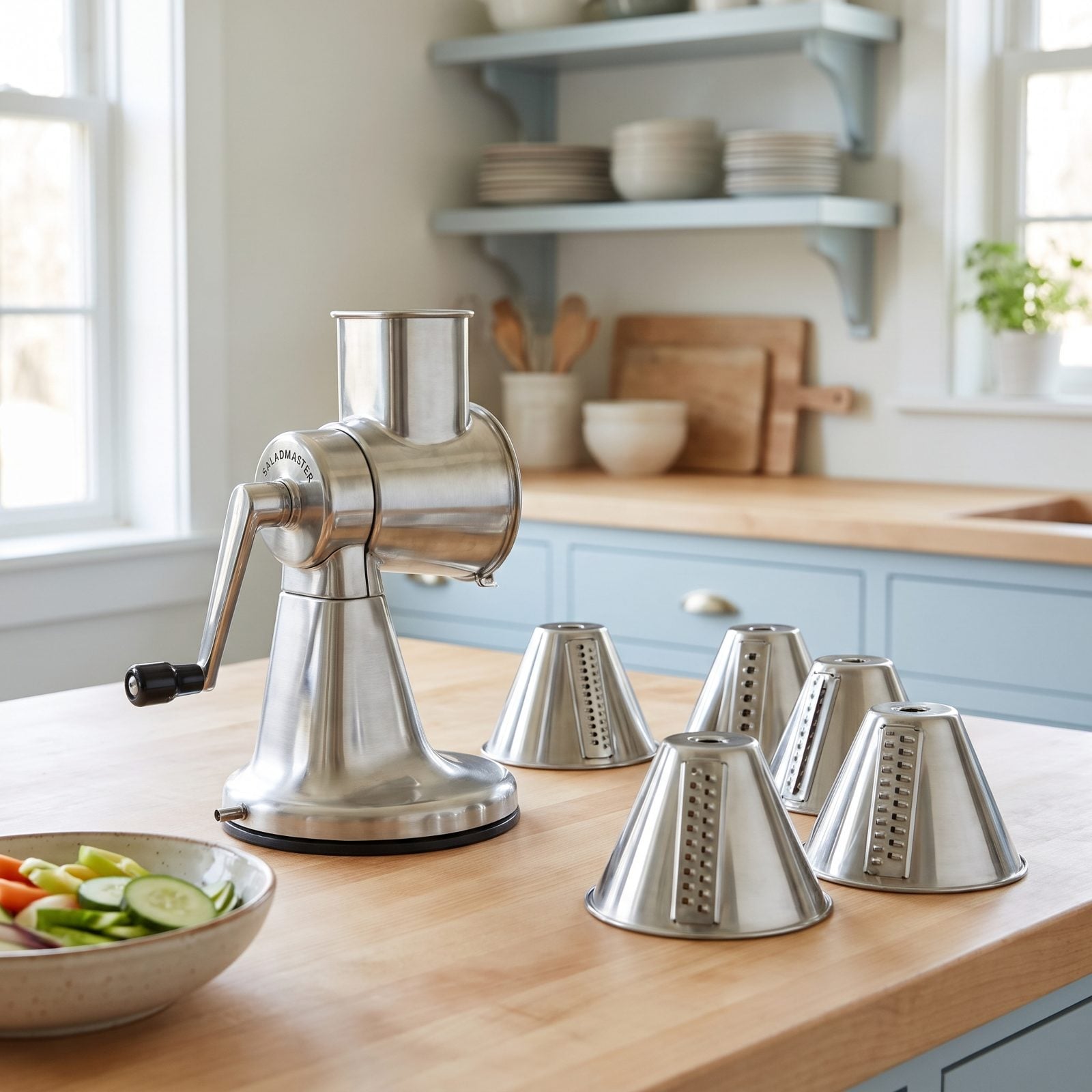
The machine is nothing without the cones. Saladmaster built a hand-crank — and later motorized — food processor that pushes vegetables against interchangeable stainless cutting cones, and a complete boxed set with every cone present is the whole ballgame.
These sold through in-home demonstrations, usually alongside pricey cookware, so a surprising number survived in good shape. Count the cones against the original chart, check for the Saladmaster stamp, and look for the suction base or clamp still intact. Missing cones are the single biggest value drop. Replacements are scarce and specific to the model, so a gap in the set is hard to fill.
8. Napier Silver-Plated Cocktail Shaker with the Art Deco Lines
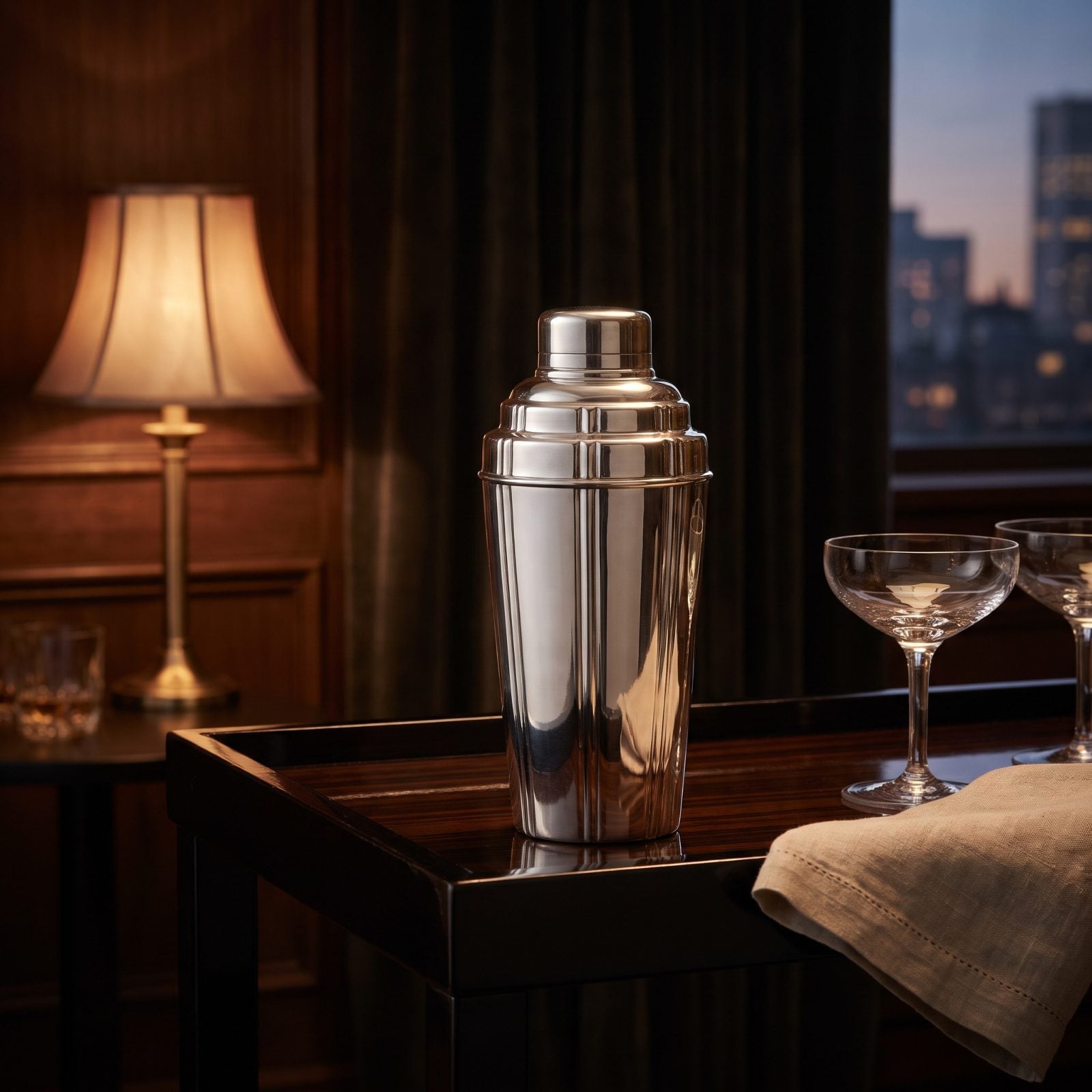
Napier made jewelry before it made barware, and it shows. The company’s silver-plated shakers from the 1930s carry a weight and a confidence the thin modern ones never match. Your telltale is the stamp on the base: ‘NAPIER,’ sometimes alongside a patent number.
Honest plate wear is fine, even desirable. Dents in the body and a strainer cap that won’t seat are not. The figural and novelty shakers — penguins, bells, lady’s legs — climb far higher than the plain cylinders, but a clean Deco column still turns heads on a bar cart.
7. Eppelsheimer Cast-Iron Apple Peeler Clamped to the Table
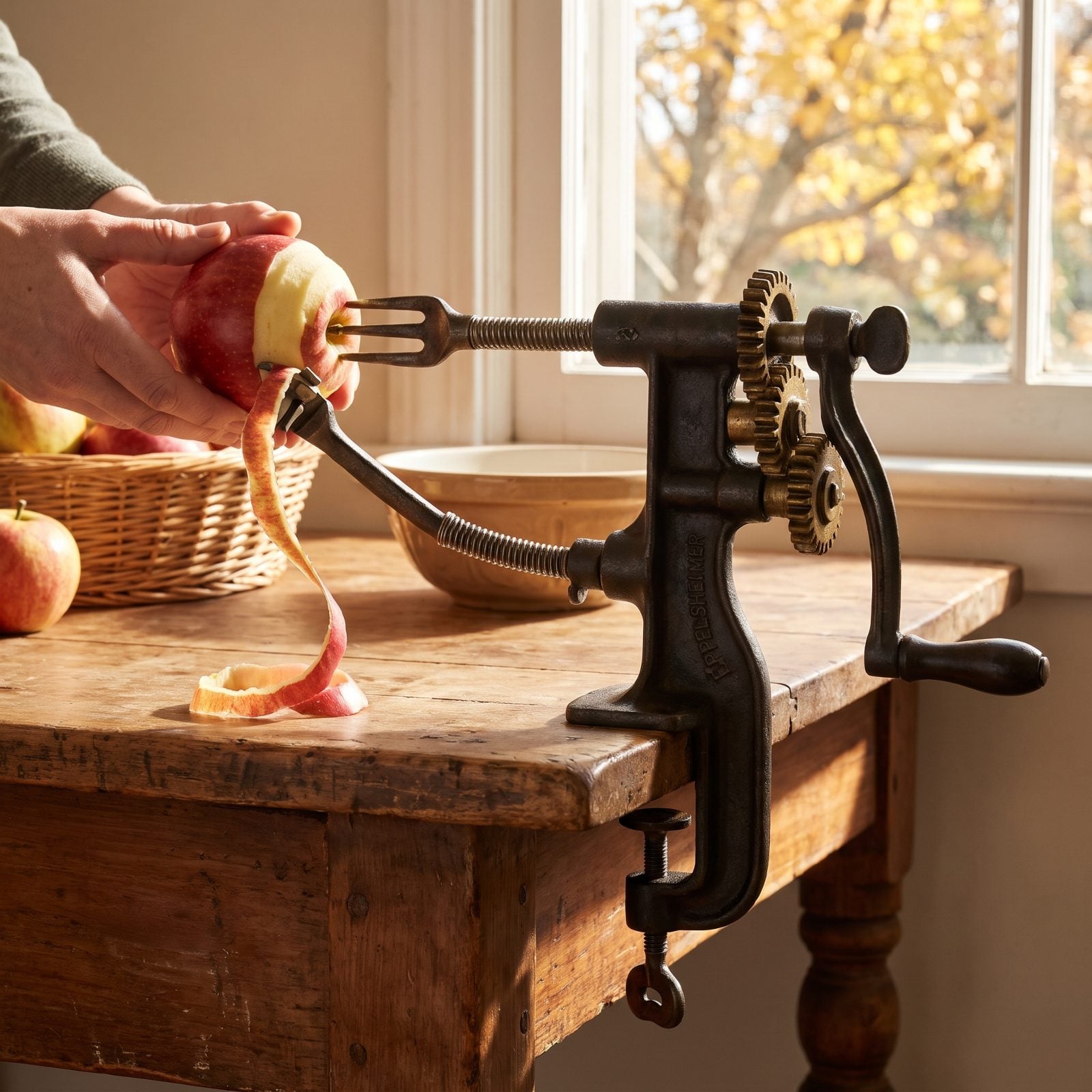
These hand-cranked peelers have been around since the 1800s, and plenty still work after a century of cider season. Eppelsheimer pieces, with their raised cast lettering and patent dates on the frame, sit at the serious end of the market.
Completeness is everything: the three-prong fork, the peeling blade arm, the table clamp all intact and the gears turning smoothly. Reproductions flood this category, so study the casting. Old iron has crisp, deep lettering and a grainy surface. New castings feel soft and vague, like a photocopy of a photocopy.
6. Revere Ware Copper-Clad Whistling Kettle with the Bakelite Handle
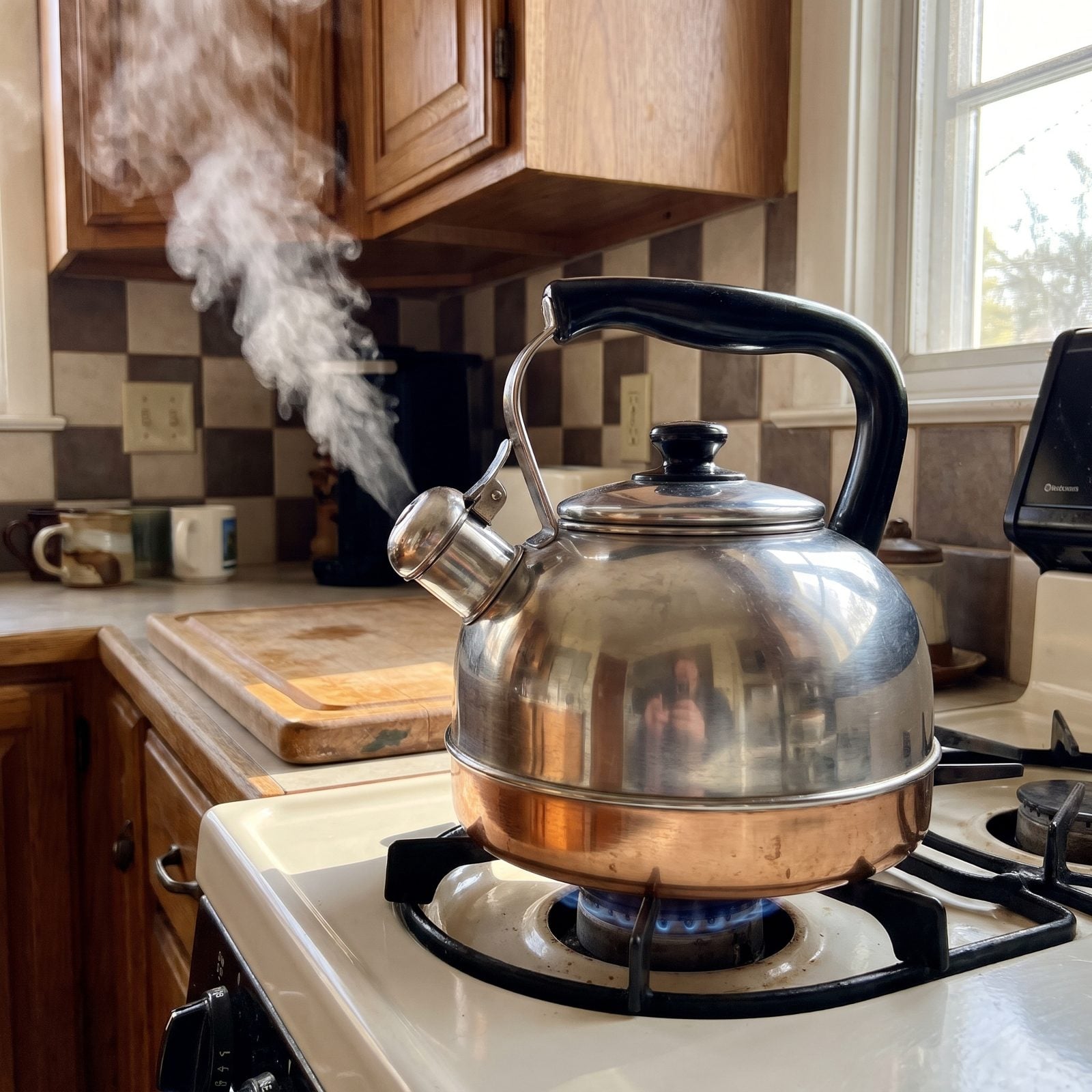
Everyone’s grandmother owned Revere Ware, which is exactly why collectors get picky. Common pieces are worth little. What moves are the early kettles — copper-clad bottom intact and bright, Bakelite handle uncracked, stamped maker mark readable underneath.
Flip it over. Pre-1968 pieces made in Rome, New York carry the older logo and command more than the later production. A kettle with its copper polished away to pink patches has lost its best feature, because collectors want that warm copper disk glowing like a penny.
A buyer’s guide from one vintage cookware parts seller explains why collectors check the stamp: “The older, “Vintage” Revere Ware (before 1968) was made using an electroplating process that resulted in a thick, heavy layer of cladding giving it the legendary “Revere Ware” cooking qualities.”
5. Dazey Glass Ice Crusher with the Cast-Metal Crank
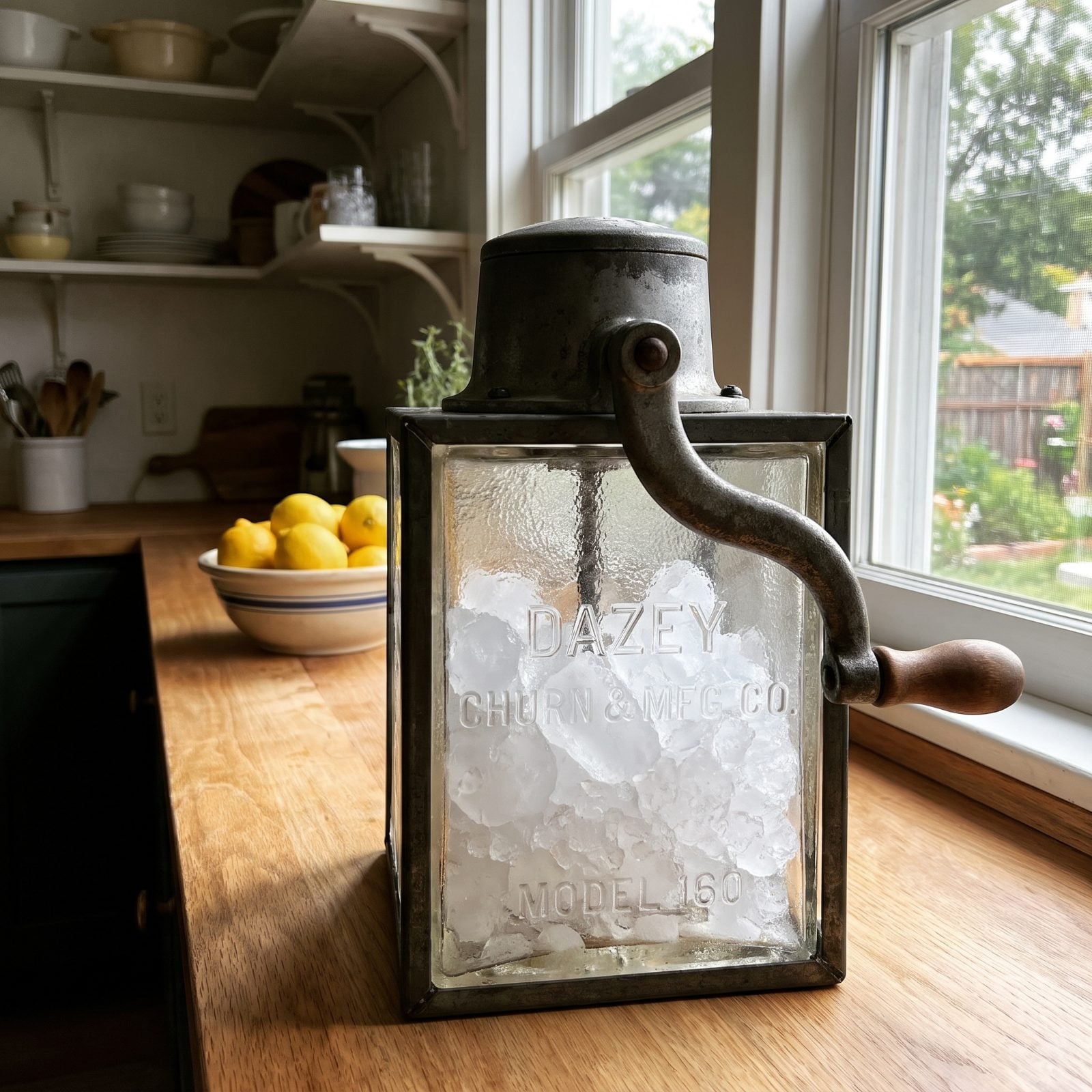
The glass jar is the fragile part and the whole game. A Dazey crusher with its original embossed glass base uncracked, mated to its painted cast-metal crank head, is a tidy little collectible. The glass is almost always what’s missing or chipped.
Red-painted tops photograph best and sell fastest. The embossed ‘Dazey’ in the glass confirms the maker. Shake it and listen — a rattle usually means a loose or damaged mechanism inside the head.
4. Swing-A-Way Wall-Mounted Can Opener in Working Order
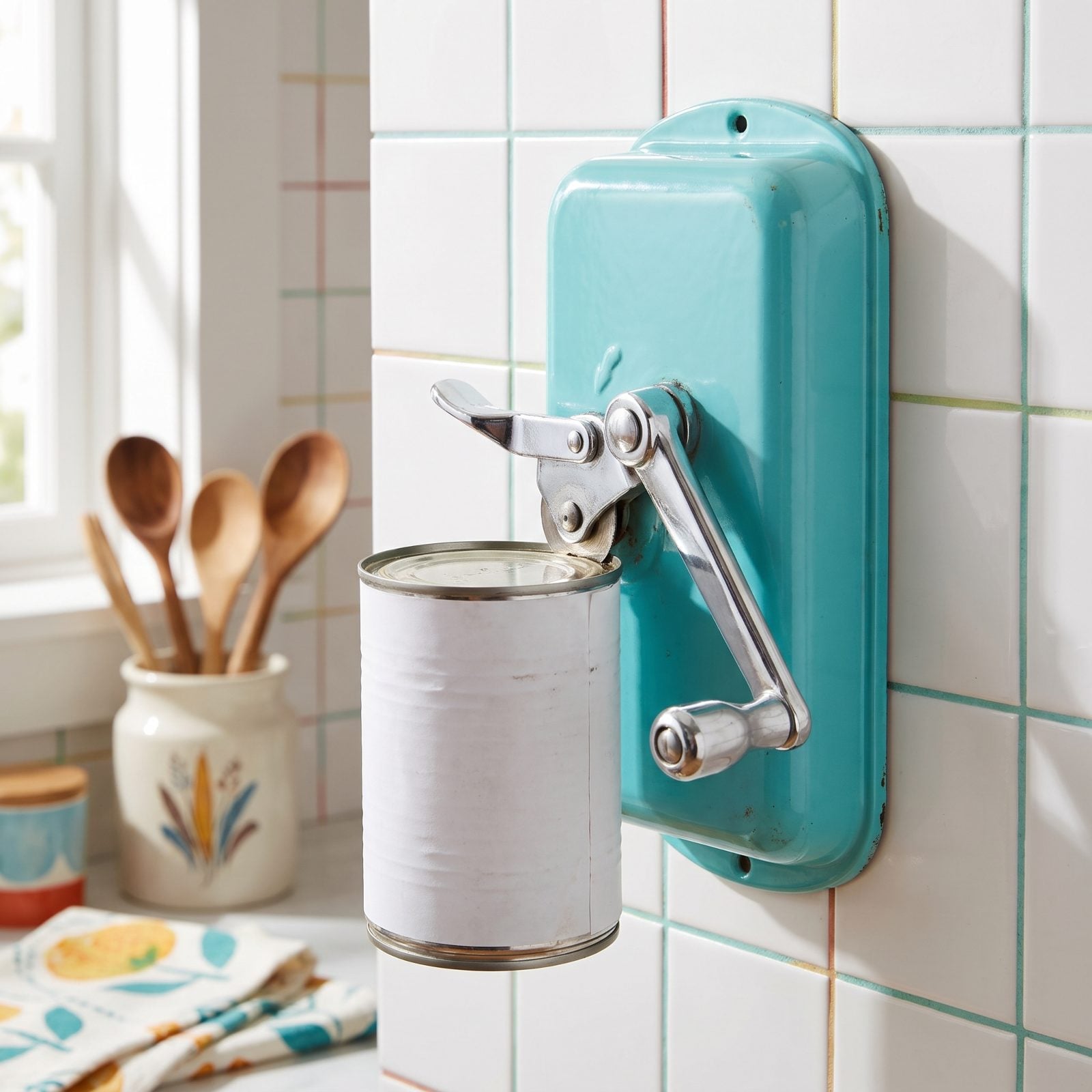
Humble, yes. Collectible, also yes — especially in the harder-to-find enamel colors. Swing-A-Way wall mounts in turquoise, red, or yellow pull far more attention than the plain chrome ones every hardware store sold by the thousand.
The mechanism has to work. These were built to last decades, and a smooth gear with a sharp cutting wheel is what you’re buying. Rust on the enamel is tolerable; a seized crank is a dealbreaker. People actually bolt these onto modern kitchen walls, which keeps demand steady.
3. Androck Nut Grinder with the Original Glass Jar Base
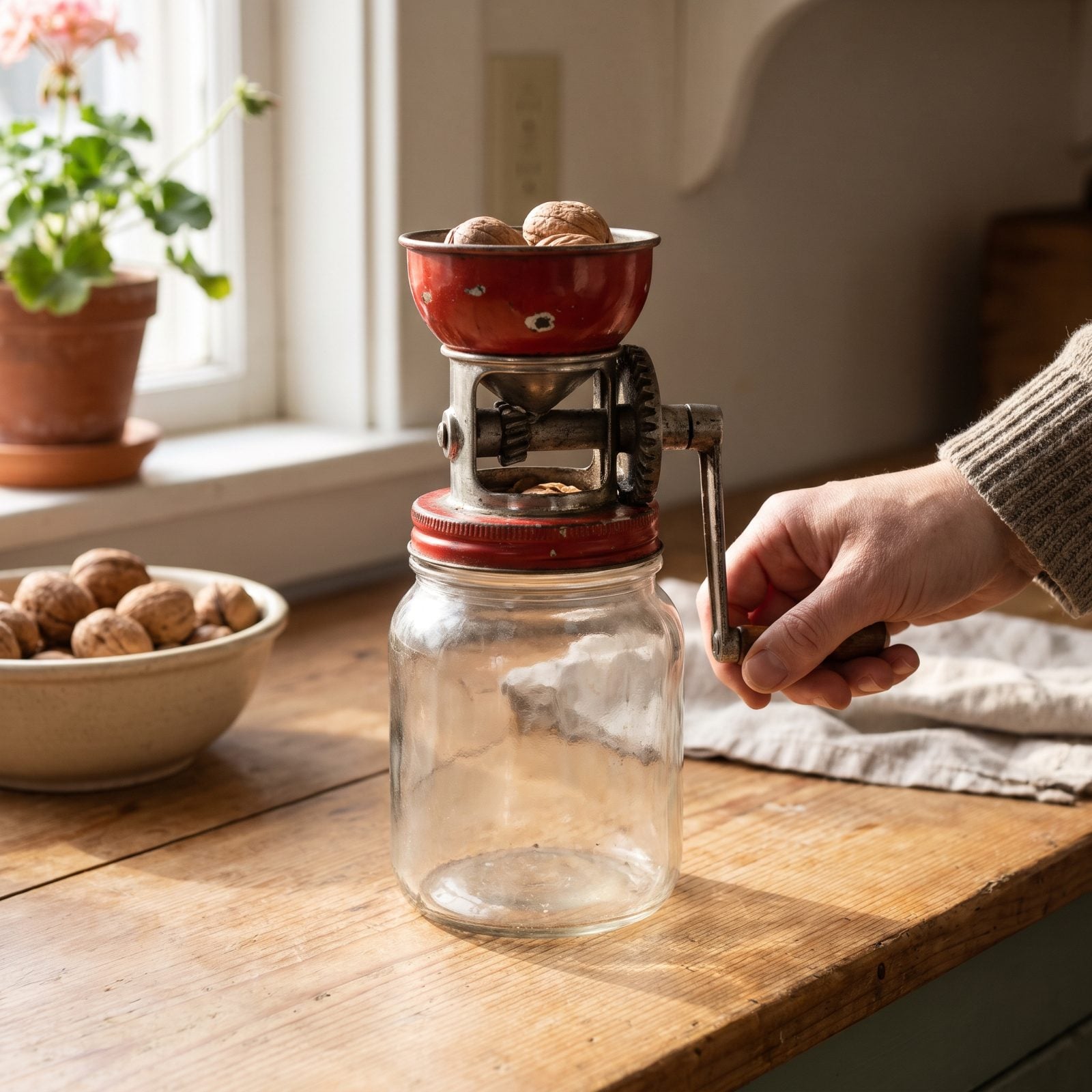
Half the charm of these old grinders is the glass jar that catches the ground nuts — and half the risk, too. Androck, better known for its spring-handled ricers and gadgets, made nut grinders with painted metal tops that screwed onto a glass jar base.
Find one with the jar intact, the enamel bright, and the crank turning freely. The painted tops chip and the glass goes missing, so a complete, matched example is scarcer than you’d think. Red and green enamel tops read best on a shelf.
2. Mirro Copper-Anodized Gelatin Molds Hung in a Cluster
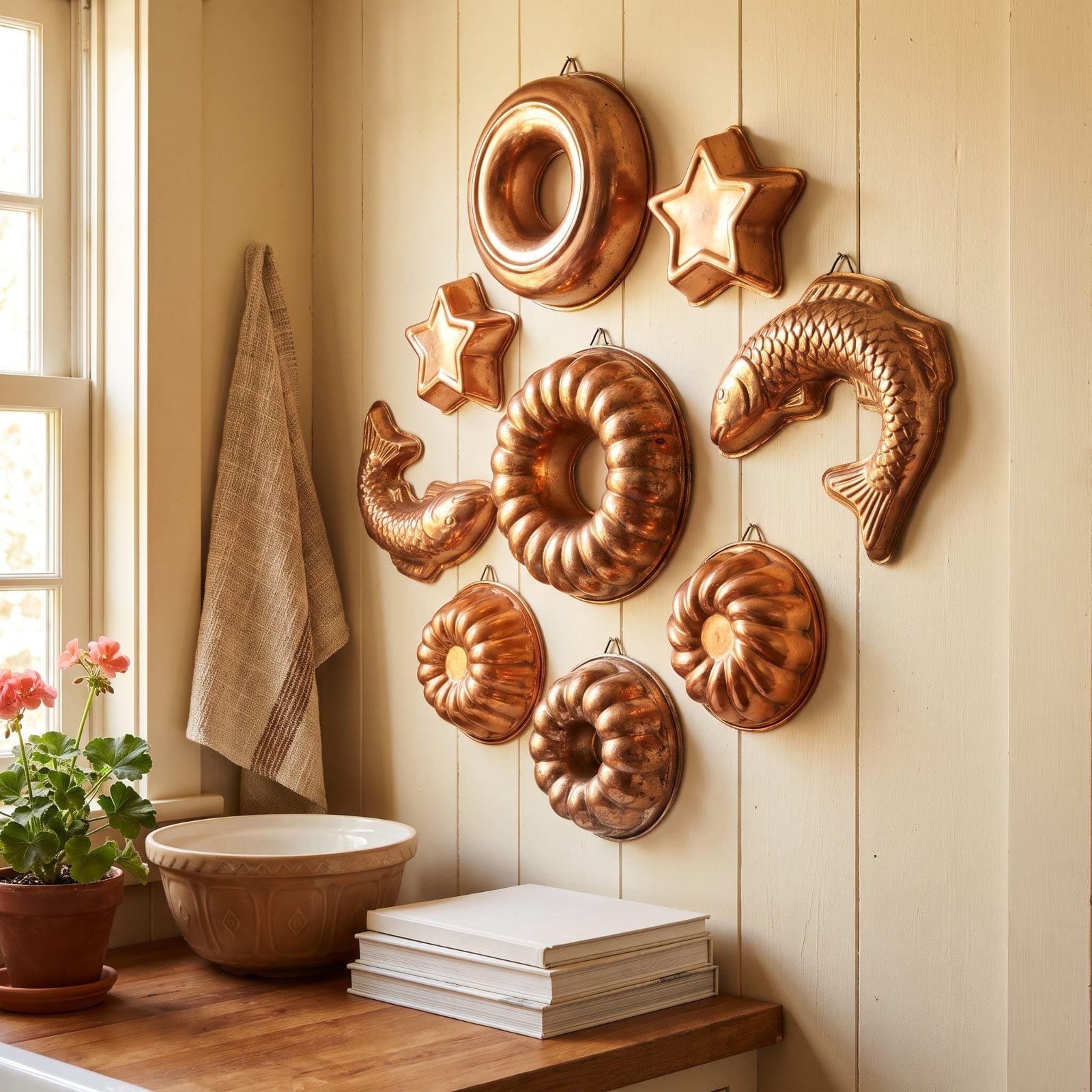
Copper molds decorate kitchen walls across America, and most are cheap anodized aluminum rather than real copper, these included. That doesn’t make them worthless. It makes them affordable, collectible, and genuinely good-looking hung in a group.
Mirro’s copper-anodized molds carry the maker stamp on the back and a hanging ring on the rim. Figural shapes — fish, rabbits, fruit clusters — beat plain rings. The anodized finish can scratch and dull, so grab the bright, evenly colored examples with crisp raised detail.
1. The Decoware Tin Bread Box With the Hand-Painted Florals
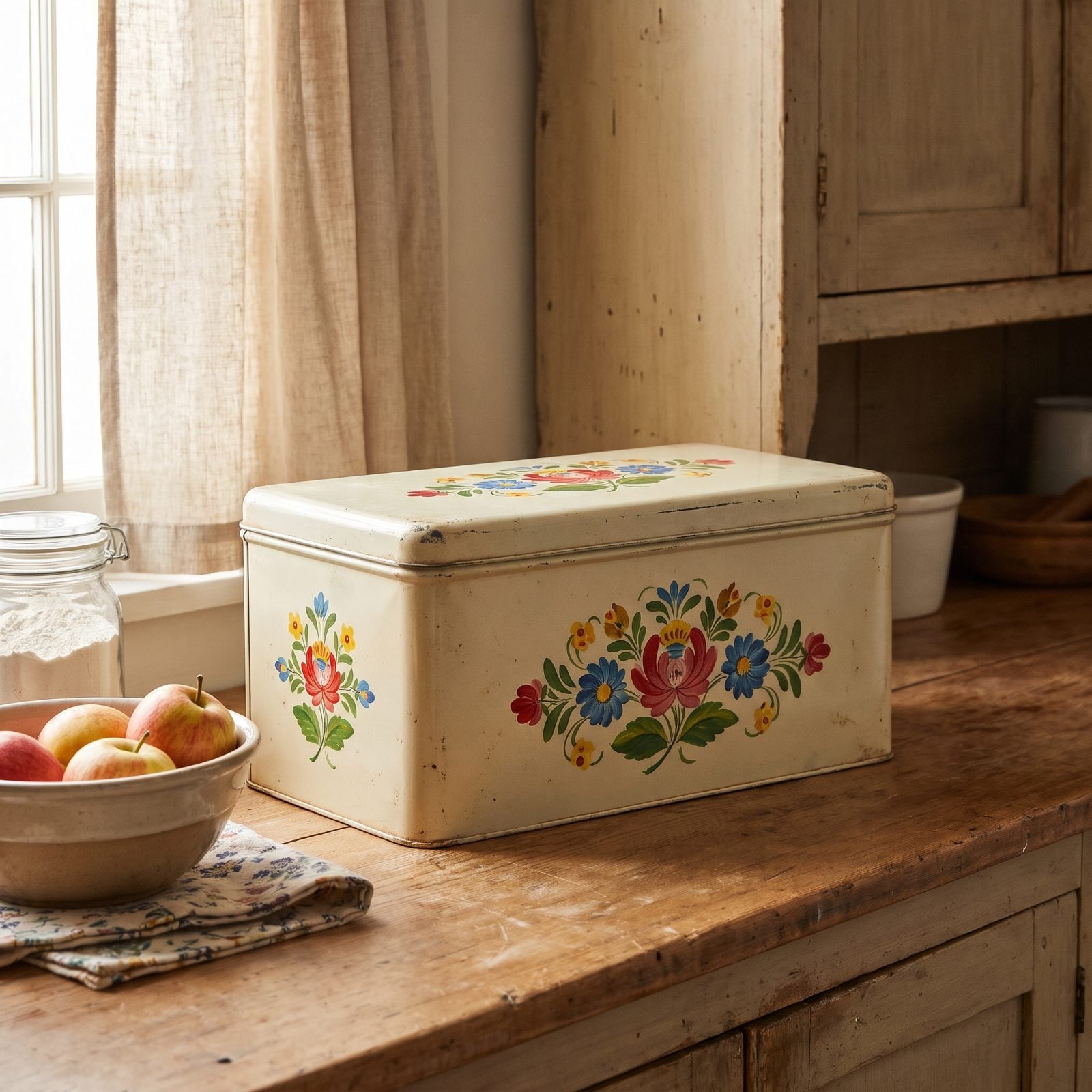
Decoware turned out lithographed tin kitchenware by the truckload mid-century, and their bread boxes are the ones that fill vintage shelves now. Buyers hunt the florals, roosters, and apple motifs printed straight onto the tin. A clean, bright graphic with no fading does most of the pricing work.
Here’s what people get wrong. Rust is forgivable — a little honest patina even helps — but a scratched or peeling litho pattern guts the value. And don’t overlook the lid. Roll-top versions with the tambour still rolling smooth command more than the plain hinged ones ever will.
Check the back corner for that stamped Decoware mark. Unmarked lookalikes turn up everywhere, and nobody gets excited about them.