We’ve all watched someone spend an entire summer evening slapping their own ankles under the picnic table, when a cheap fan aimed low would have ended the whole war. That’s the thing about the best backyard upgrades. They don’t look like much, and half of them sound faintly ridiculous right up until they solve a problem you’d stopped noticing you had. The ones below lean weird on purpose: a bench that banks heat like a brick in the oven, a boundary you cannot see, a log that grows your dinner. Practical first, strange second. Each one nudges an outdoor space away from being a patch of grass and toward something you’d actually choose to sit in.
Please note that some of the images in this article were created with the assistance of AI.
44. The Under-Table Mosquito Fan Nobody Tells You About

Mosquitoes are terrible fliers, and that’s the whole trick. They cruise at barely a walking pace and they hunt low, going for ankles and calves where your exhaled carbon dioxide pools. Aim a plain oscillating fan at knee height under the table and it scatters that CO2 trail, then shoves the bugs off course before they can land.
No propane, no chemicals, no citronella bucket that never actually did a thing. A quiet clip-on fan running through dinner beats any torch. Honestly? It’s a little embarrassing how long people suffer before trying it.
43. A Gabion Bench That Banks the Day’s Heat
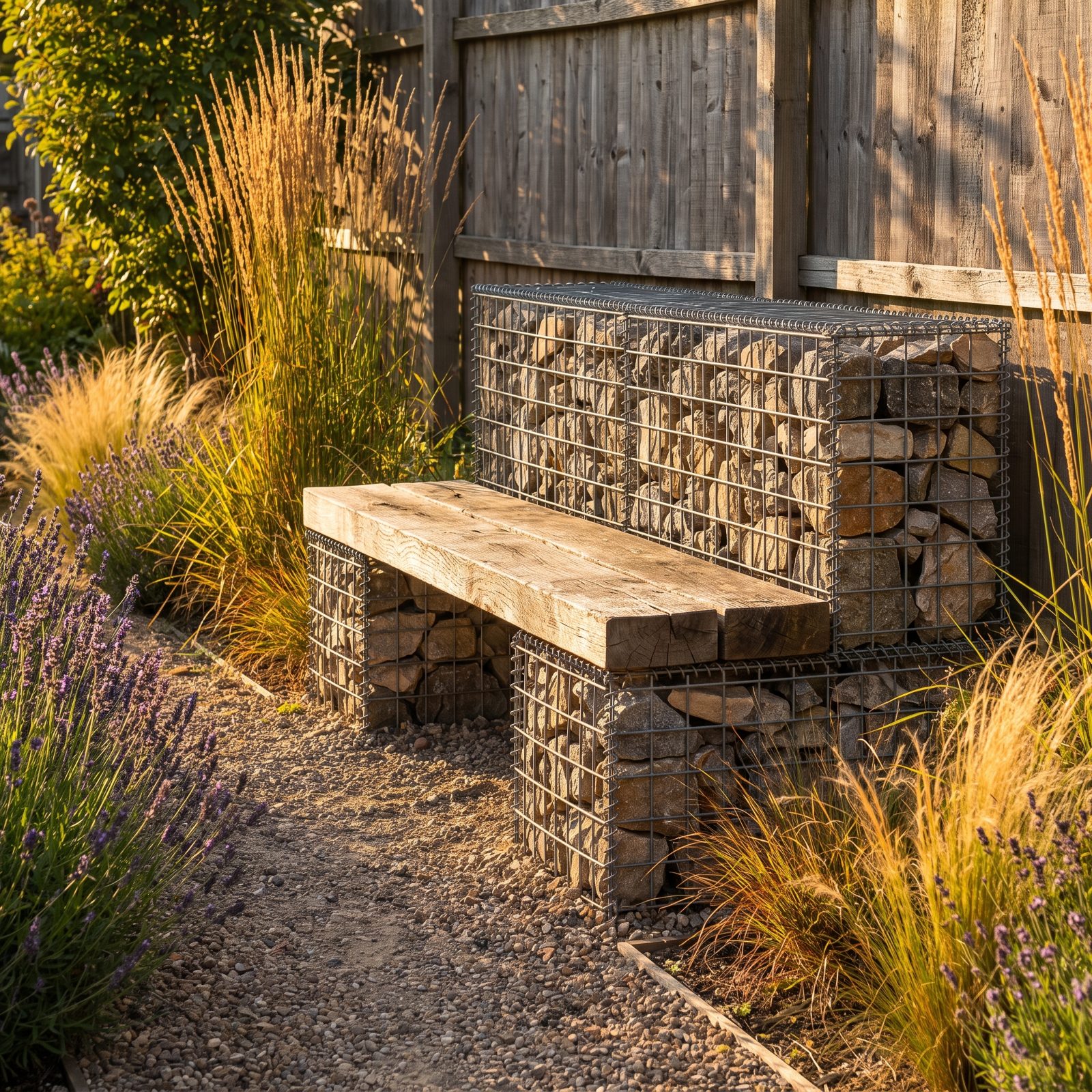
Stone hoards heat. Pile enough of it into wire cages, point the bench at the afternoon sun, and the whole mass soaks warmth up all day long. After sunset it hands that warmth back for hours. So you sit down once the air has turned cool and the seat is still faintly warm under you.
Gabion benches cost almost nothing beyond the wire cages and a pile of rubble, which you may already have buried somewhere in the yard. They pull double duty as a retaining feature and a wind buffer. But it’s the warmth that catches everyone off guard the first evening they linger outside longer than they meant to.
42. The Pergola Pulley Rack That Dries Laundry Over Your Head
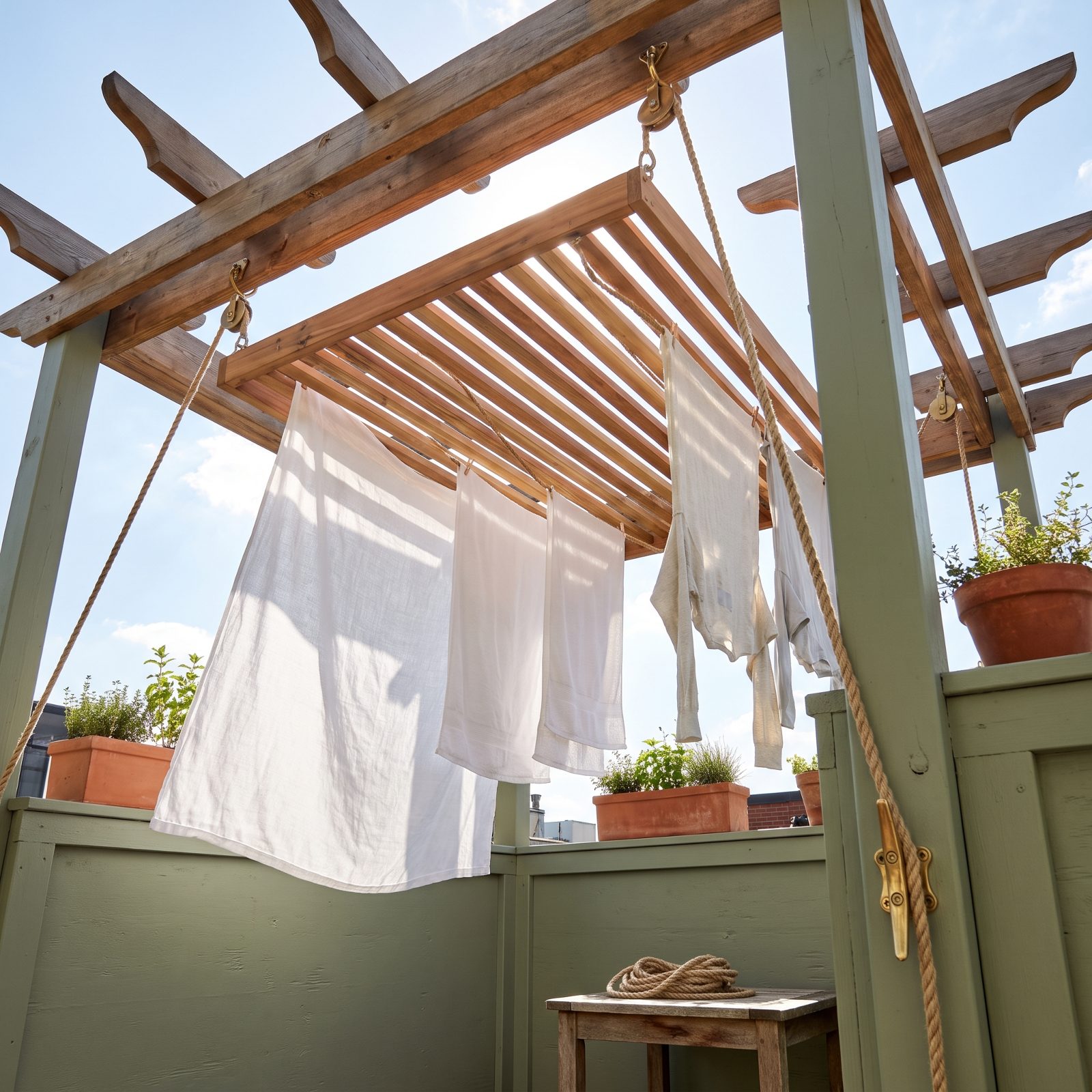
Picture the old Victorian kitchen ceiling rack, the one on ropes and a cleat, hauled outdoors. Mount a slatted rack to your pergola beams, rig it on pulleys, and you lift laundry up into the sun and wind where it dries faster than anything on a ground-level line.
When it’s down, you load it at waist height. No reaching, no stooping. When it’s up, the patio floor stays clear and the washing floats overhead, out of the way of chairs and feet.
41. Trapdoor Deck Storage Hiding Under Your Feet
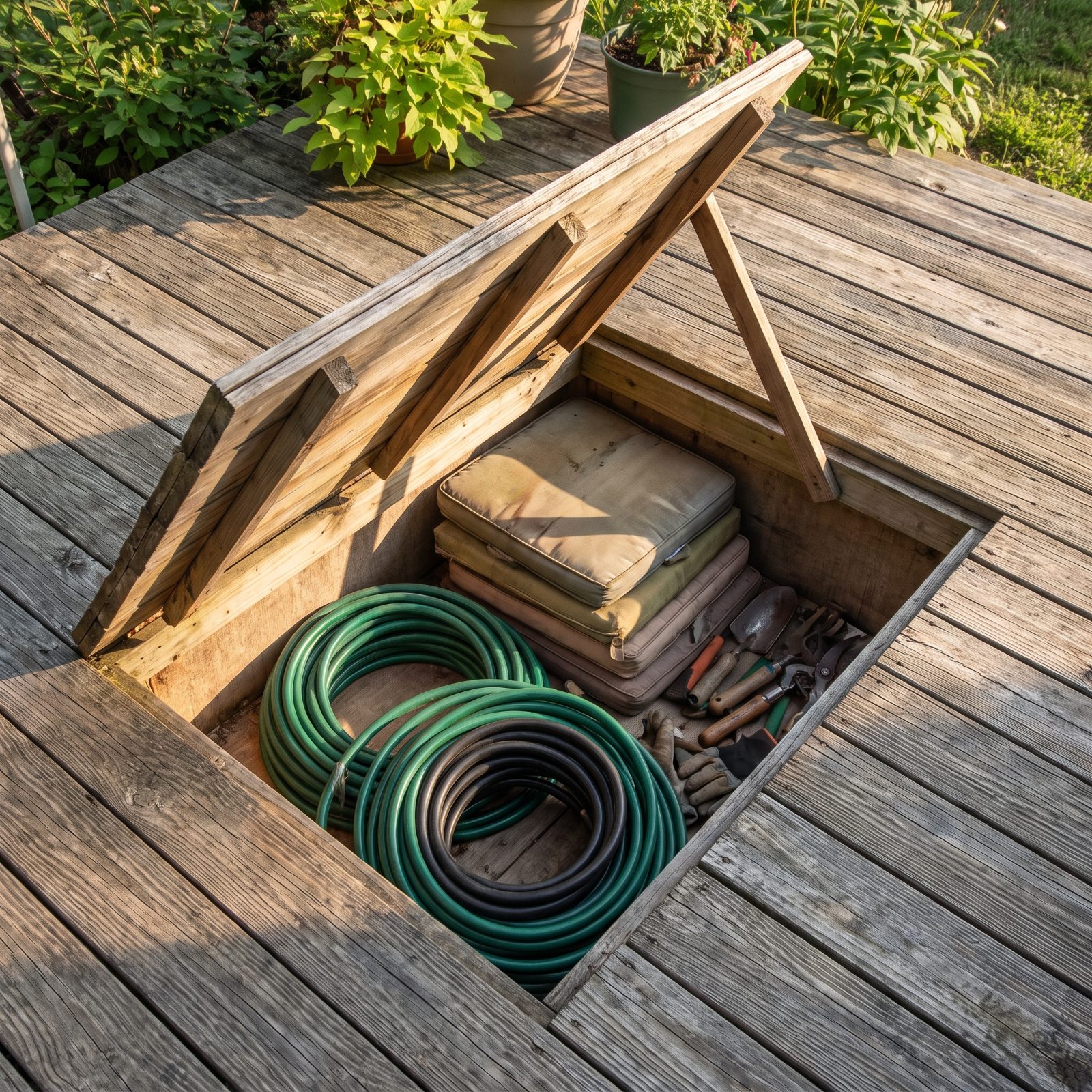
Every raised deck has dead air underneath it, and usually that space collects nothing but spiders and lost tennis balls. Cut a section of boards onto a hidden hinge, though, and you’ve got a lidded hatch dropping into dry, out-of-sight storage: hoses, cushions, kids’ pool toys, all the clutter that otherwise colonizes the patio.
The deck surface stays flush and unbroken, so nobody suspects it’s there until you lift the lid. Best use of space most people never think to claim.
40. The Ha-Ha: A Boundary That Vanishes

Here’s an 18th-century estate trick worth stealing. A ha-ha is a sunken ditch with a retaining wall on one side, dug so the garden-side lawn runs level right up to the drop, hiding the wall from view. From the house, the view still sweeps out over the sheep pasture beyond — no tall fence, no hedge, nothing high enough to stop the eye.
Its original job was keeping livestock out of the formal gardens without blocking the vista. On a smaller lot it still earns its keep, holding back a slope or screening off a neighbor’s yard while leaving your sightline wide open. And the name? So the story goes, it comes from the startled laugh of people walking straight into the thing.
39. A Rain Chain That Pours Straight Into a Bog Garden
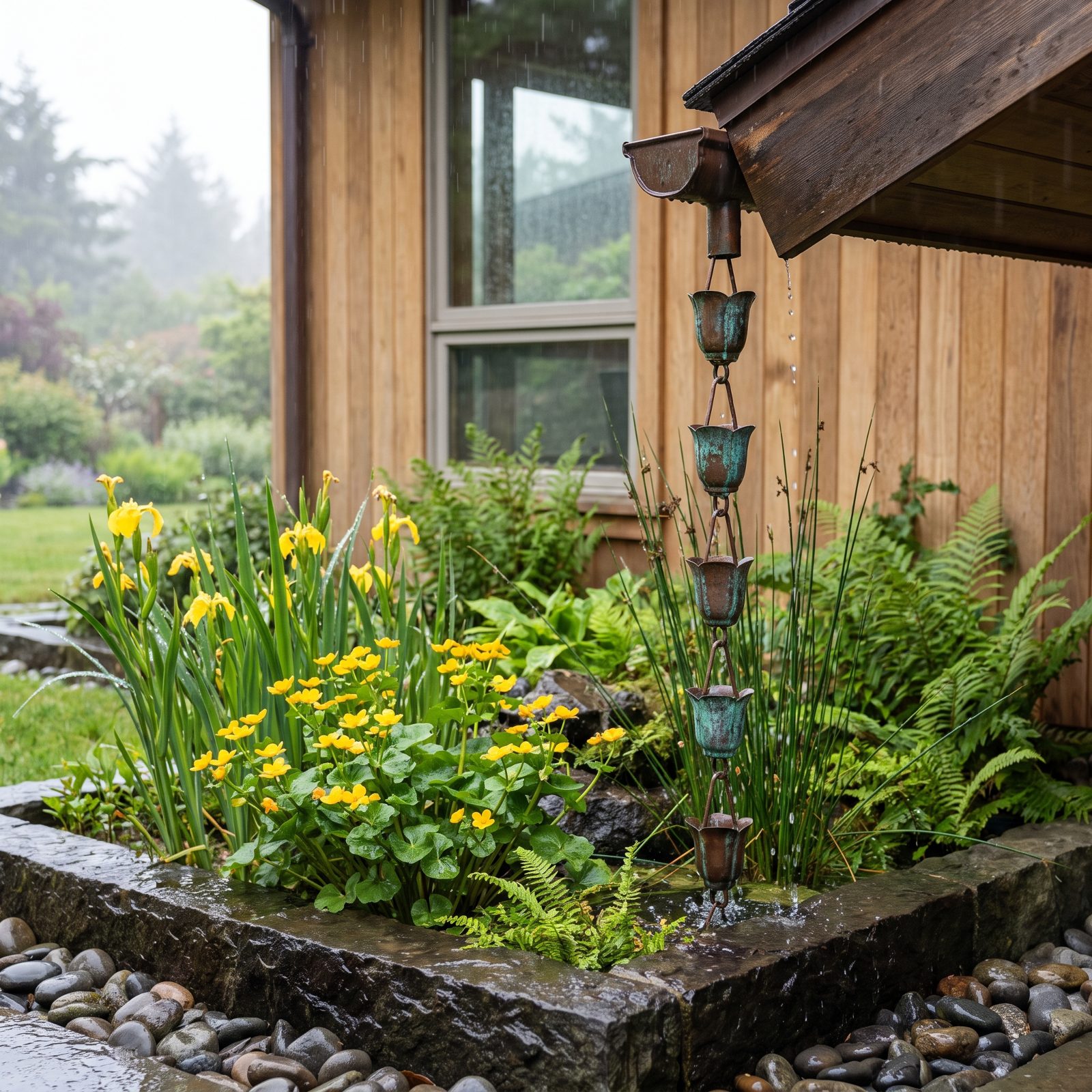
Two problems, one fix. Downspouts are ugly, and they dump a torrent you can barely stand to watch. A rain chain swaps the pipe for a string of linked cups that guide water down slowly, turning the rain into something worth watching instead of a clatter in the gutter.
Run it into a shallow bog planter and the water finally has somewhere to go. Marsh plants — irises, marsh marigolds, ferns — drink up the overflow that would otherwise drown a normal bed. You quit fighting the runoff and start farming it.
38. A Belgian Fence of Fruit Trees as a Living Partition
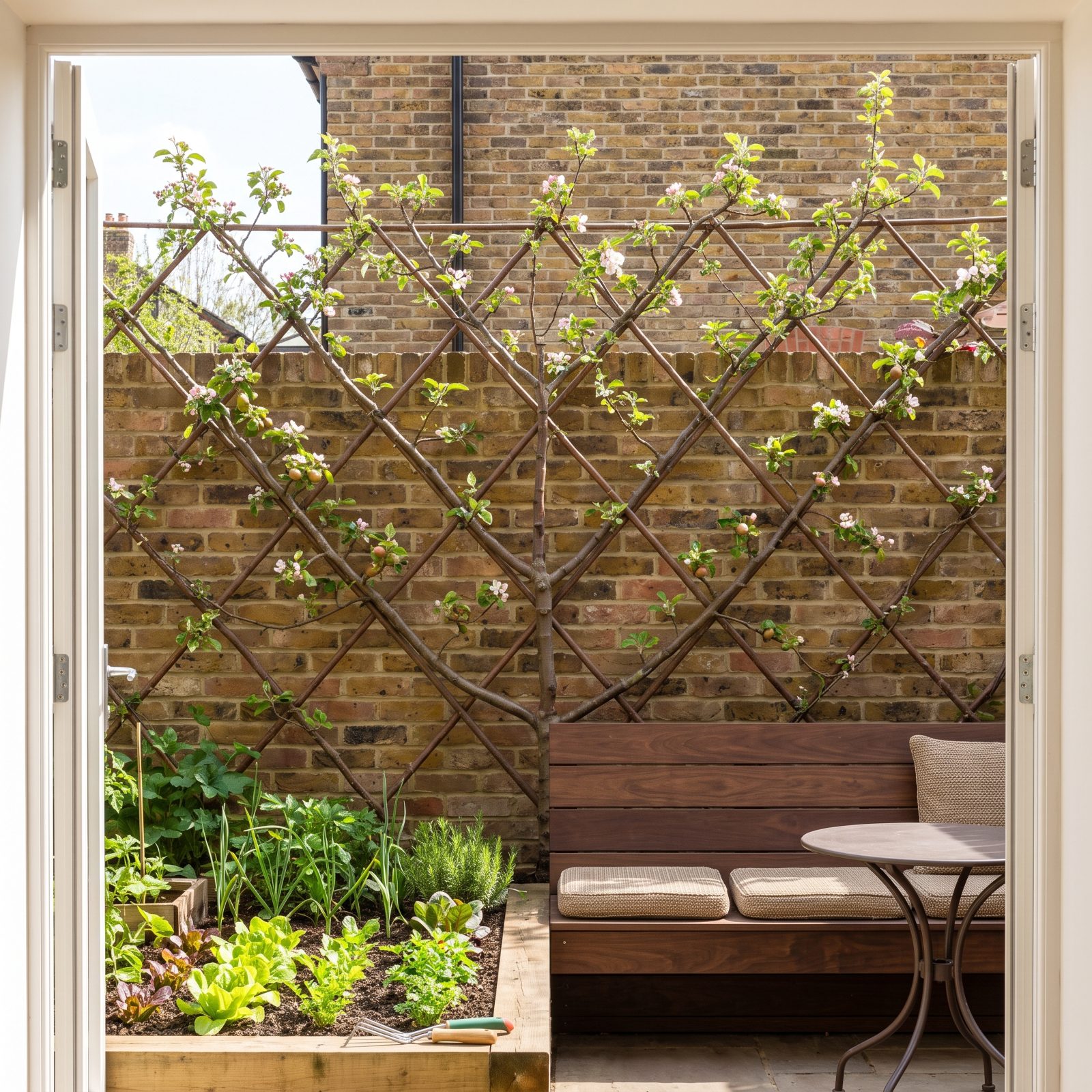
Fruit trees trained flat into a crossing diamond lattice — that’s a Belgian fence, and it works two jobs at once. It screens one part of the garden from another while quietly growing apples and pears along a strip barely a foot deep.
Because the branches are held flat and open, every leaf gets its share of sun and air, which means fewer disease headaches and far easier picking. It asks for patience and a few years of tying in young whips. What you end up with is a hedge you can eat — a boundary that pays rent.
37. The Flush-Mounted Boot Scraper That Ends the Mud Argument
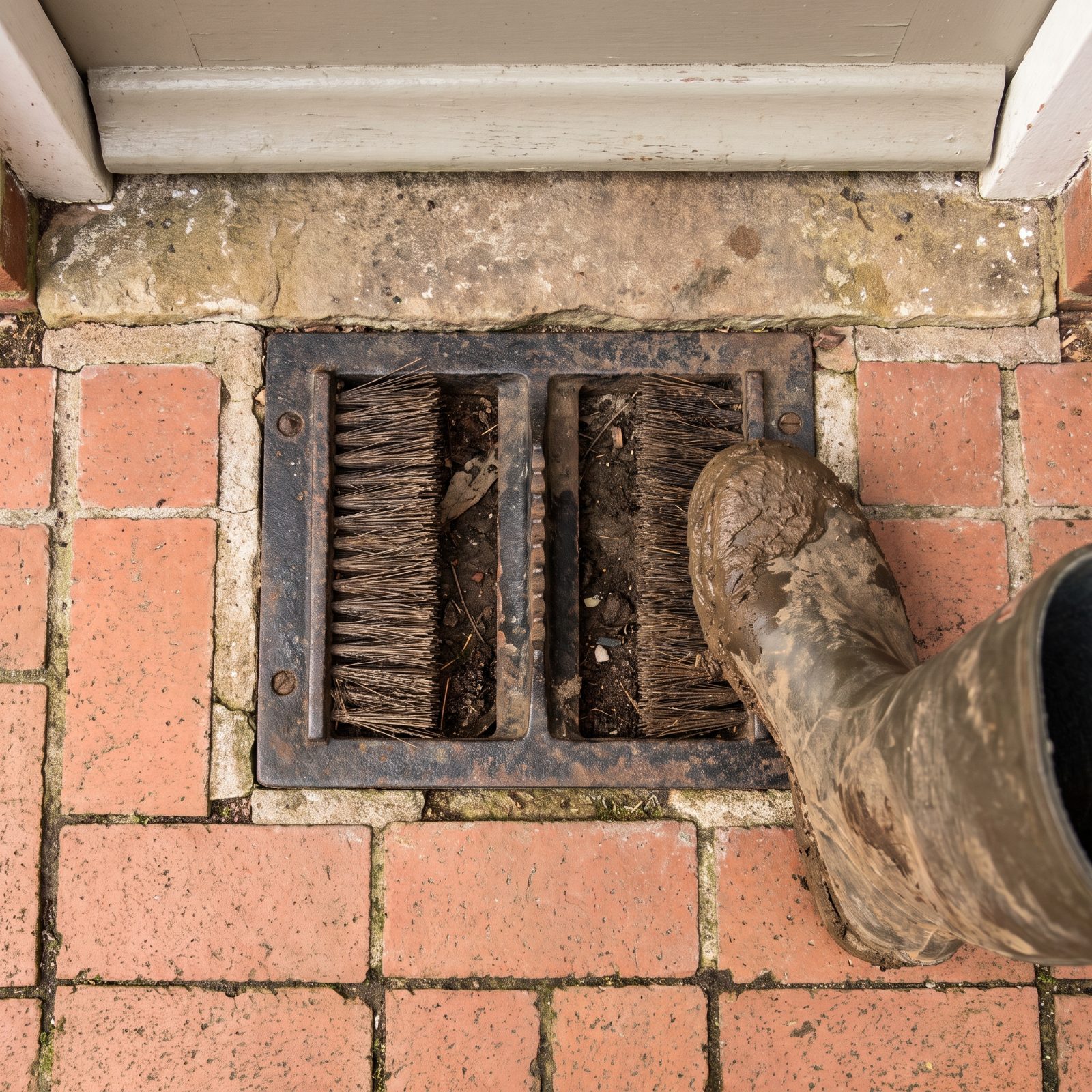
A tiny thing that settles an endless household squabble: mud tracked across the kitchen floor. The old freestanding iron boot scraper always gets kicked over and turns into its own trip hazard. Set one flush into the brick step at the threshold, and it’s right there when you need it and out of the way when you don’t.
The good ones pair a blade for scraping off clods with a brush for the fine stuff. Clean boots at the door, peace indoors. There’s a reason every proper old farmhouse kept one by the back step.
36. A Mushroom Log Screen That Grows Dinner

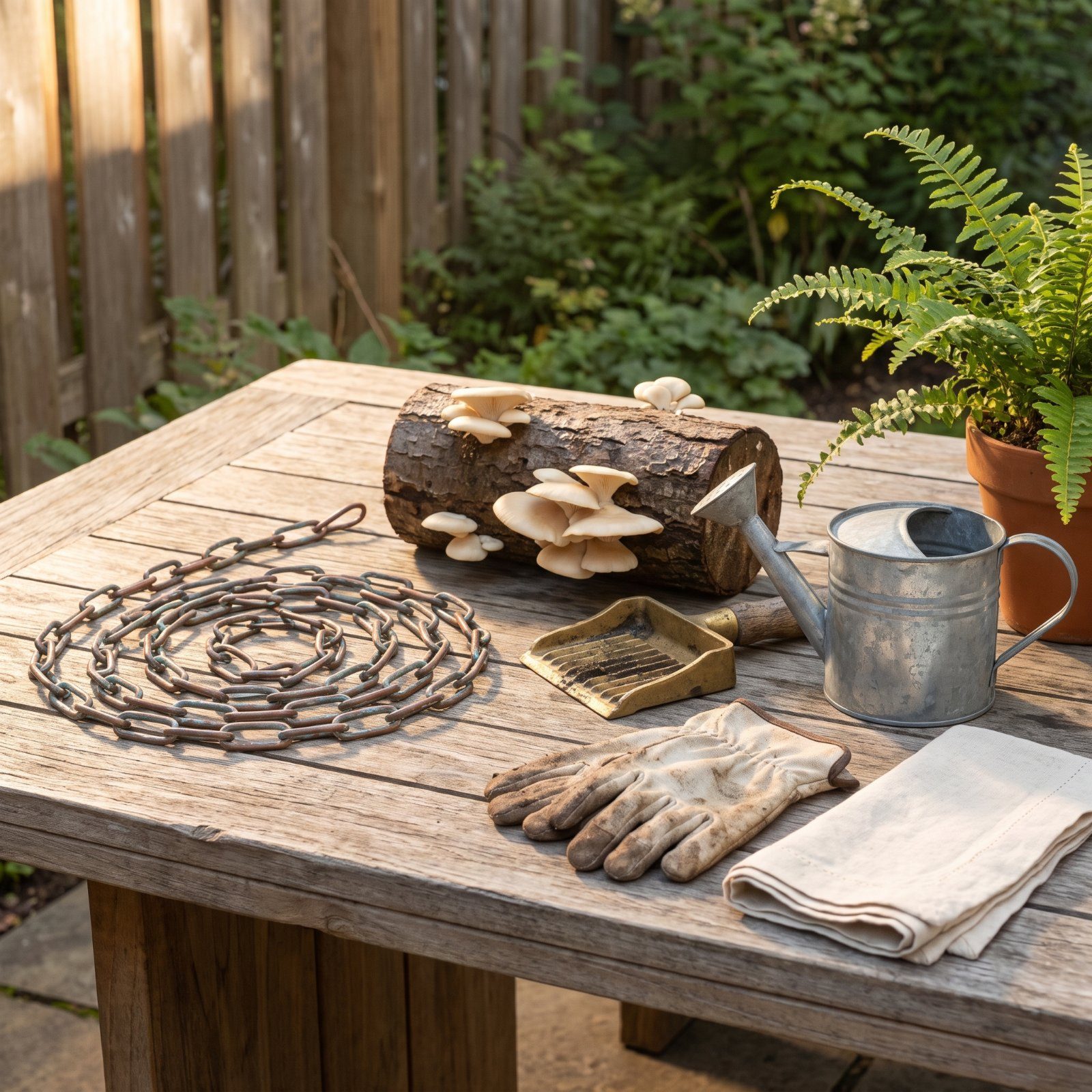
That shady, damp corner usually gets written off as the problem spot. Stand a row of hardwood logs there, drill them and plug them with shiitake or oyster spawn, and the dead corner turns into a low screen that fruits mushrooms a few times a year.
Oak and beech logs work well. Once inoculated they’ll produce for several seasons with almost no attention beyond the occasional soaking. Rare is the garden feature that hides an ugly fence line and feeds you at the same time.
35. A Sunken Cold Frame With a Seat Lid
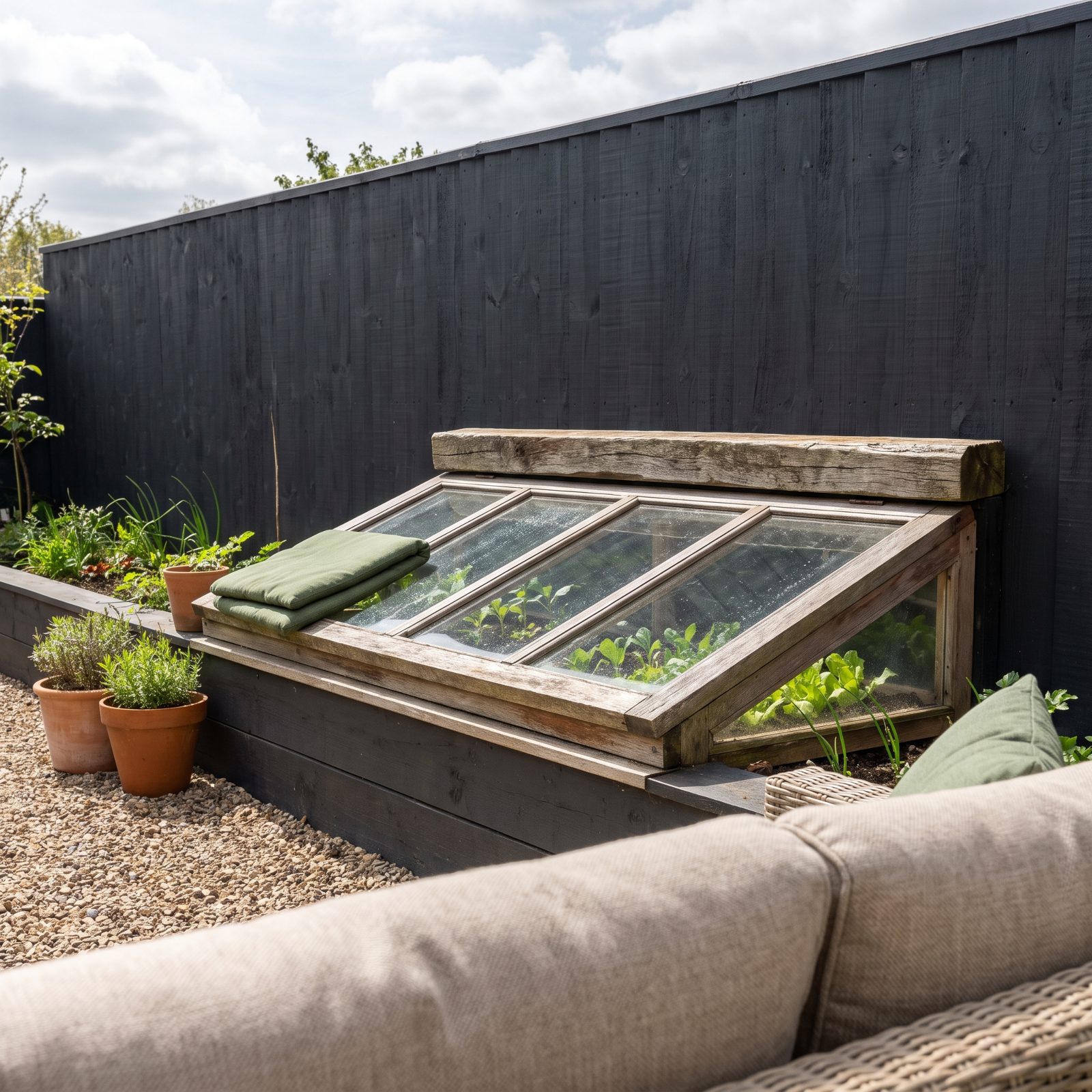
Build a cold frame into the ground rather than on top of it, and the surrounding soil insulates it, so seedlings shrug off a cold snap that would have killed them in a surface box. Earth holds temperature far better than a thin wooden wall ever could.
Now the clever part. Make the sloped glazed lid strong enough to sit on, or give it a solid hinged top, and the frame becomes a bench. You perch there with a coffee while the lettuce pushes up under your feet. One footprint, two uses — and it earns its spot in a small garden where nothing can afford to do only one job.
34. The Worm-Composting Bench That Doubles as Seating
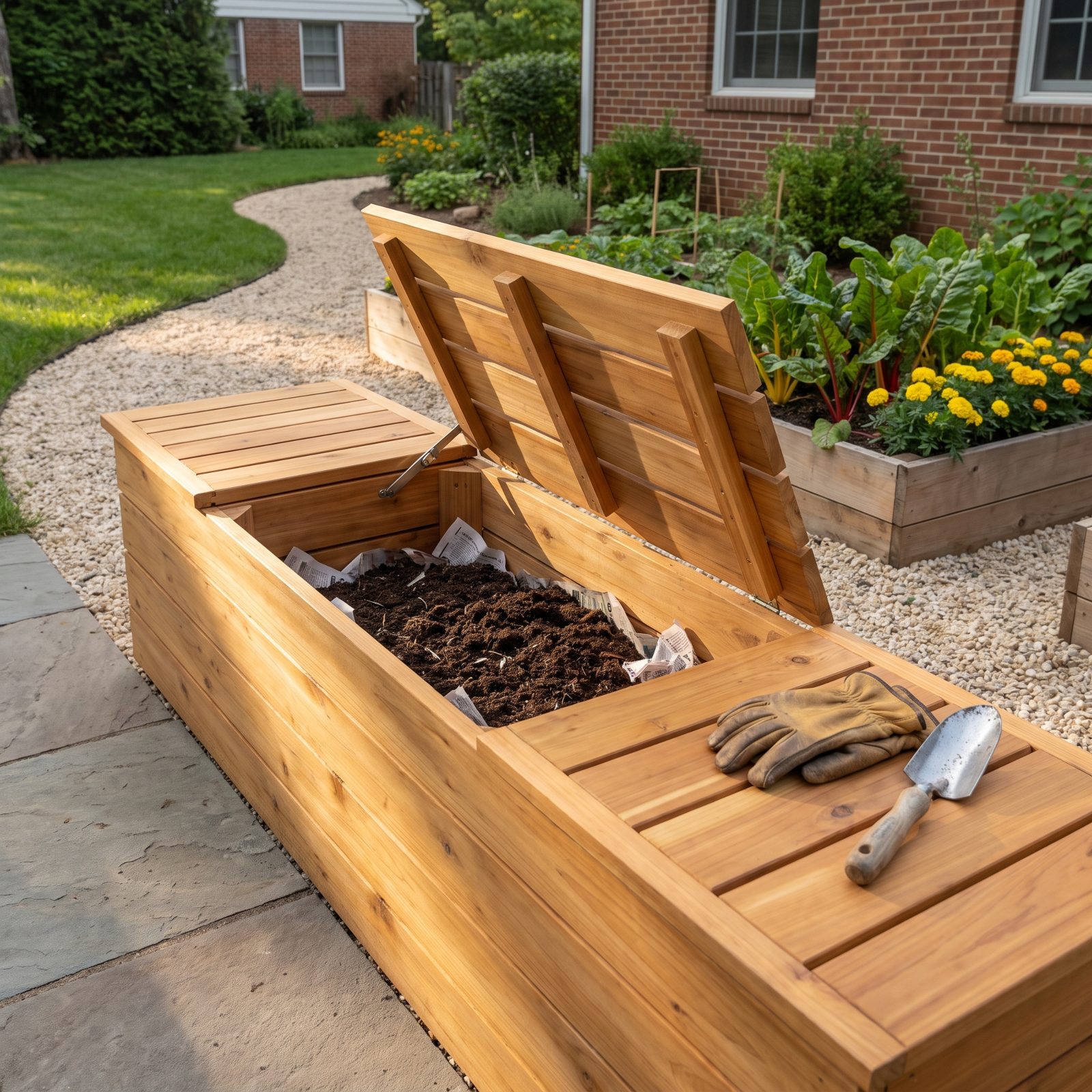
Most people never think to put worms under a seat. But build a long box with a hinged slatted lid over its middle section and fixed slatted tops at each end, drop a worm bin inside, and you’ve got somewhere to sit that happens to eat your kitchen scraps. The worms stay cool and shaded under the lid, which is exactly what they want, and the closed ends make handy spots to set down your gloves and trowel.
You lift the lid, bury the peelings in the covered section, close it, sit back down on the bench. No stink, as long as you balance the greens and browns. And the castings that come out the bottom? Richest thing you’ll ever hand a tomato.
33. A Rain-Tank Bench That Hides the Water Barrel
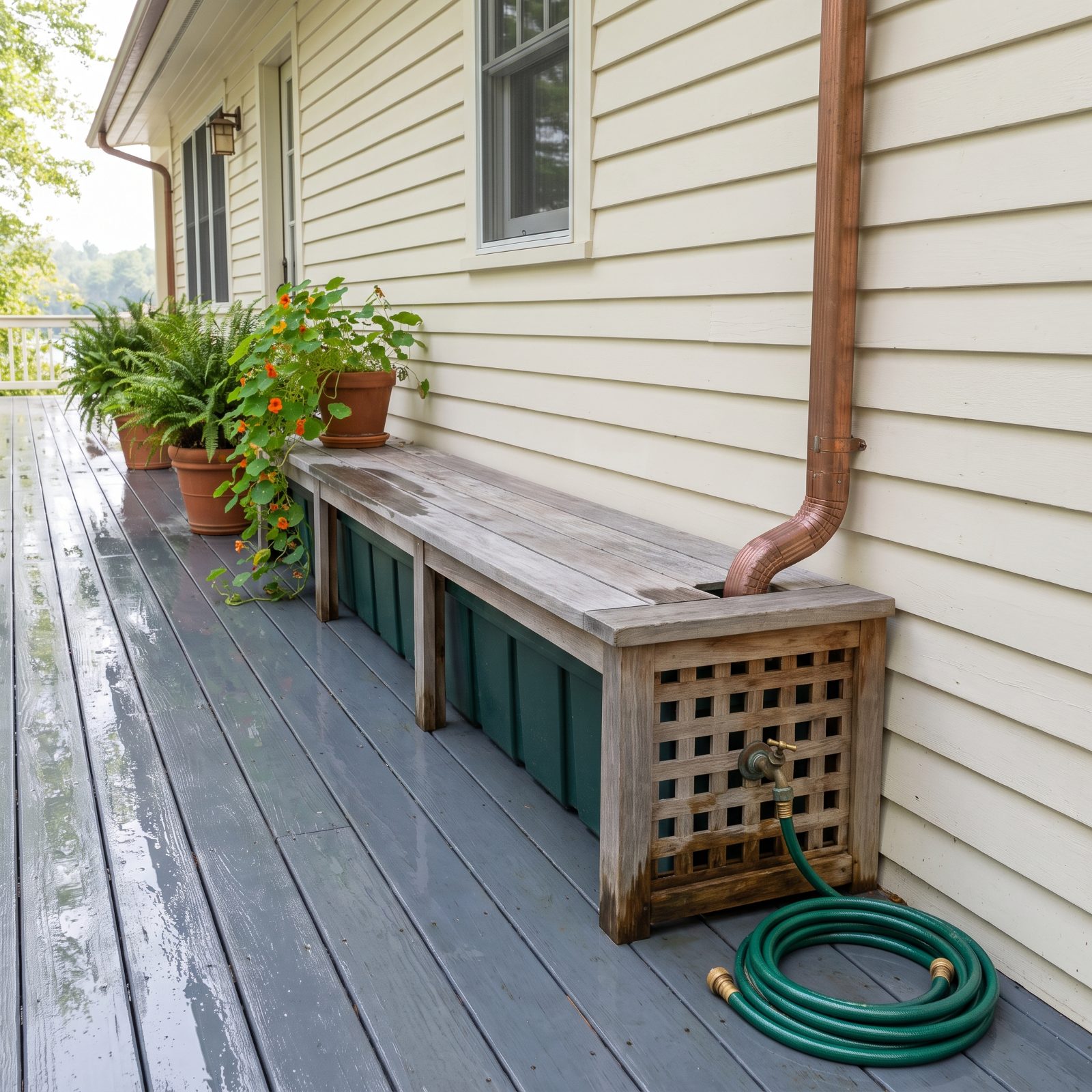
A rain barrel sitting out in the open looks like a chore you never got around to finishing. Slide a slim, dark green tank under a long bench, behind a single slatted cedar end, and suddenly it reads as furniture.
The downspout feeds the tank. The bench gives you a place to pull your boots off. A spigot at the base fills a watering can without you hauling anything from the house. Even a modest roof collects a startling amount off a single storm — free water for the beds, from a tank that blends in rather than sticking out.
32. A Wicking Planter That Works as a Room Divider
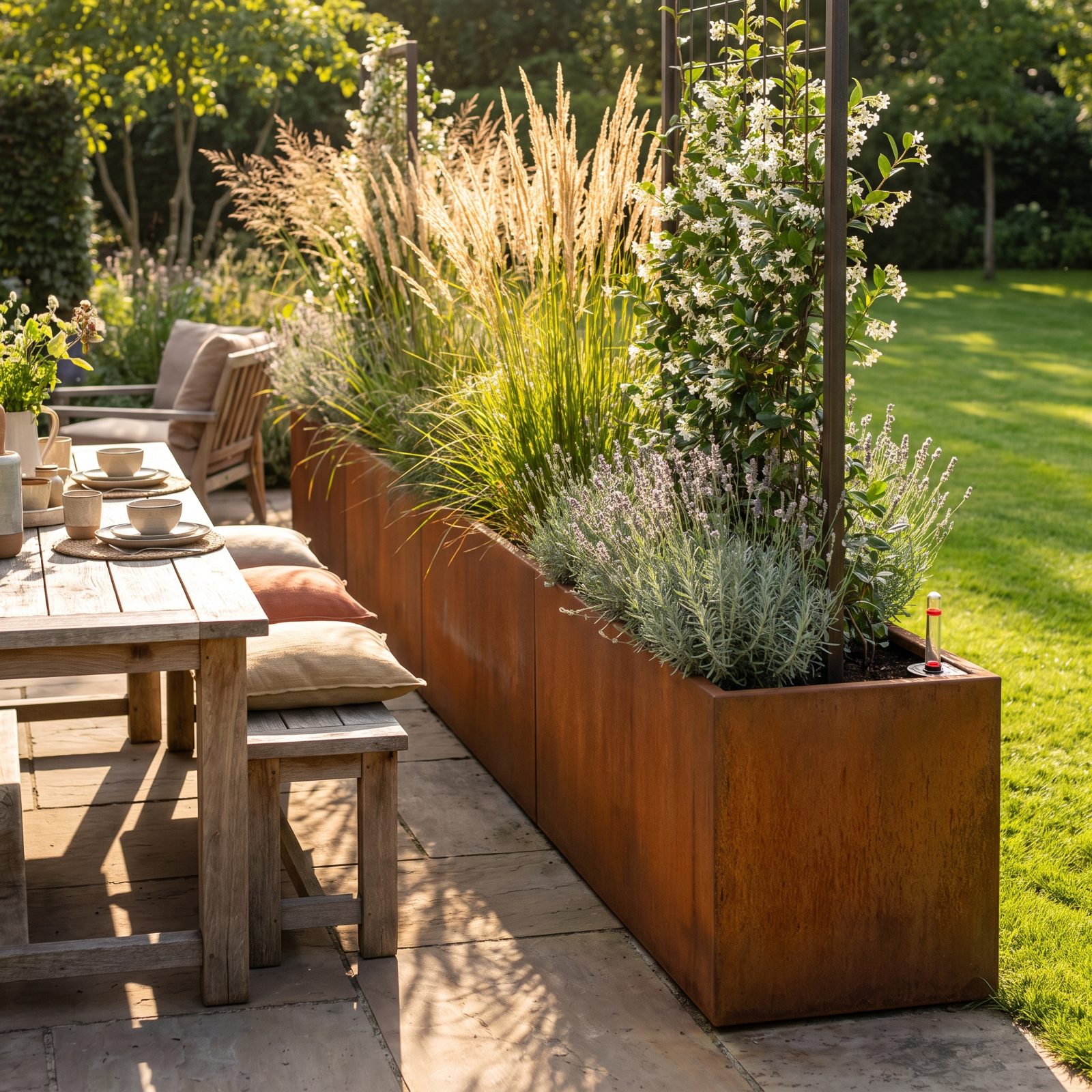
A good divider does two jobs: it blocks a sightline and it grows something. A wicking planter manages both while barely asking for water.
The reservoir sits in the base and the soil pulls moisture up as the roots need it, so you can vanish for a week without murdering anything. Plant it tall — grasses, lavender, a climber on a trellis — and it screens the compost corner or the neighbor’s view while marking where the dining area stops and the lawn begins.
31. A Buried Olla Grid That Waters While You Sleep

Ollas are old. Farmers buried unglazed clay pots in their fields thousands of years ago, and the trick still outperforms most of what you’ll find at the garden center.
Bury the porous pot up to its neck in the soil, fill it, cap it, and the clay seeps moisture straight to the roots as the surrounding soil dries. Plant a grid of them across a bed and you’re watering once every few days instead of every single evening. Less evaporation, no runoff. The roots even learn to grow toward the pots.
30. An Herb Trough Running Down the Dining Table
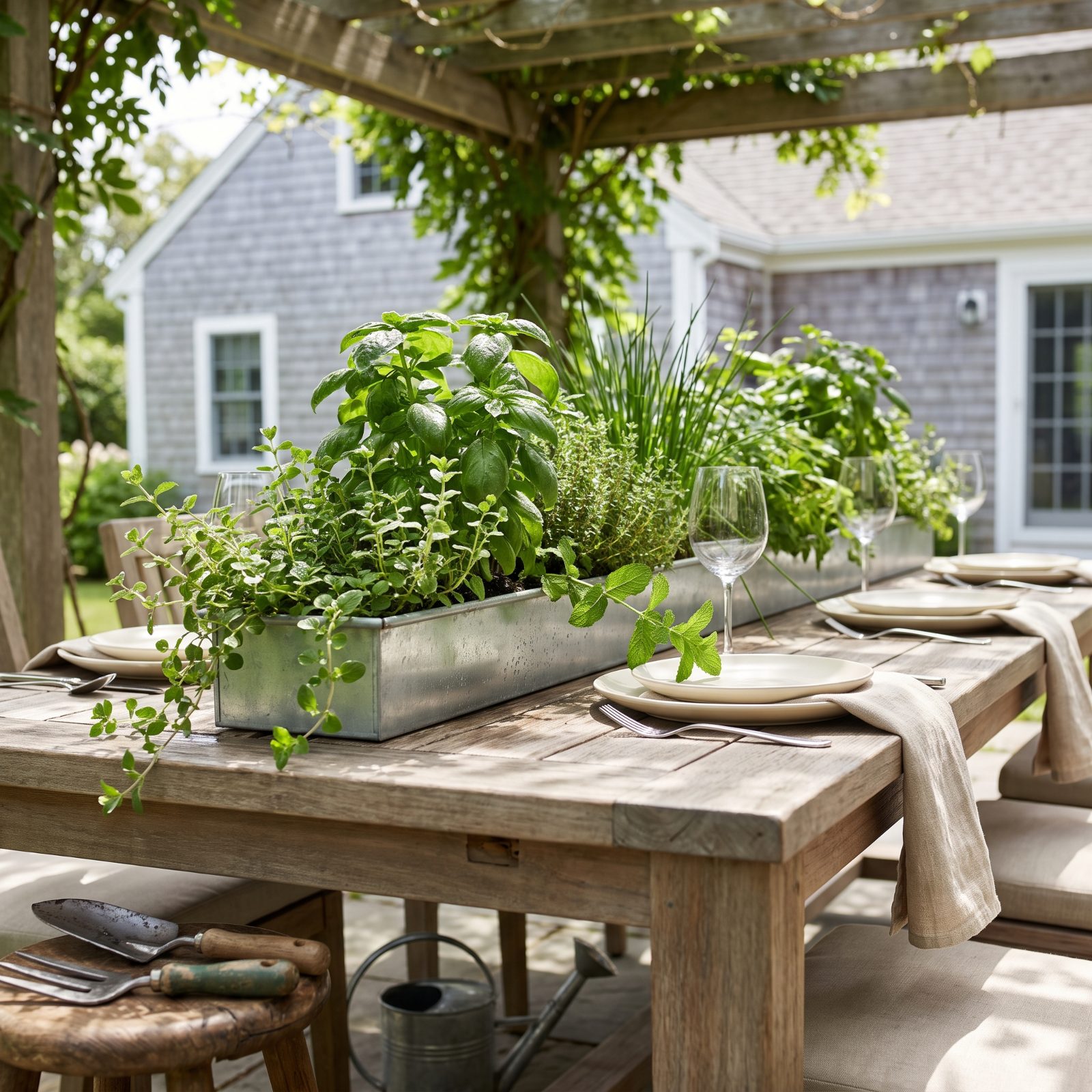
Skip the cut-flower centerpiece that’s dead by Thursday. Run a shallow zinc trough down the middle of the table and plant it with basil, thyme, chives, and a bit of trailing oregano instead.
It smells like dinner before dinner arrives. Guests pinch leaves as they talk — which is the whole idea — and the brushing releases the oils until the table practically breathes basil. Set the trough right on the bare wood, water sparingly so nothing leaks onto the tabletop, and pull the trough indoors when the cold comes.
29. The Waterproof Blanket Drawer Built Into the Bench
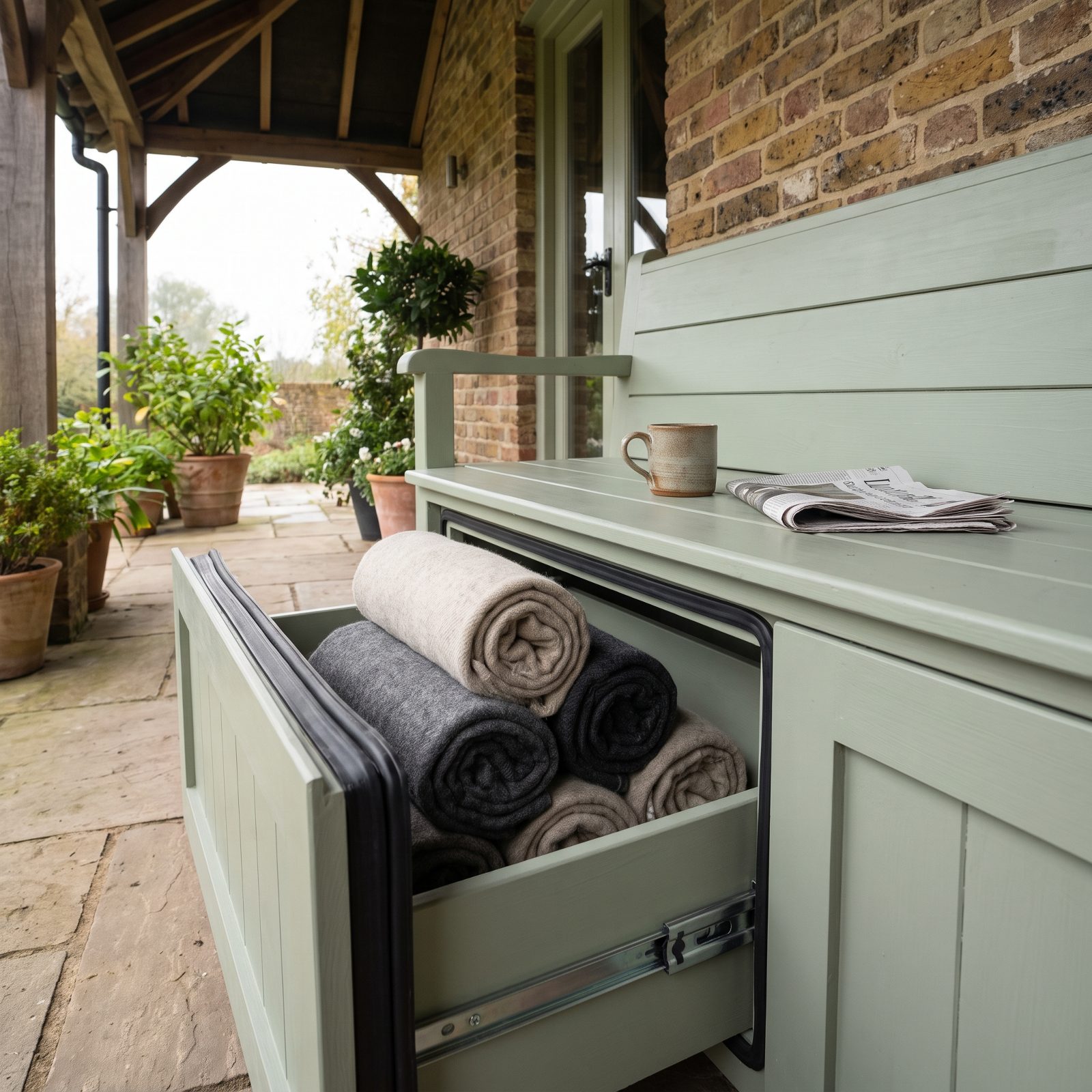
Nobody uses the throw blankets outside because the throw blankets live inside, and nobody wants to make a trip for them. Build a sealed drawer into the base of a bench and that whole problem evaporates.
A rubber gasket keeps the damp out. Fold the wool throws and cushions in, and they’re waiting the second the evening turns cool — warm, dry, at arm’s reach.
28. Stacked Firewood That Doubles as a Windbreak
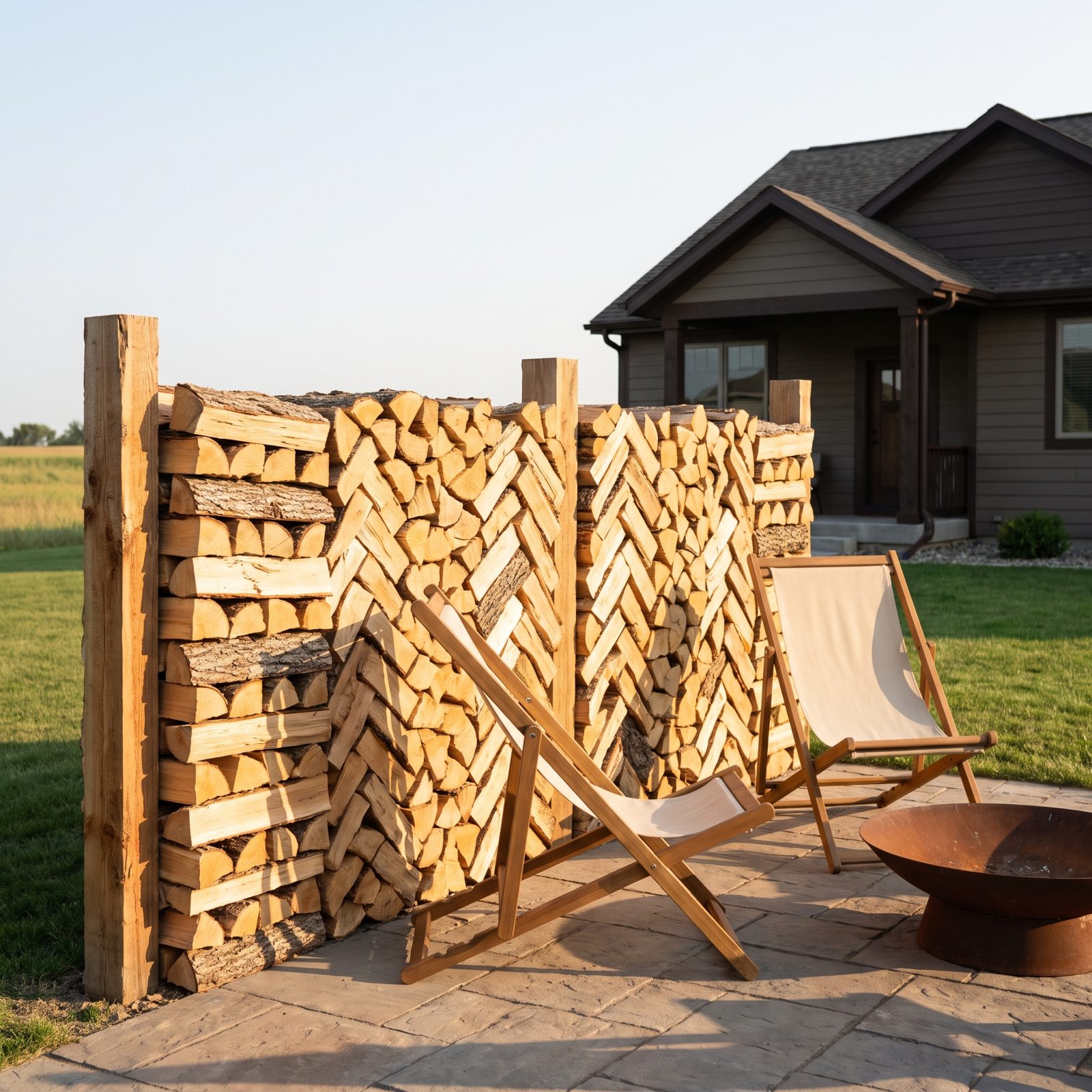
Firewood has to go somewhere. Stack it into a wall instead of a heap and it earns its keep twice over.
Build it chest-high along the windward edge of a patio, split logs laid in a herringbone in one bay and cut ends stacked in the other, and it knocks a stiff breeze down to something a candle can survive. The seating behind it stays warmer and calmer, the wood seasons right where you can grab it, and honestly the stacked logs look better than any screen you’d buy. One thing — set the bottom row on the stone patio rather than the grass so it doesn’t sit in damp and rot.
27. A Sunken Fire Bowl That Caps Flush With the Patio
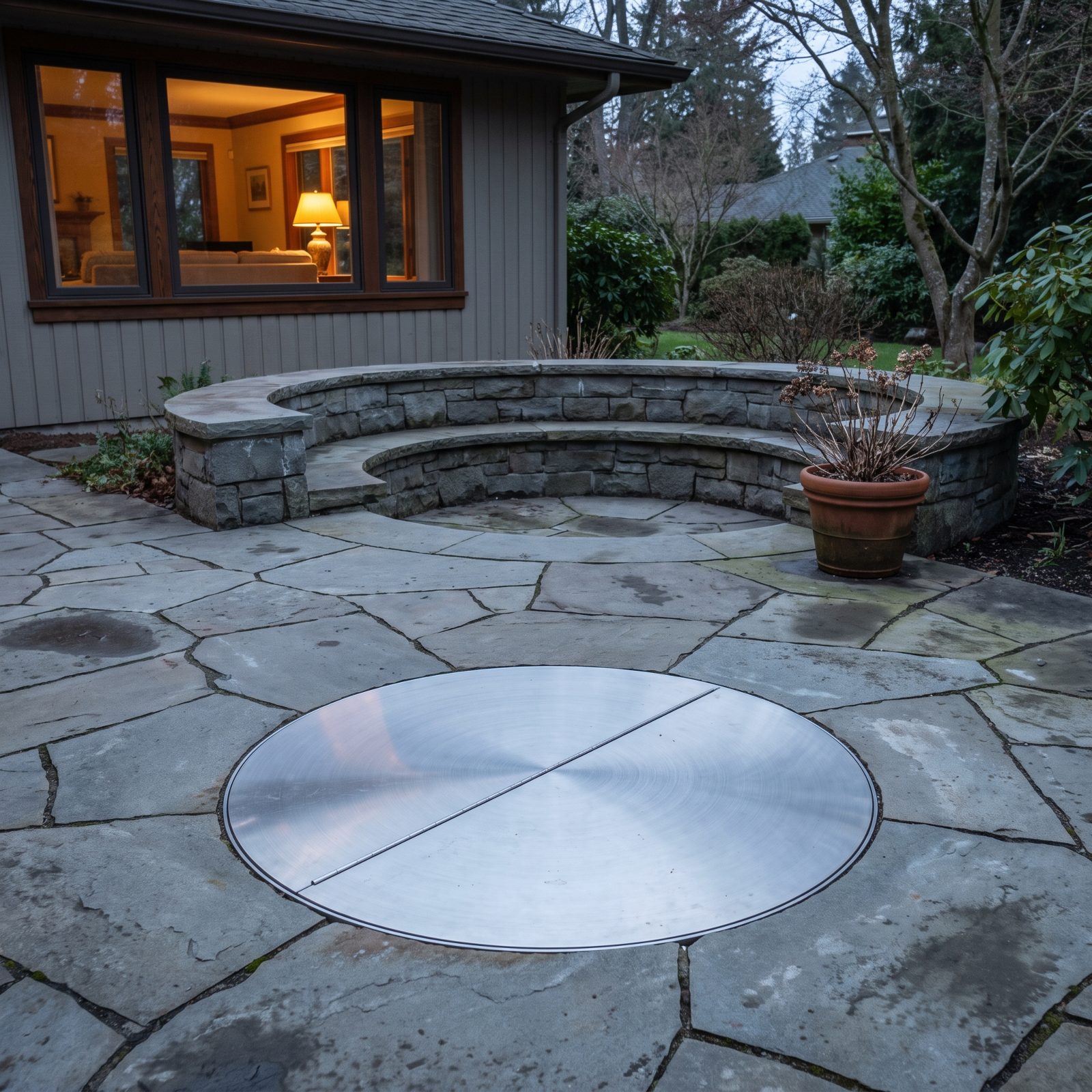
A fire pit sitting open all year is a leaf trap and a stubbed toe waiting to happen. Sink the bowl below the paving, give it a flush steel cap, and for most of the year it simply disappears into the patio floor.
Lift the cap on a cold night and there’s fire where there was flat ground. Drop it back on in the morning and the kids can sprint straight across it. No rusting ring hogging the middle of the yard, no tarp that blows off in the first storm. Just patio — until you want otherwise.
26. A Pivoting Louver Wall That Turns Sun Into Shade
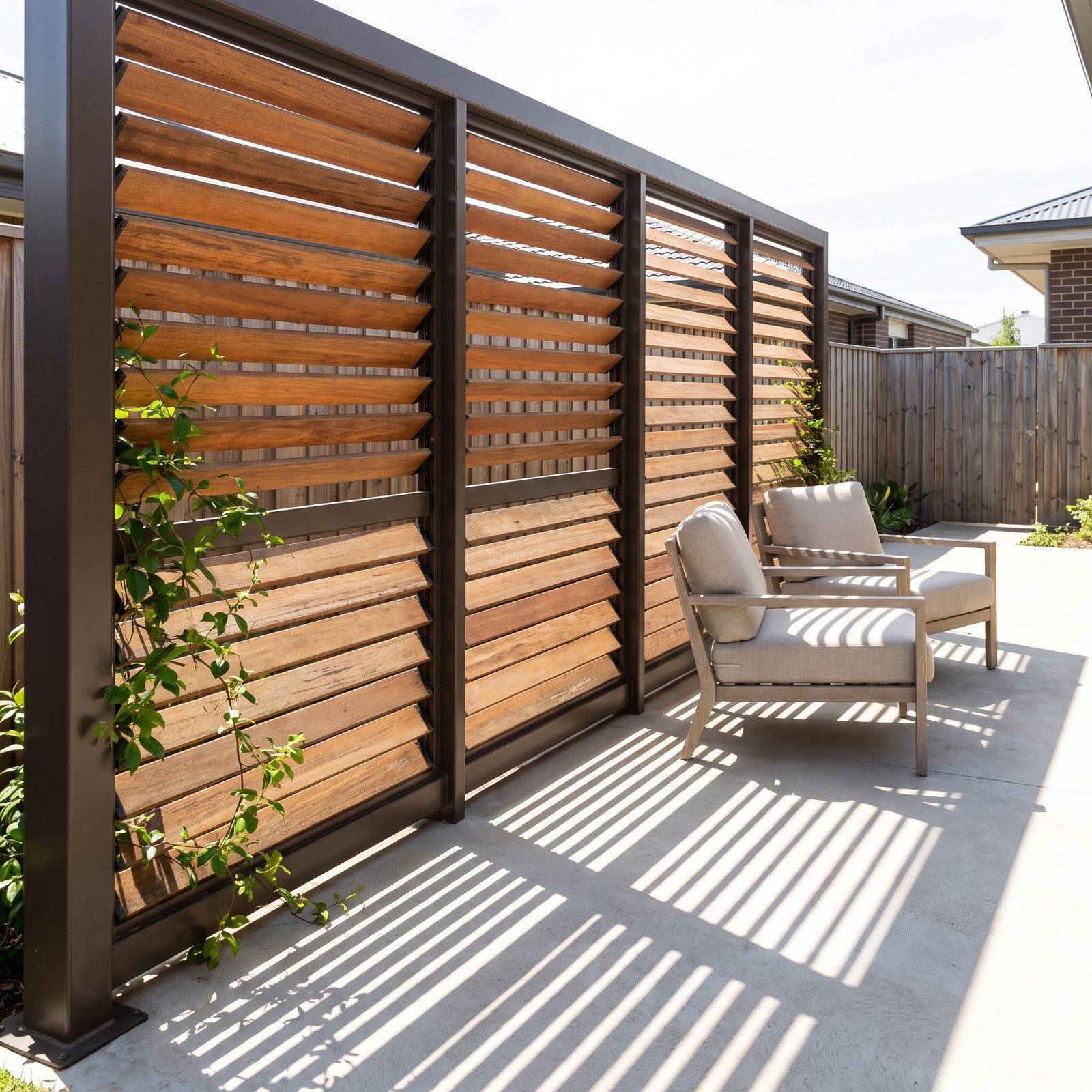
A fixed pergola solves the sun for about two hours a day, then fights you the rest of it. Louvers that pivot move with the light instead.
Angle the slats to block the low afternoon glare, open them flat for the morning sun, close them against a prying neighbor. One wall, three jobs, depending on how you turn it. And the striped shadows it throws across the floor shift all afternoon long — half the pleasure of sitting under the thing.
25. An Overhead Infrared Panel That Heats You, Not the Air
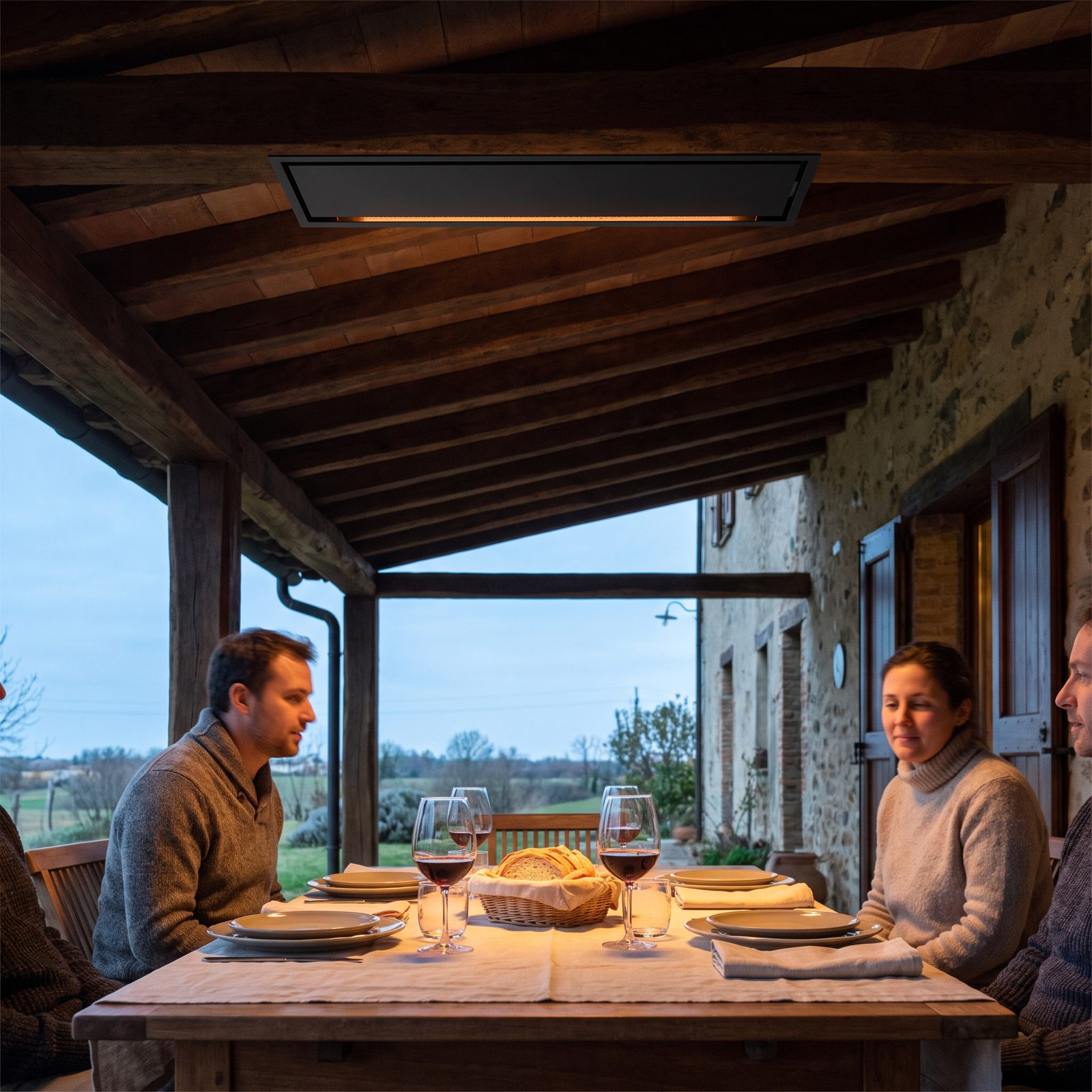
Patio heaters that warm the air are losing the fight the second a breeze shows up. Infrared skips the air entirely and warms whatever it’s aimed at — meaning you.
Mount a panel overhead under a covered patio and it throws heat straight down onto the table and the people around it, like standing in a patch of sun on a cold day. No propane tank to swap. No roaring flame. No gust carrying the warmth off into the next yard. It warms the dinner, not the dusk.
24. Shielded Amber Downlights That Don’t Blind the Neighbors
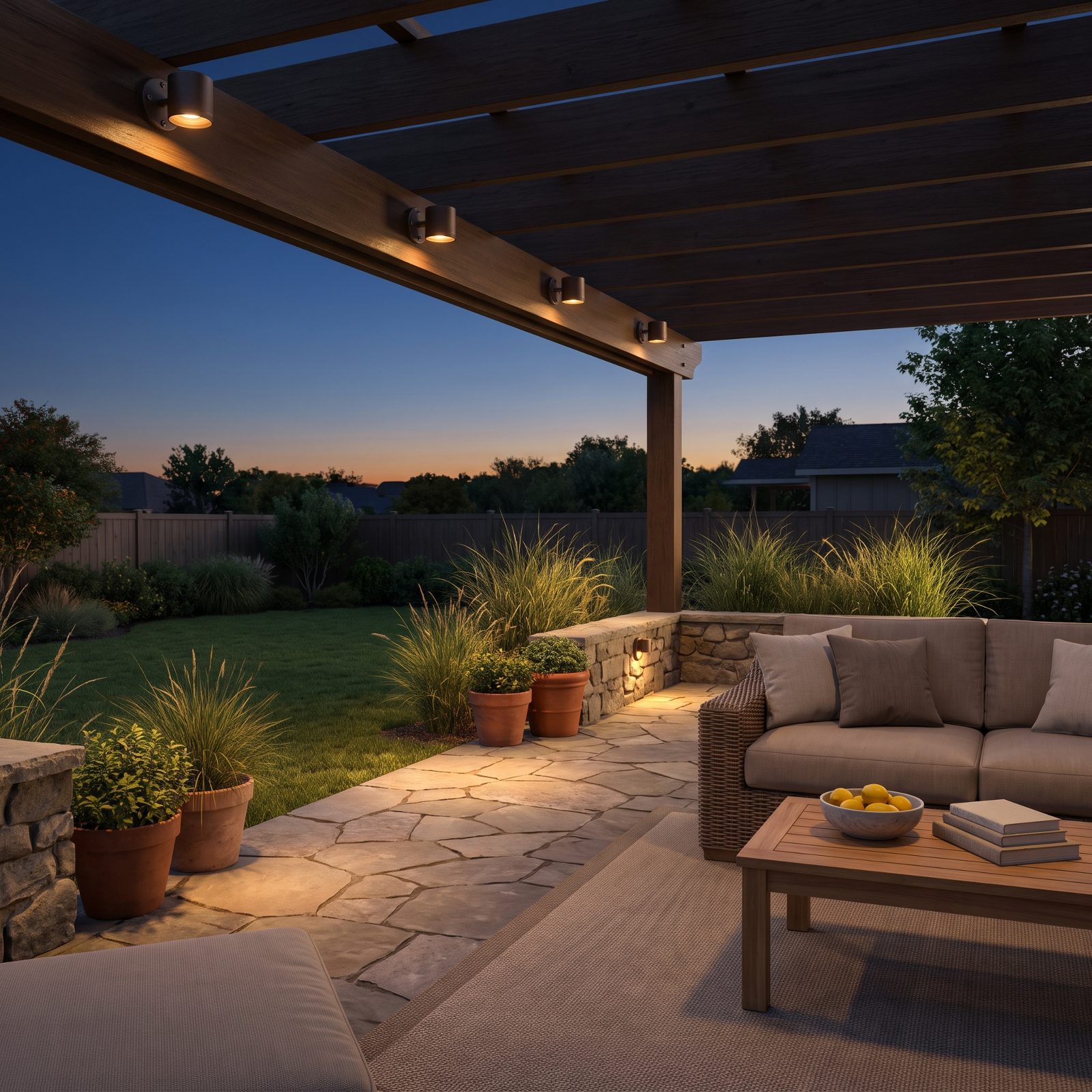
Most backyard lighting makes the yard feel like a parking lot. White LEDs blast sideways, fry your night vision, and spill straight into the neighbor’s bedroom window. Shielded amber downlights flip all of that: the bulb hides behind a cap and only a warm circle lands where you actually need it, on the steps, the path, the table edge.
Amber sits at the warm end of the spectrum, so it reads as relaxing rather than clinical. It pulls in far fewer moths and mosquitoes too. Anyone who’s eaten dinner under a swirling bug halo will know exactly why that matters.
23. Retractable Pergola Screens You Pull Down When the Wind Turns
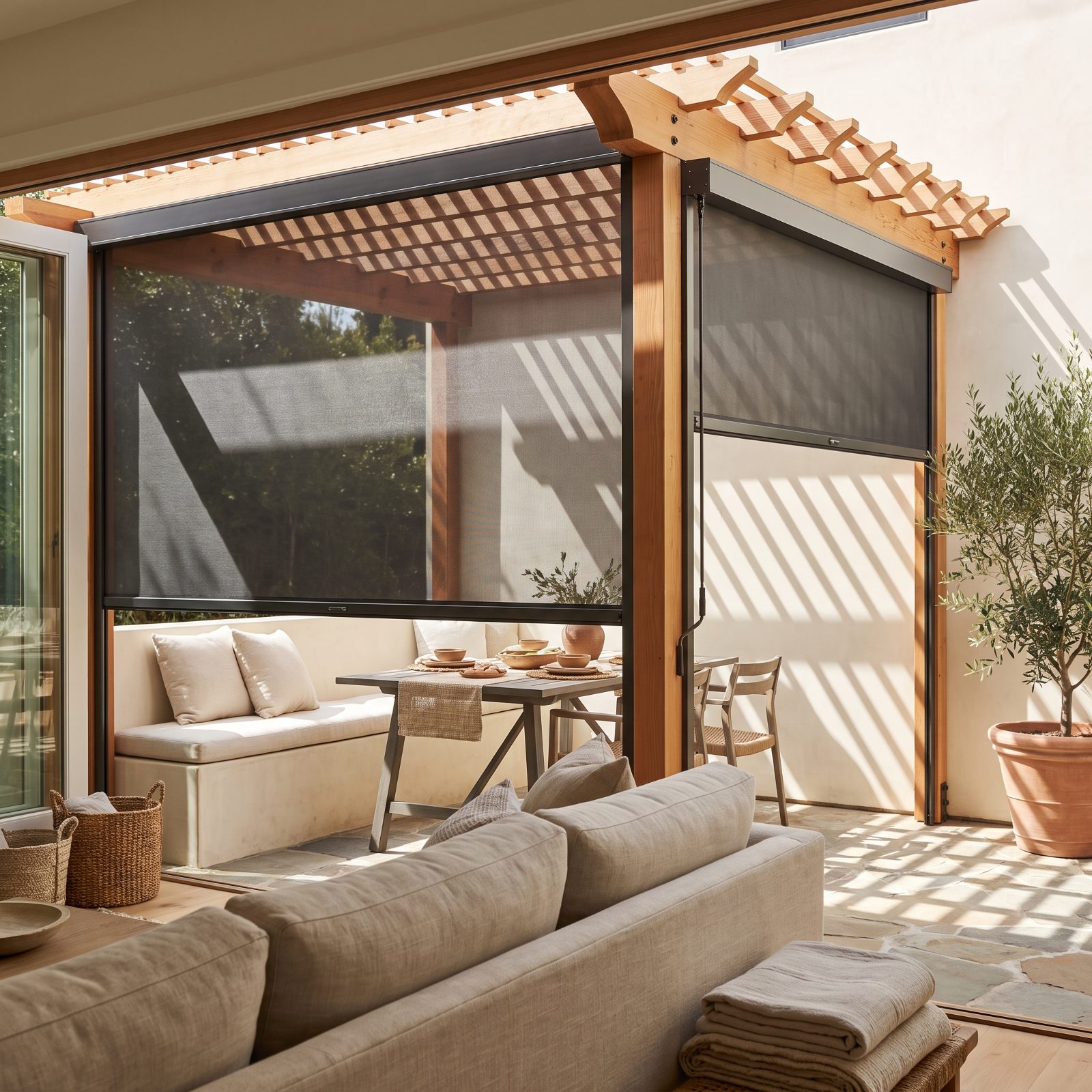
A pergola looks great and does almost nothing about the two things that actually chase people indoors: low afternoon sun and a sudden breeze. Retractable screens fix both. They roll out of a slim housing along the rafters, drop down between the posts, and cut glare and wind without boxing you in.
Mesh still lets you see the garden; solid vinyl gives you full privacy and real wind-block. Motorized versions exist, and they’re lovely. But a hand-crank unit costs far less and never needs a power socket planted in the middle of your yard.
22. A Clear Rain Roof That Keeps the Pergola Usable in a Downpour
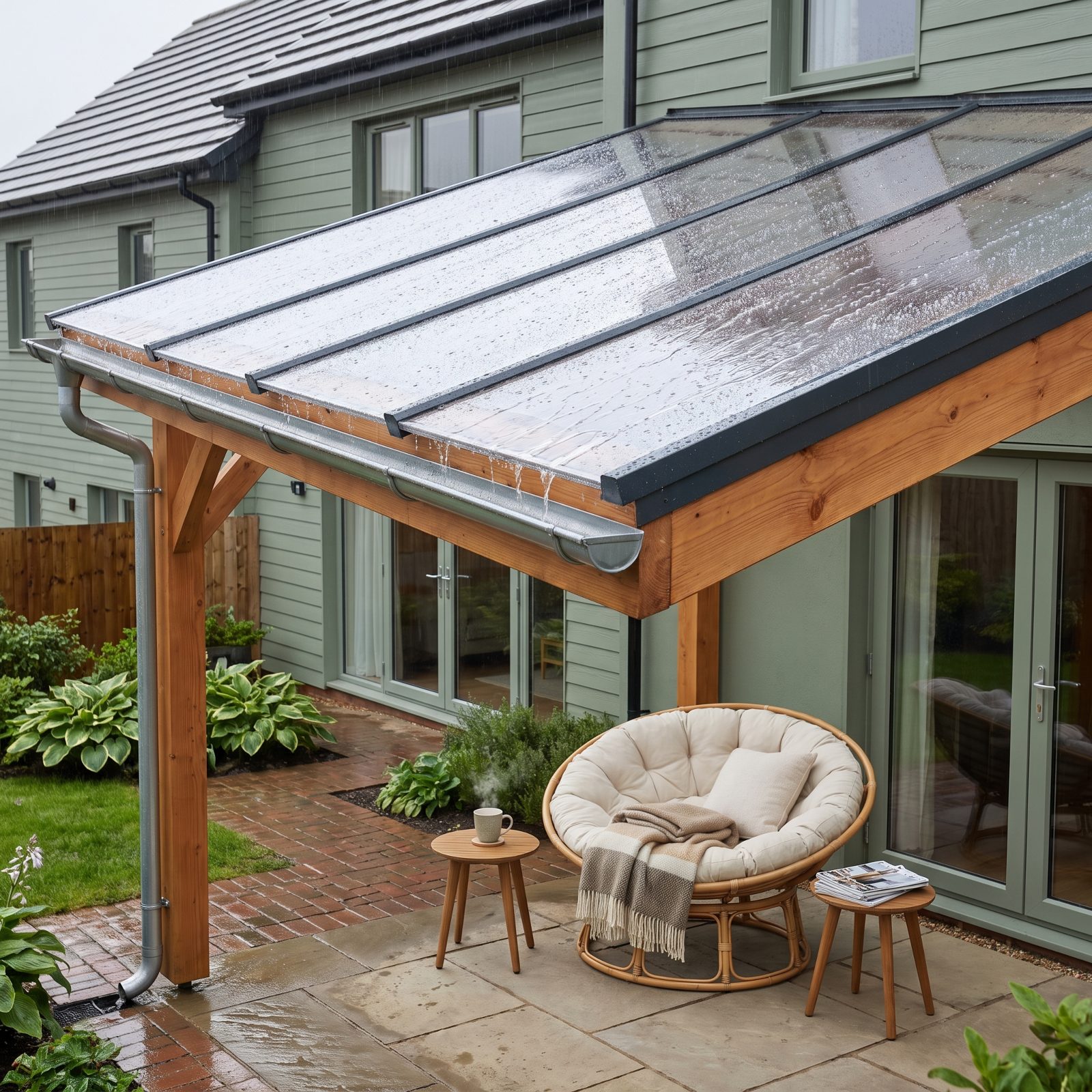
The pergola’s great weakness is rain. You build this lovely outdoor room and then flee inside the second a cloud opens. A clear polycarbonate roof, pitched slightly and fitted with a side gutter, keeps the worst of the weather off while light still pours through. A little blown-in rain will still dampen the edges and the furniture, but you can stay put through a downpour.
Polycarbonate beats glass out here. It won’t shatter, it’s far lighter on the frame, and good panels carry a UV coating so they don’t yellow in a couple of seasons. And the sound of rain drumming on it? Honestly one of the better reasons to sit out there at all.
21. A Track-Mounted Shade Sail You Can Reposition by Hand
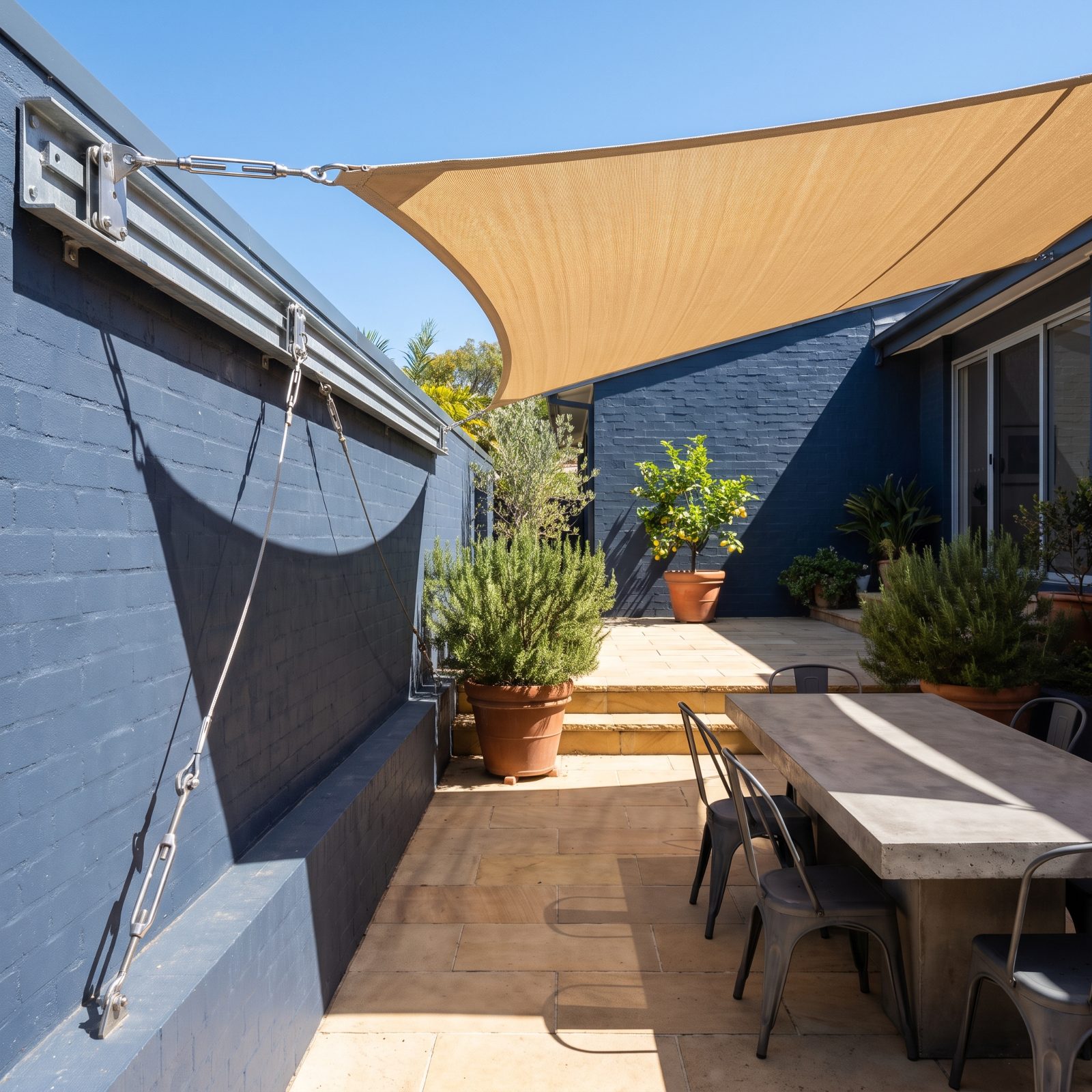
A fixed shade sail only shades one spot, and the sun won’t hold still for you. A track-mounted version slides along a rail, so you can chase the shade across the afternoon or pull it back entirely when you want the warmth on your shoulders.
Here’s what people get wrong. They string the sail loose, it flaps, it sags, it collects rain, and it rips at a corner in the first real gust. A sail needs to be drum-tight, with marine-grade fittings and a proper slope. Done right, it moves where you want it and stays put when the wind arrives.
20. Removable Hammock Posts That Disappear When You Mow
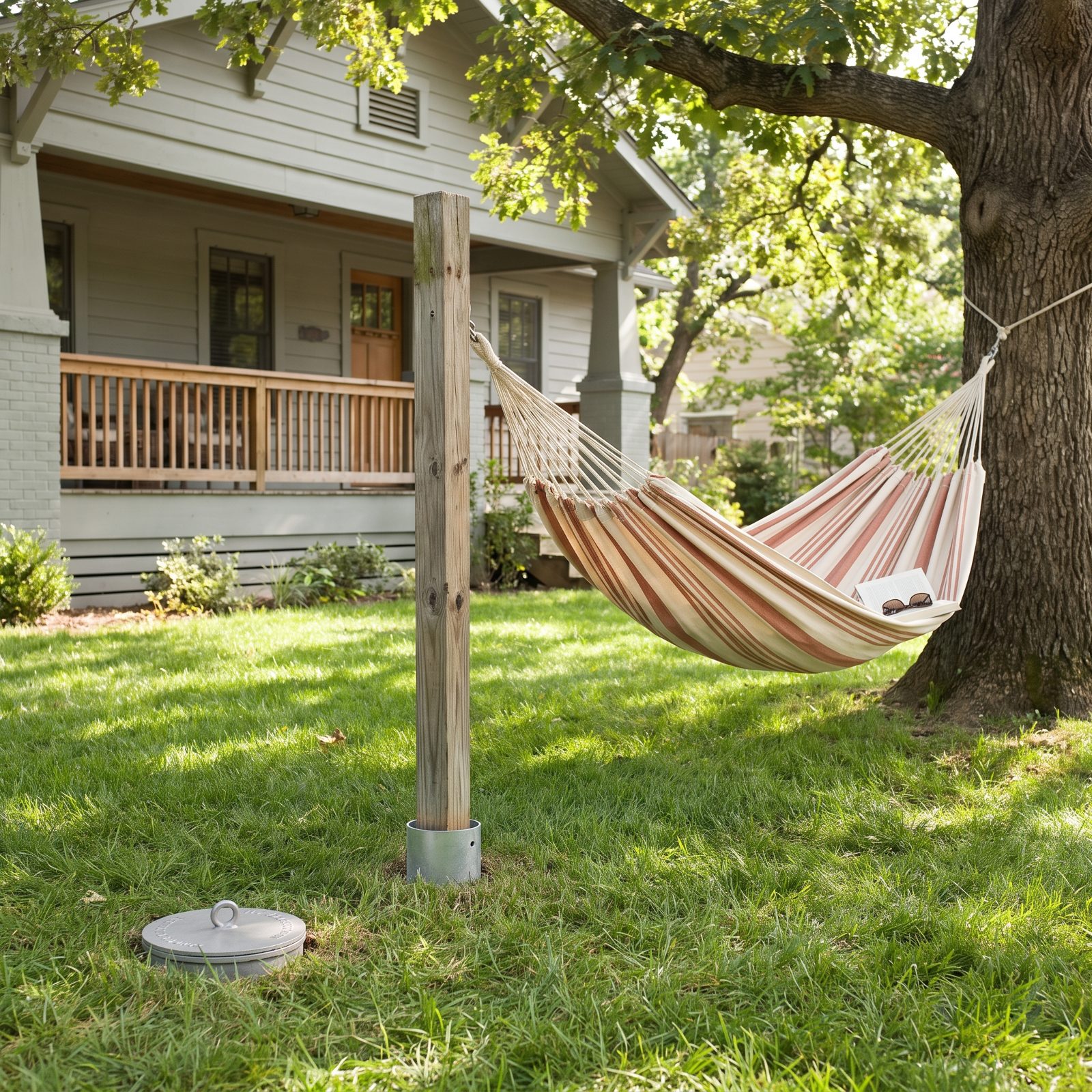
Hammocks need two anchor points, and most yards don’t have two conveniently spaced trees. So people concrete in permanent posts, then spend the next decade mowing around two stumps they use maybe three weekends a year.
A ground sleeve fixes that. You sink a galvanized metal sleeve into the lawn, drop the post in when you want the hammock, and lift it out when you don’t. In this setup the rim stands a few inches proud of the grass; sink yours deep enough to sit flush and the mower rolls straight over it. Open lawn all week, a lounge in two minutes flat.
19. A Fold-Down Counter Bolted Straight to the Fence
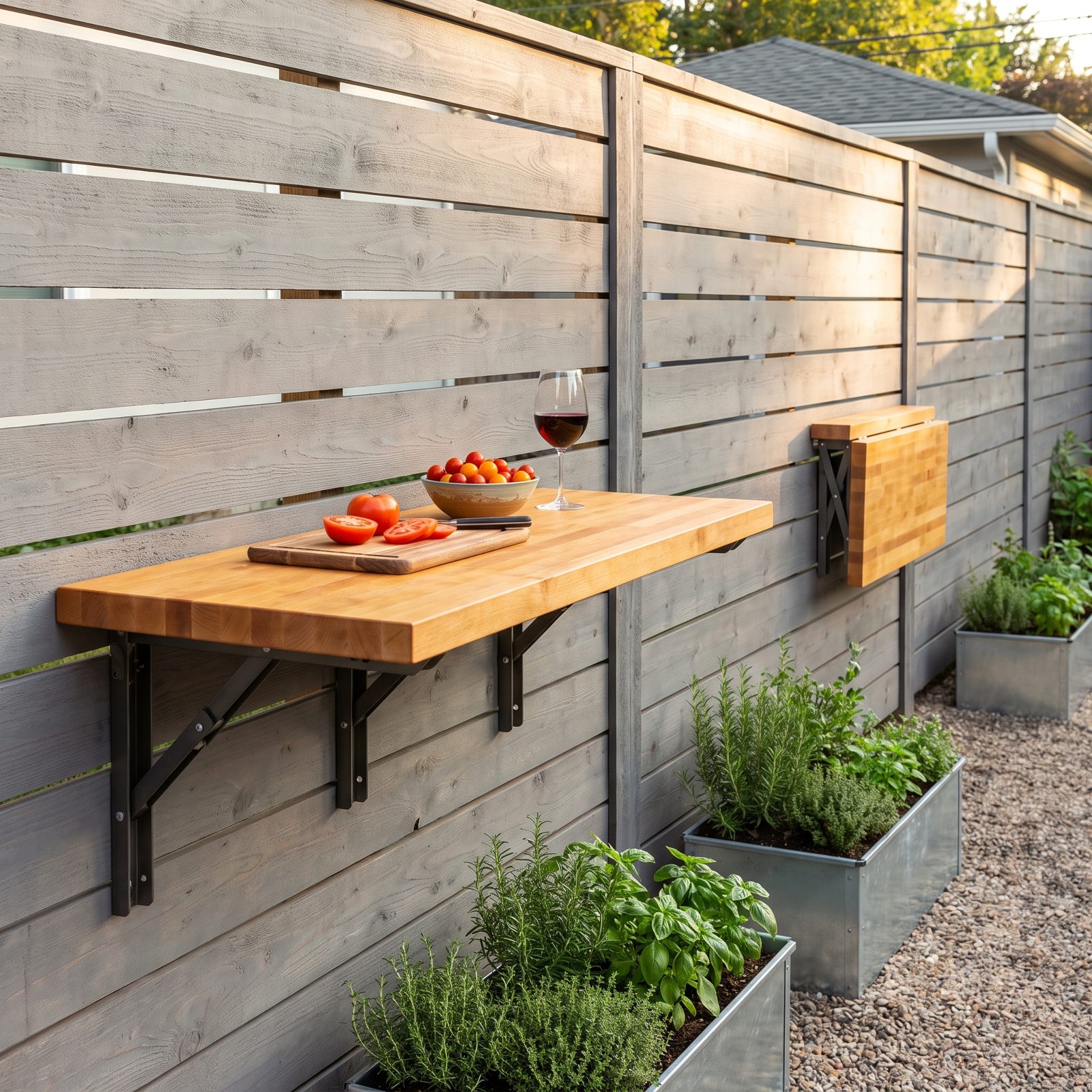
Small yards never have enough surface. You end up balancing drinks on chair arms and chopping on your knees. A fold-down counter solves it for almost nothing: a butcher-block slab on folding brackets, bolted to a sturdy stretch of fence.
Up, it’s a bar, a prep station, somewhere to park the platter. Down, it folds flat against the boards and hands you back the whole footpath. One rule, and it’s non-negotiable: if the brackets go straight onto the fence boards, as here, bolt them right through solid, sound boards with heavy-duty fixings, never into anything split, thin or rotten. Skip that and it’ll tear loose the first time someone leans their weight on it.
18. A Pass-Through Counter Cut Into the Kitchen Wall
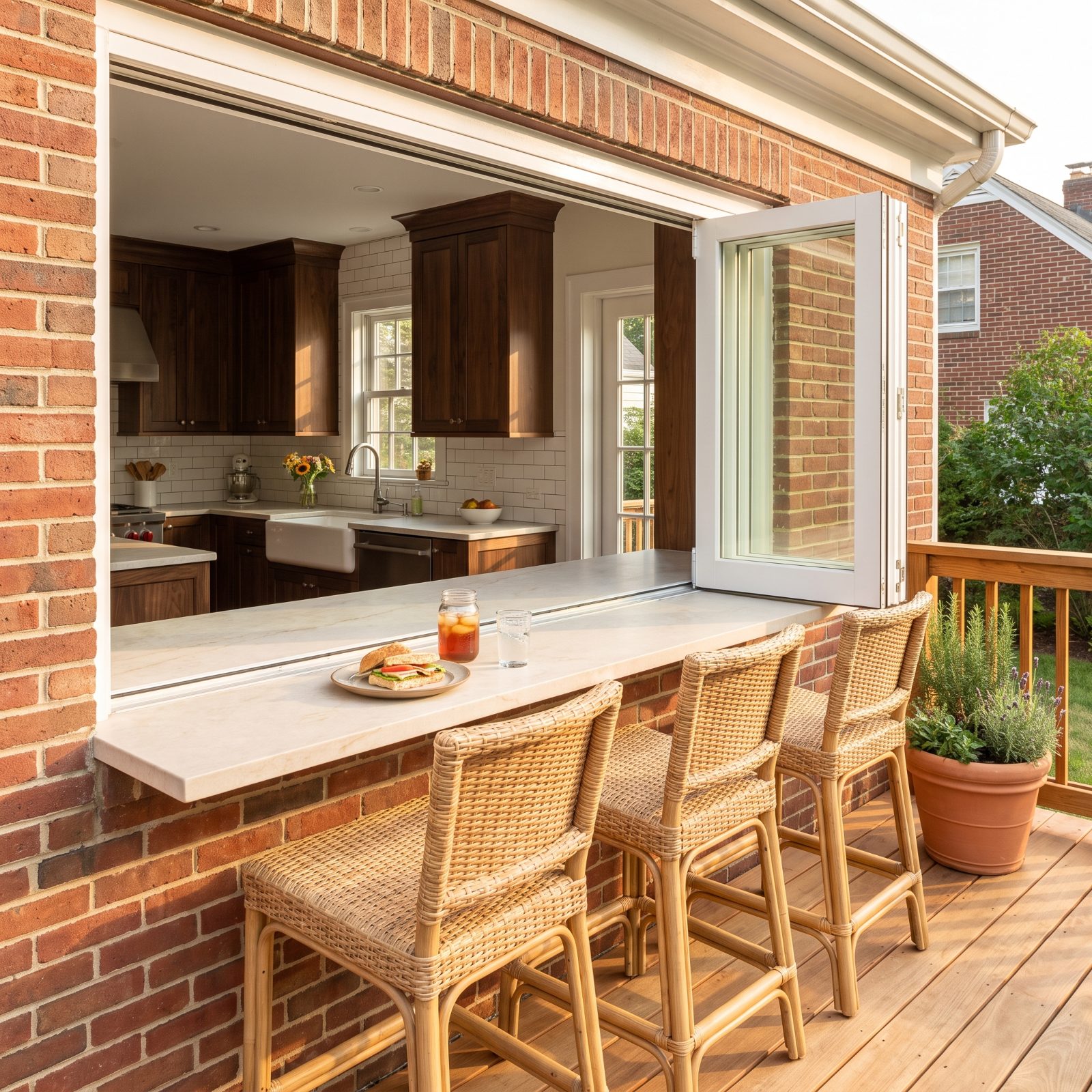
This is the upgrade that changes how a yard gets used. Convert a kitchen window into a pass-through with a deep sill counter, add a few stools outside, and suddenly food travels in one motion instead of a dozen trips through the back door.
No more juggling trays, propping the door with your hip, or discovering the salad got abandoned on the counter inside. The cook stays plugged into everyone outside rather than being banished to the kitchen while the party carries on without them. Yes, it’s real construction, flashing and a header and the whole business. It earns its keep at every single meal from May to October.
17. A Potting Sink That Runs Off the Garden Hose
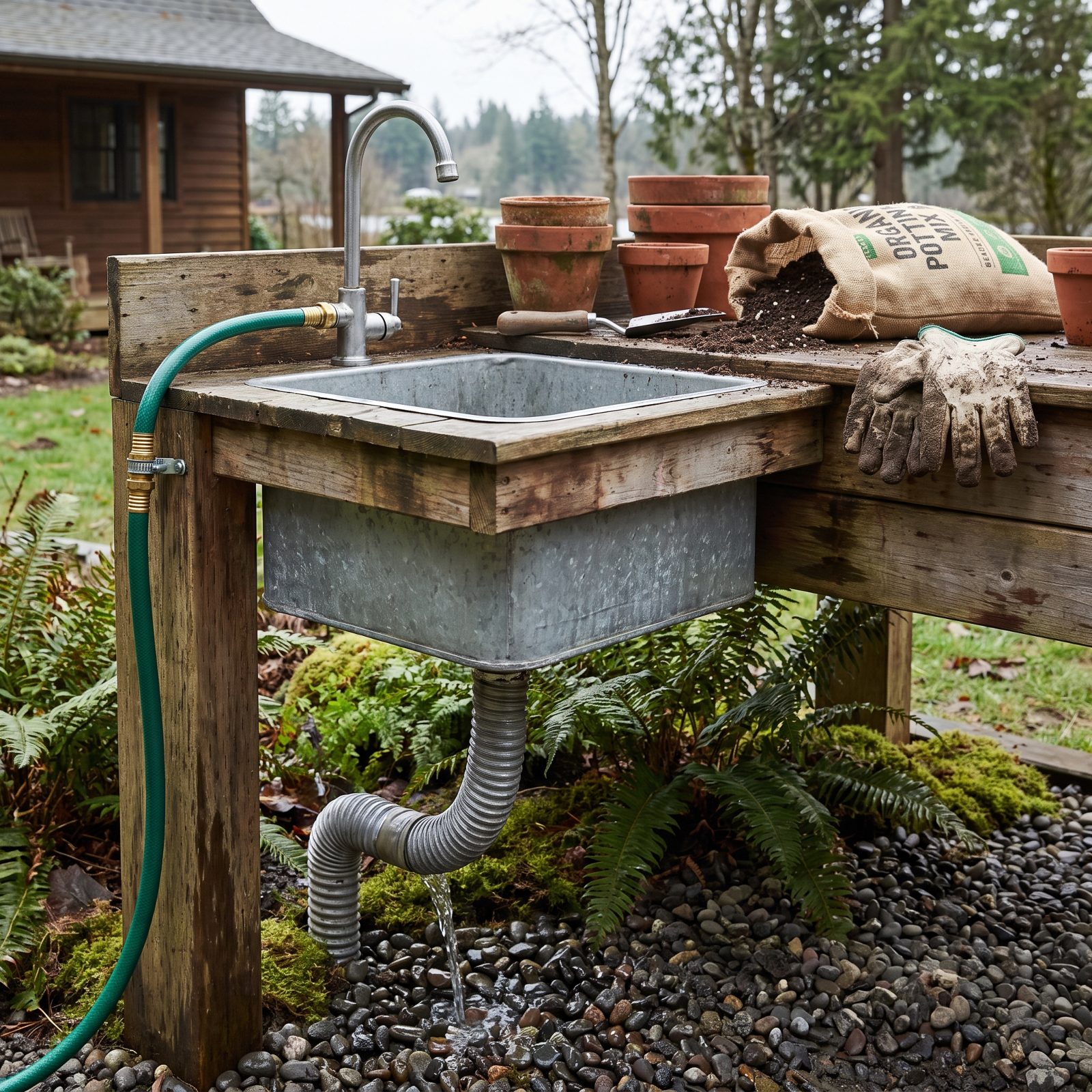
Anyone who gardens knows the routine. Hands caked in soil, mud tracked across the kitchen floor, a rinse at the good sink that the household never fully forgives. A potting sink out by the beds ends that march for good.
No plumbing required. Feed it from the garden hose with a simple faucet, then let the drain empty onto a gravel bed or into a border that could use the water anyway. Rinse roots, fill watering cans, scrub pots, clean tools, all without stepping inside once. It’s rough and practical, and it’s one of the first things that makes a yard feel genuinely worked in rather than merely looked at.
16. A Slide-Out Induction Burner for the Outdoor Counter
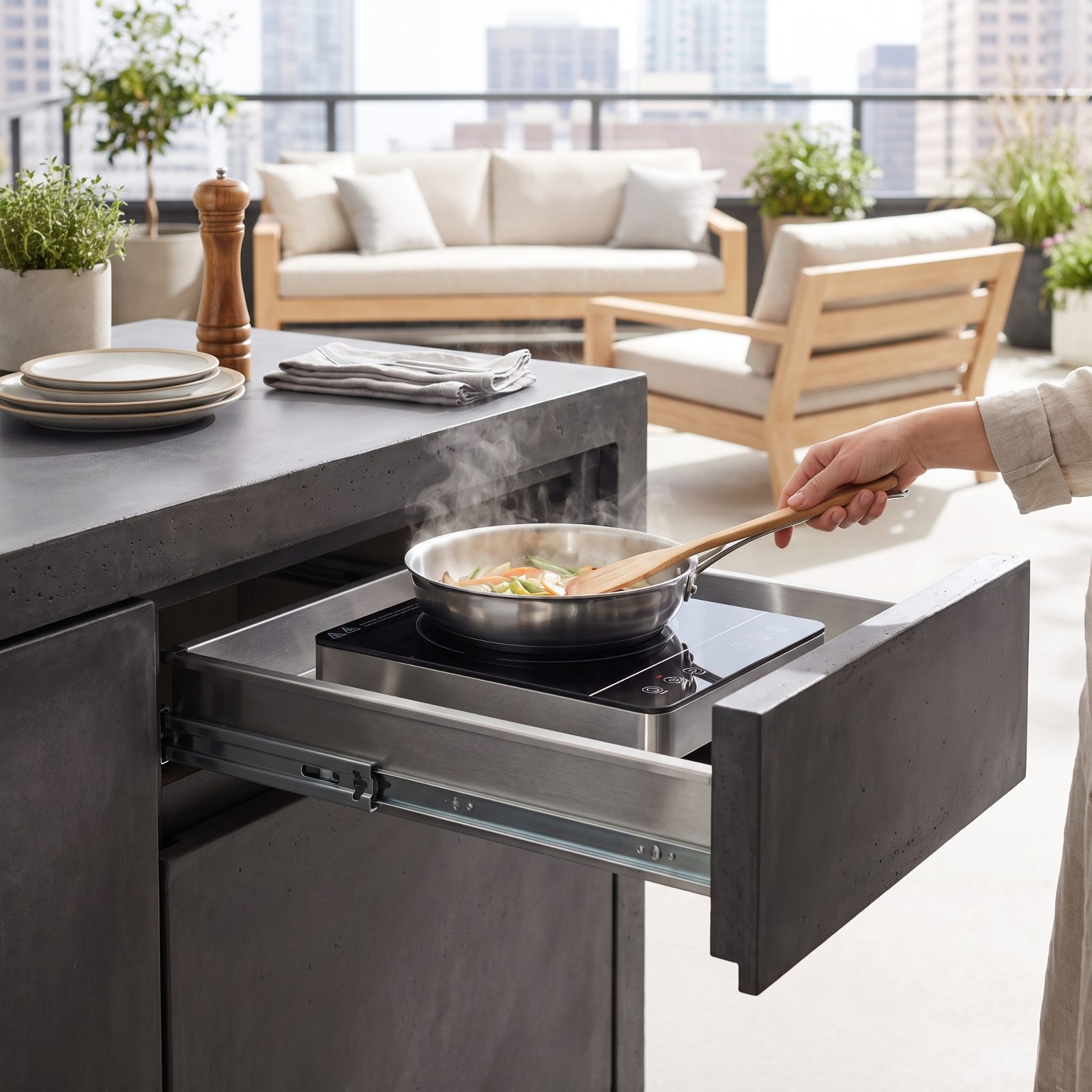
A full built-in gas kitchen outside is a serious project with serious bills behind it. An induction burner on a slide-out drawer gives you most of the function for a fraction of the fuss. It cooks fast, no open flame, and when you’re done it slides back under the counter and disappears.
One catch worth knowing: induction only works with magnetic cookware, so your old aluminum pan won’t light up. Cast iron and most stainless are fine. It needs a weatherproof outlet nearby too, which is cheaper to run than a gas line and a good deal less nerve-wracking.
15. A Weatherproof Outdoor Pantry That Lives by the Grill
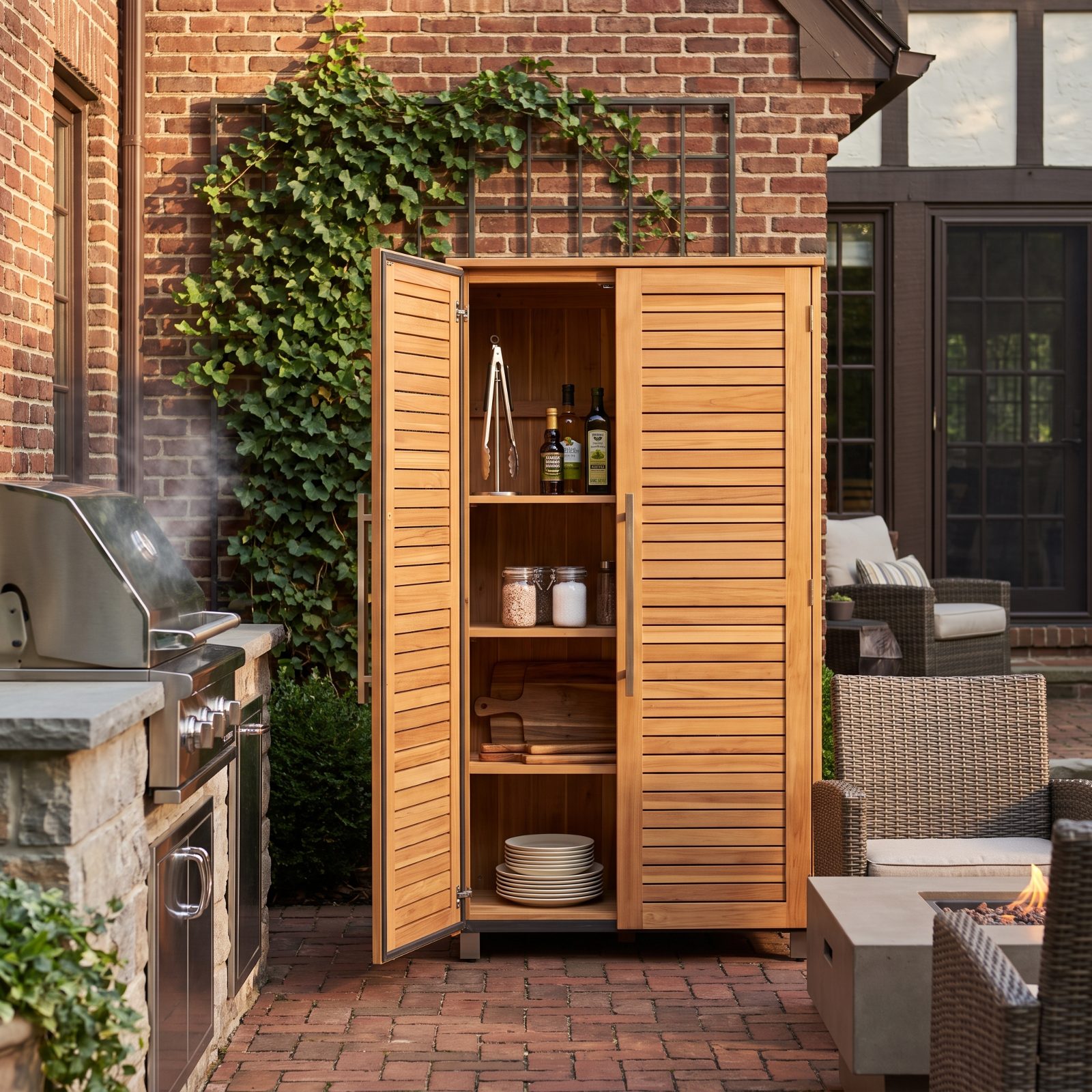
Grilling turns into a relay race the moment you realize the tongs are inside, then the salt, then the platter, then the oil. Every trip in is a trip you stopped watching the food. A weatherproof pantry by the grill keeps everything you reach for out there with you.
Look for weather-resistant hardwood units with louvered, slatted doors that let air circulate. Plenty of pretty cabinets claim to be outdoor-rated, then swell and mildew and warp their way through one wet winter. What separates a real outdoor build from a glorified wardrobe is the airflow, so moisture dries out instead of getting trapped. Pay for the ventilation.
14. The Fold-Open Shed Bar
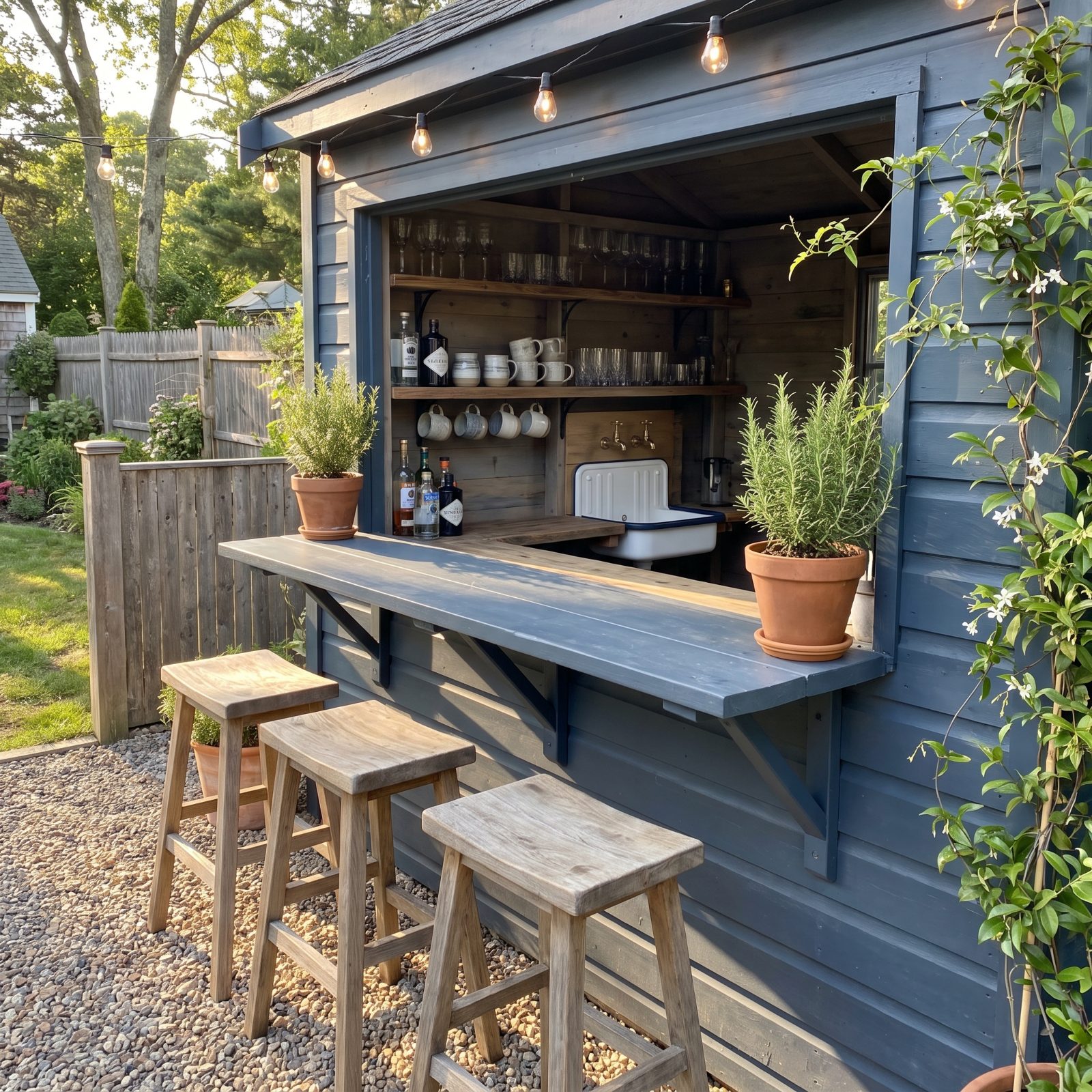
The opening is the whole trick. A wide window is cut into the front of the shed, with a fold-down counter running beneath it on sturdy brackets screwed to the siding, and suddenly your tool storage is a bar that keeps its back to the weather. Rain comes, you wipe the counter down and let the roof overhang shelter the open shelves behind it.
Don’t skip the water. A small wall-mount sink with brass taps, plumbed in from the house, means you can rinse glasses all party long without trekking back to the kitchen. What you’re really buying is the feeling that the garden has a room with a purpose, rather than a shed you apologize for.
13. A Moon Gate Entrance
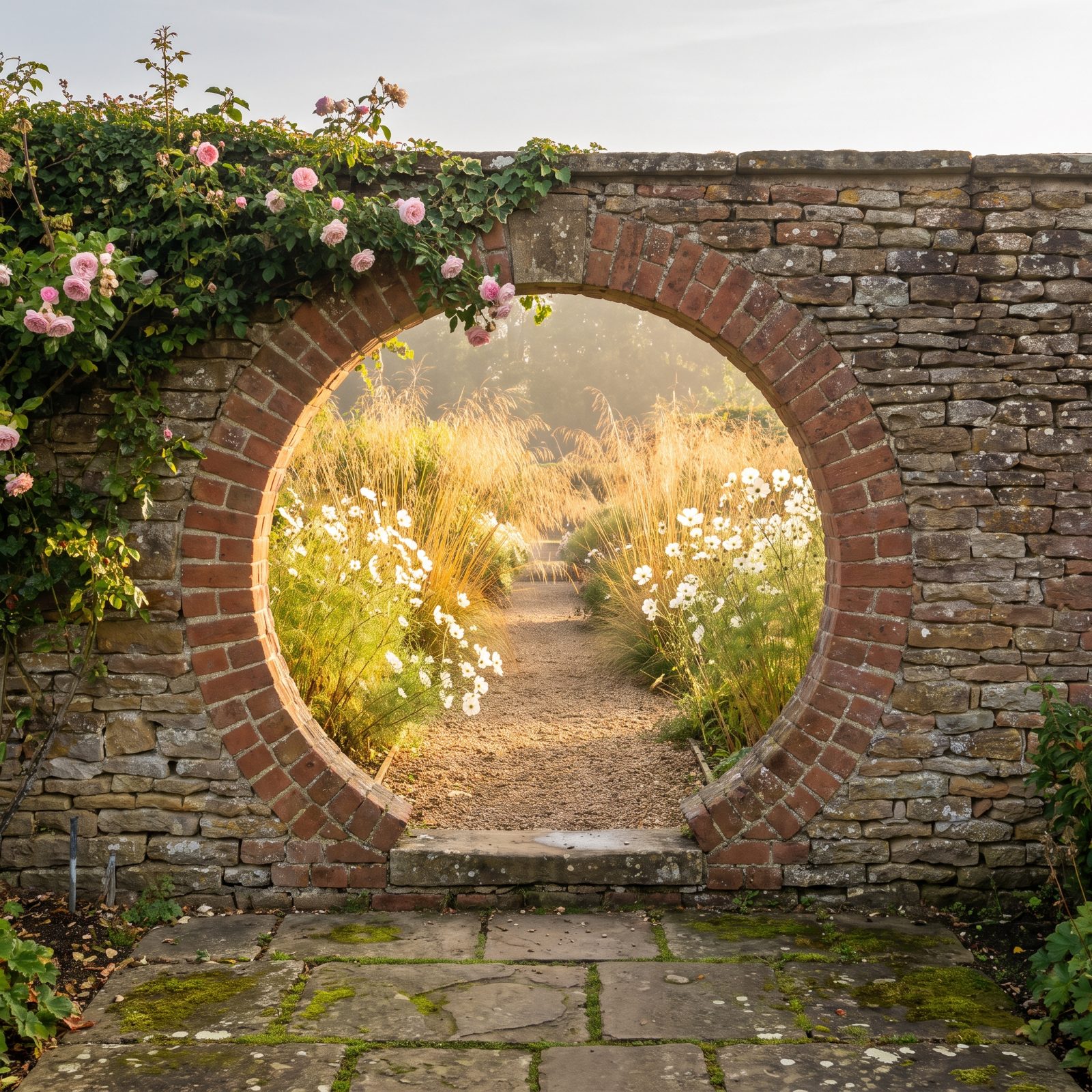
The circle is older than almost anything else in garden design. It was borrowed from Chinese courtyard walls, where a round opening framed the view like a painting you had to walk through. Done well in a backyard, it turns a plain gap in a fence into an event.
Here’s what people get wrong: they build the wall too short, so the sides pinch in and the ground cuts off the bottom of the ring. A moon gate wants to read as a near-perfect circle. Short wall, shrunken circle, lost effect. Build the wall first. Judge the height by eye with a rope before a single brick is cut.
12. A Permeable Paver Rug
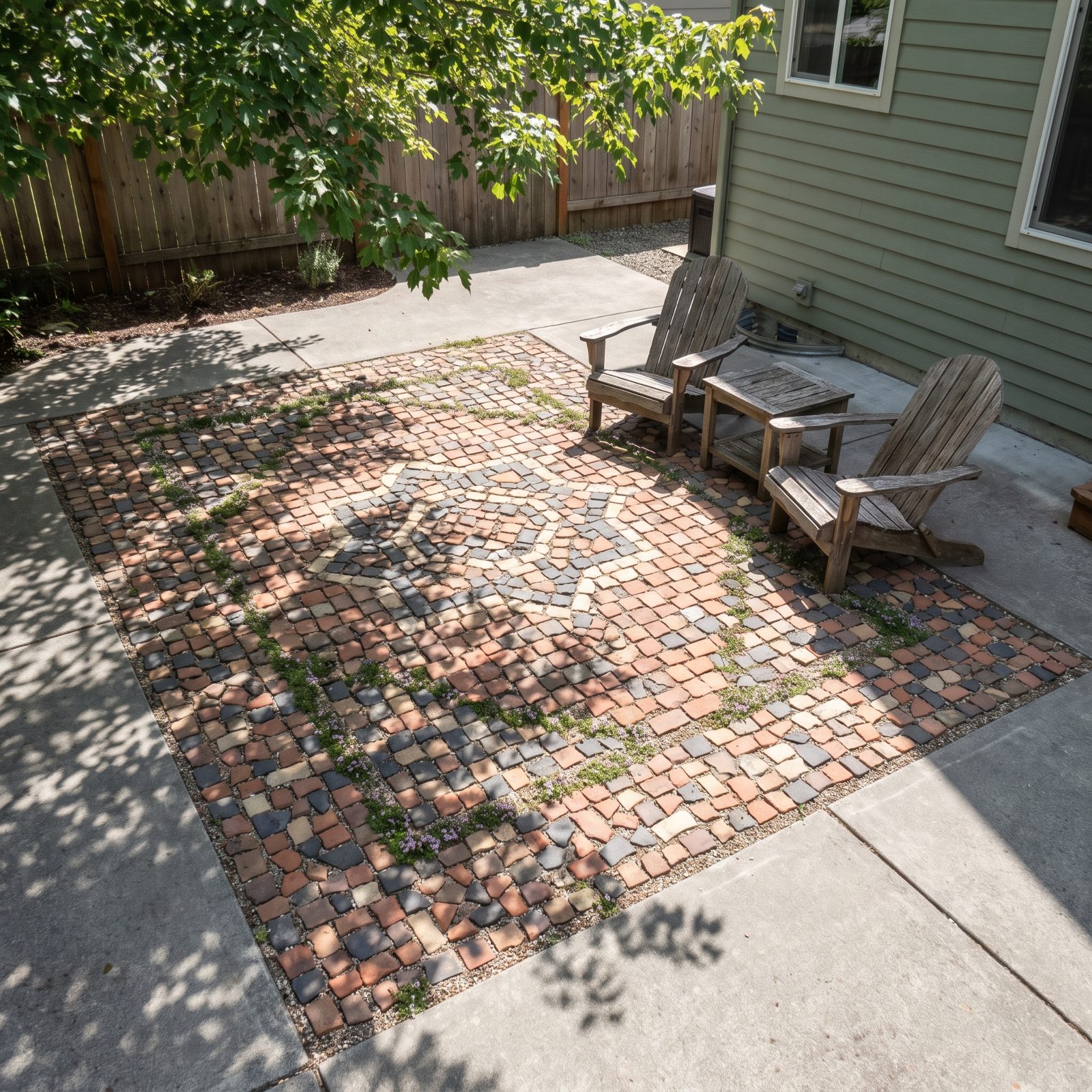
You lay a patterned area of pavers the shape and size of a rug, with gravel-filled joints instead of mortar, right where a furniture grouping goes. Rain runs straight through the joints into the ground rather than sheeting off into the lawn. The seating floats on it the way a sofa floats on a rug indoors.
The room-like read is immediate. Our eyes know what a rug means — this is the sitting area, stay here. And because water drains through, you dodge the permit headaches that come with adding more solid hardscape in towns with runoff rules. Worth checking yours before you start.
11. A Boardwalk Over the Damp Patch

Every garden has one — the low corner that stays soggy a week after rain, where grass sulks and your shoes come back muddy. Fighting it with drainage is expensive and often loses. So stop fighting. Float a boardwalk over it instead.
A simple deck on short posts, a few inches clear of the ground, turns the problem spot into the best path you’ve got. Below, you plant the things that actually want wet feet: ferns, marsh marigold, hostas the size of coffee tables. The bog becomes a feature instead of an apology.
10. A Living Willow Alcove
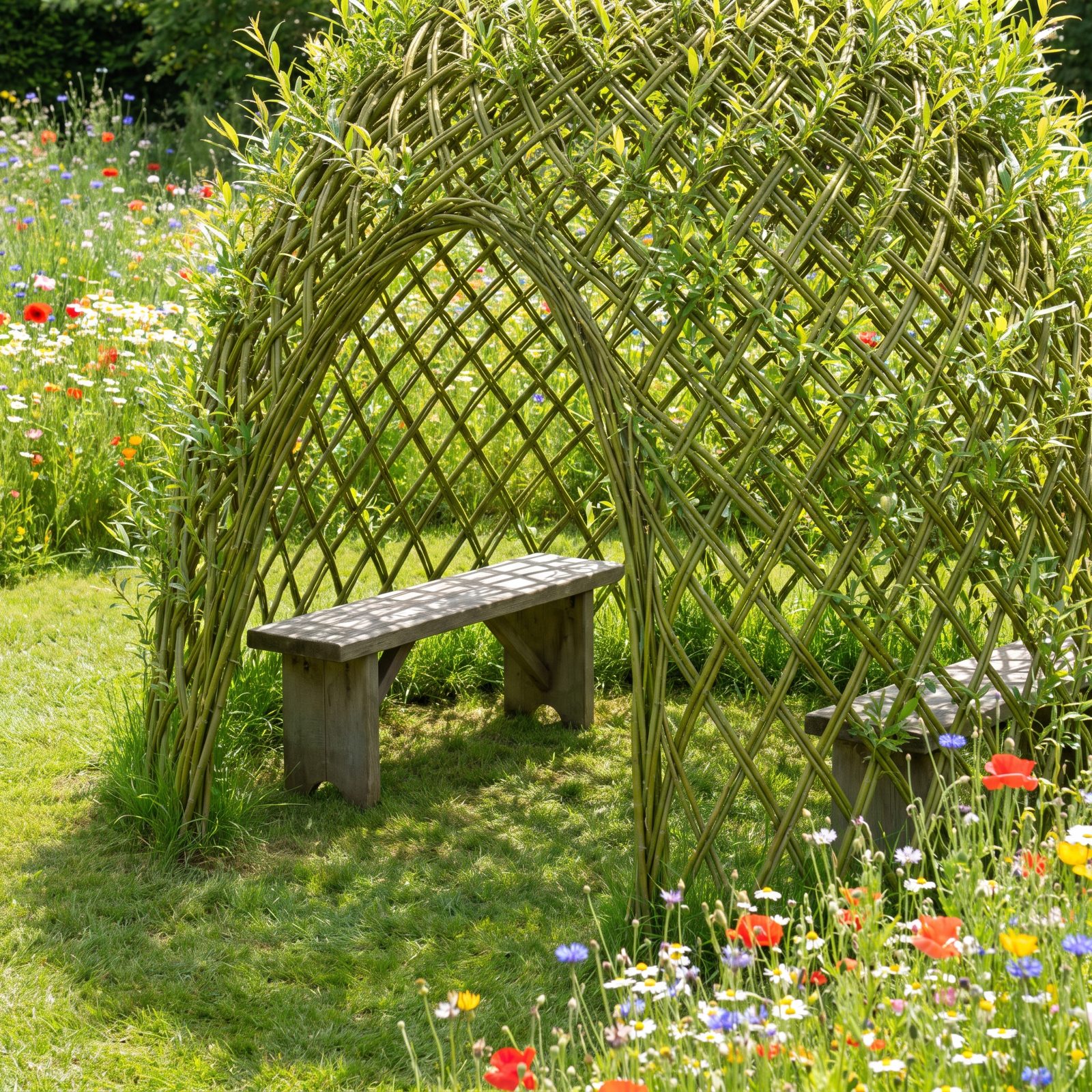
This one’s close to magic, and barely anyone tries it. You bend freshly cut willow rods into an arch or a little alcove, bind them with woven bands, and plant the whole thing into the ground over a bench, right out in the garden among the lawn and wildflowers. The fresh rods take root and keep pushing out leaves. The structure feels alive. Give it a weekend and you’ve got a green room no catalog can sell you.
Fair warning, because willow does exactly what it wants: it springs back and it sheds everywhere. You’ll be tucking in stray rods and re-tightening the woven bands as the willow dries and shrinks, and you don’t want the soil at its base drying out, because thirsty willow cracks and drops leaves with genuine menace. Keep it in a sunny, well-watered spot and it’s one of the cheapest, strangest, most satisfying builds going.
9. A Pleached Tree Ceiling
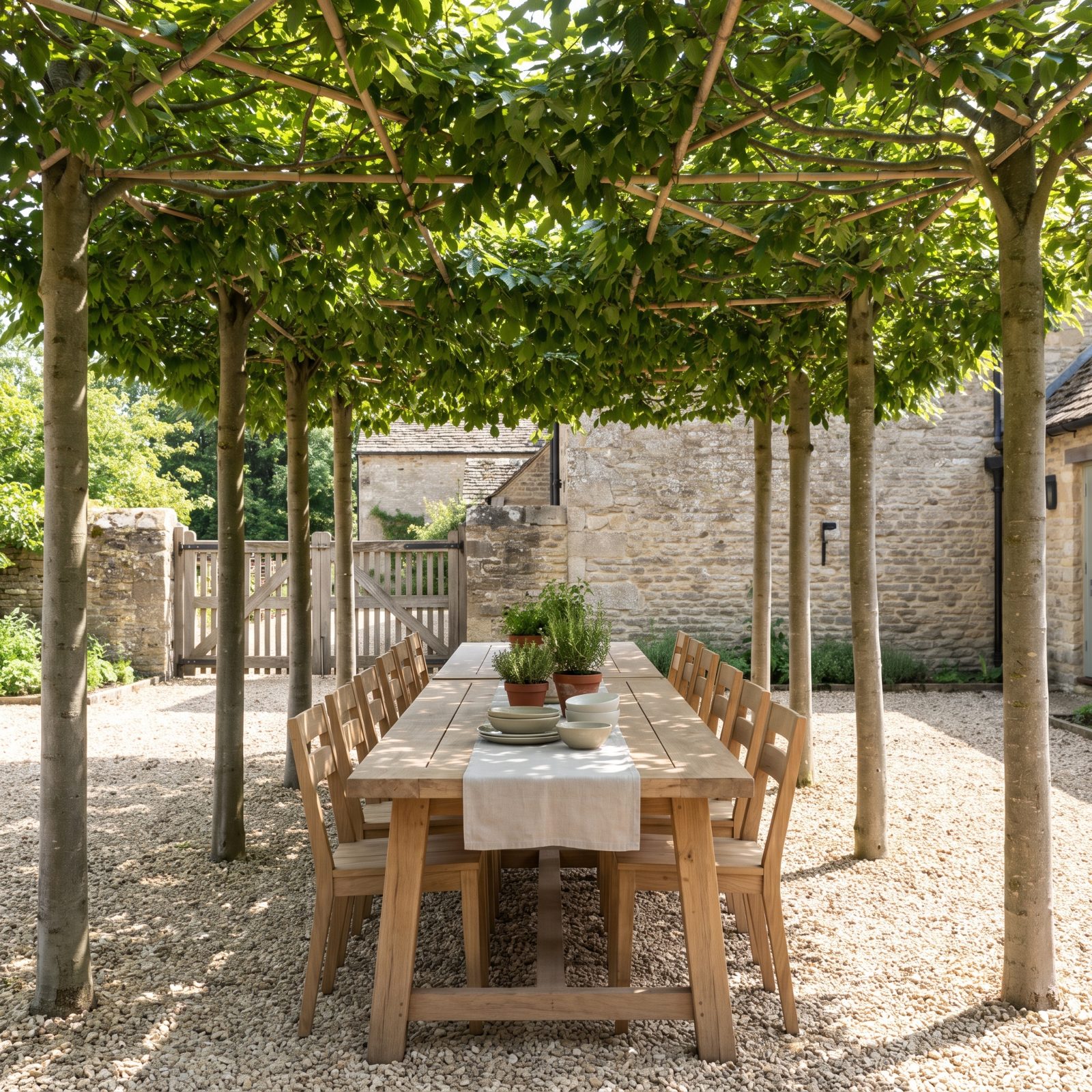
Pleaching sounds fussy. You train a row of trees — hornbeam and lime are the classics — so the upper branches weave together into a flat sheet of leaves held up on bare trunks. Columns, roof, and all, you end up with a literal green ceiling over a terrace.
It takes patience. This is a project that pays off in years, not weeks, and the trees need an annual trim to hold their shape. But a pleached canopy does something no pergola can. It genuinely cools the air underneath on a hot afternoon, filters the light to a soft scatter, and reads as a proper outdoor room the moment you step under it.
A pergola is furniture. A pleached canopy is a building you grew.
8. A Wildlife Pond Beside the Patio

Forget the fish pond with the loud pump. A wildlife pond is a shallow, planted basin with a gently sloping pebble beach on one side, so frogs, birds and dragonflies can get in and out. Set it right against the patio and you’ve added a window of moving light and sound to your sitting area.
Nobody warns you how fast it fills with life. Within a season you’ll have water boatmen rowing across the surface and dragonflies patrolling at eye level while you eat. No chemicals, no fancy filtration — just plants doing the cleaning and a shady corner to hold the algae down.
7. A Narrow Recirculating Rill
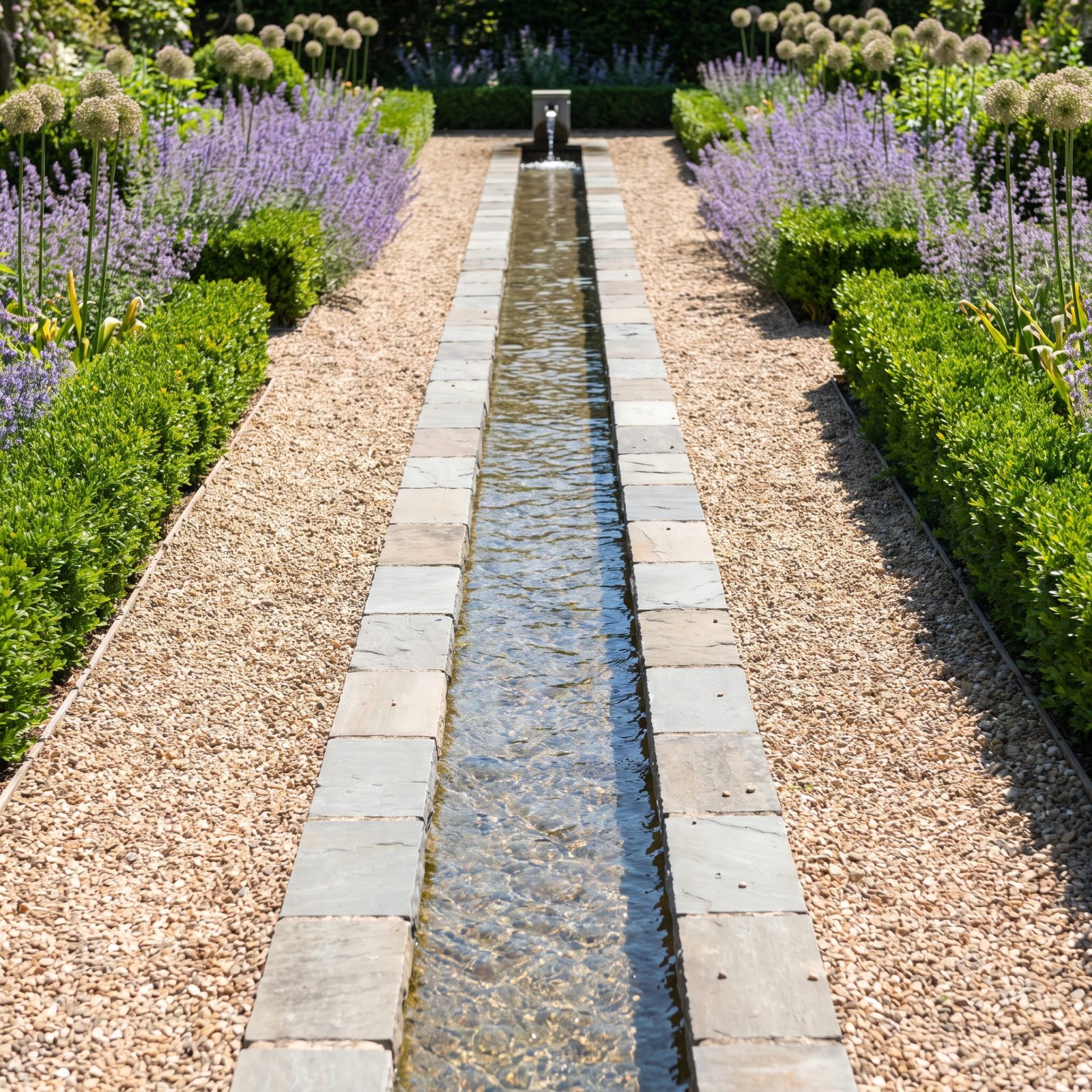
A rill is a shallow channel of moving water, narrow as a gutter, that runs along a path or down the middle of a terrace. A small pump loops it endlessly from one end to the other. And it’s the sound that earns its keep.
Even a trickle masks road noise and a neighbor’s conversation better than you’d expect, because the brain latches onto moving water and stops cataloging the rest. For a feature that takes up almost no footprint, a rill does more to make a backyard feel like a retreat than another square yard of paving ever could.
6. A Stock-Tank Plunge Pool
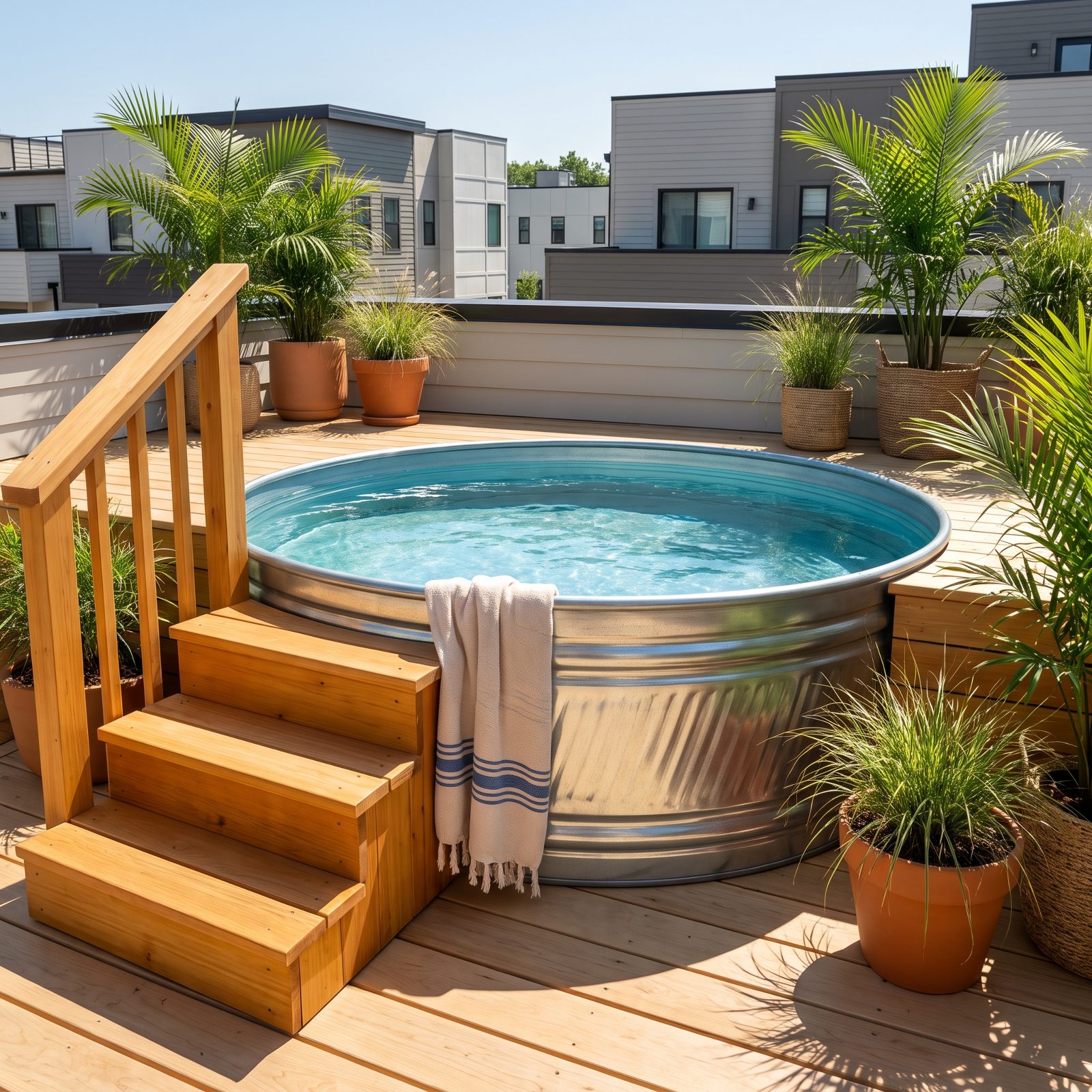
The galvanized stock tank was built to water cattle. Someone realized it also makes a tidy little plunge pool for a fraction of what an in-ground pool costs, and a backyard trend was born — one that actually holds up.
A big round tank, a basic pump and filter, and you’ve got cold water to drop into on a sweltering afternoon. It won’t impress anyone chasing a resort look. It will cool you down for a fraction of the cost of the real thing. Two things to know: galvanized steel gets scorching in full sun, so site it with afternoon shade, and the water still needs tending or it turns into a very large mosquito nursery.
5. A Garden Outdoor Shower
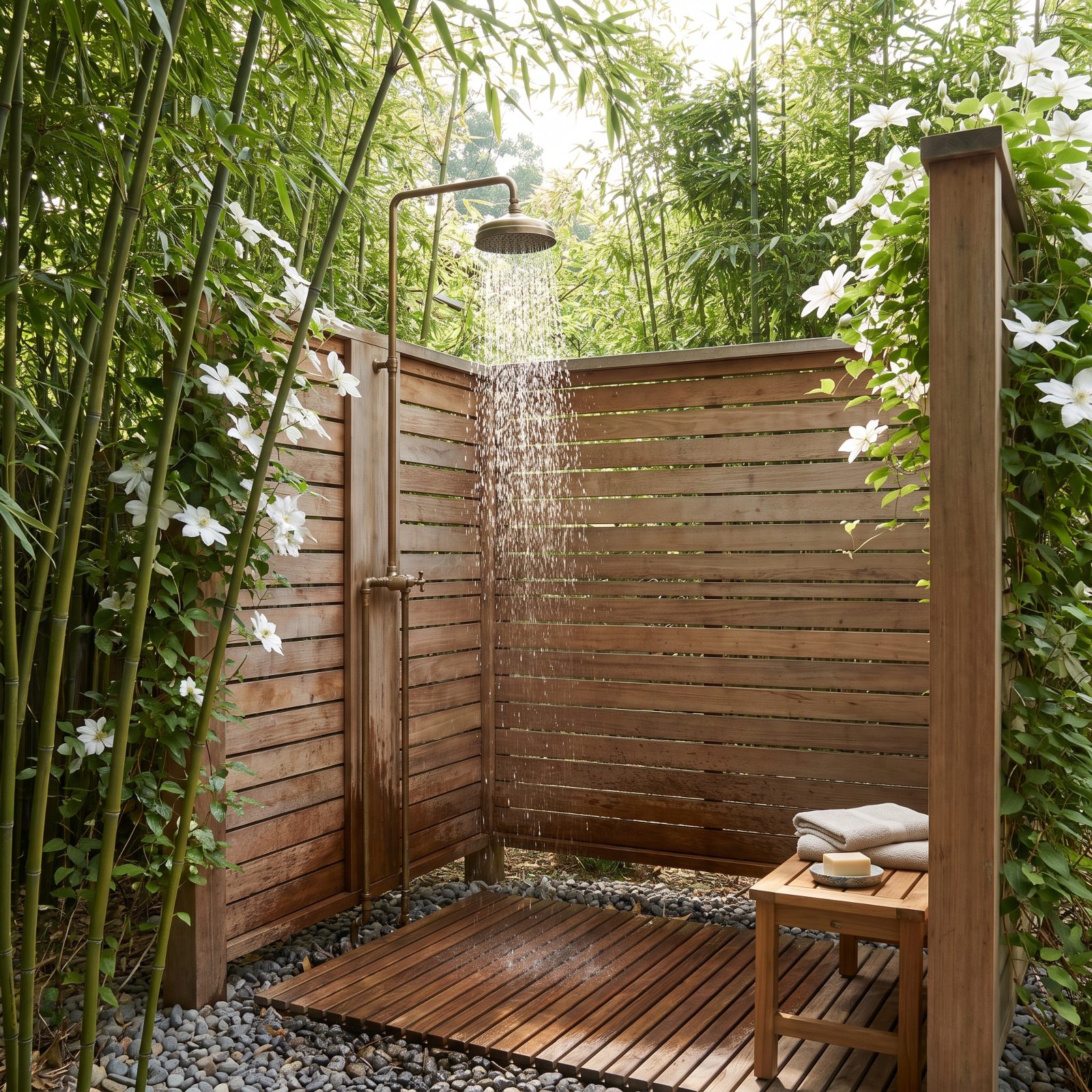
An outdoor shower sounds like a vacation-rental indulgence until you’ve used one after a day of digging. Then it becomes the thing you can’t believe you lived without.
The build is simpler than people fear. A cedar privacy screen, a slatted duckboard floor over gravel so water drains away, and a showerhead fed from a garden hose or a line run off an outside tap. For warm washing you can add a solar bag or tie into the hot supply, but even cold, it rinses off soil and sweat before you track any of it indoors. There’s a plain animal pleasure in standing under open sky with the water running that no bathroom matches, and the garden gets a genuinely useful room out of the deal. Check local rules on where the gray water can drain, then go build it.
4. The Planter That Unrolls Into a Movie Screen
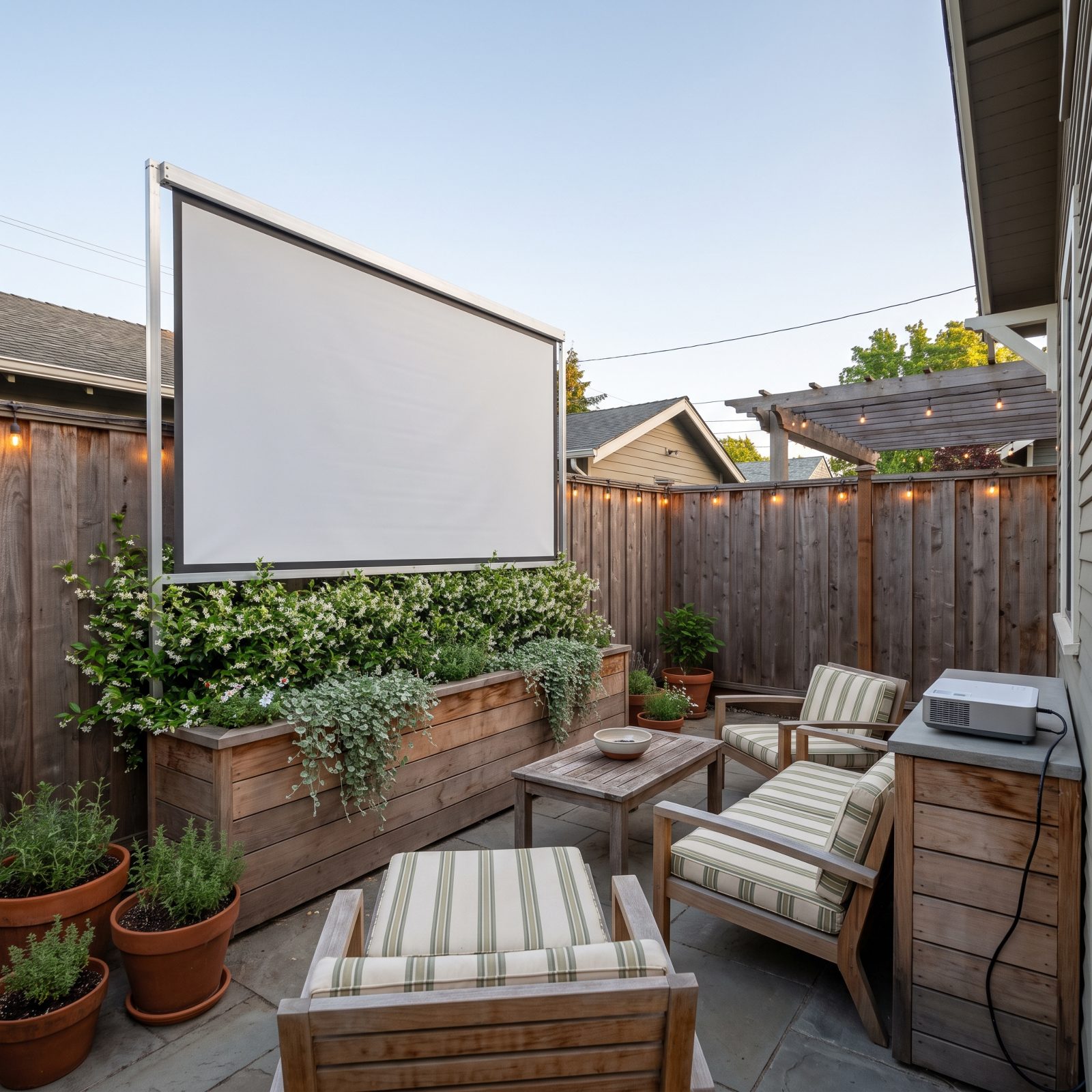
Most people hang a movie screen and then spend the rest of the year pretending the ugly white rectangle isn’t there. This one stands in a planter box. The screen pulls down from a roller case held up on two metal poles when you want it, then retracts back up into the case when you don’t, so the planting does double duty as furniture and as a frame.
Here’s the detail nobody mentions. The plants on top act as ballast and wind break, which keeps a lightweight screen from flapping like a sail on a breezy night. Pick a short-throw projector so nobody casts a shadow walking to the cooler.
3. A Weatherproof Garden Library Built Into the Fence
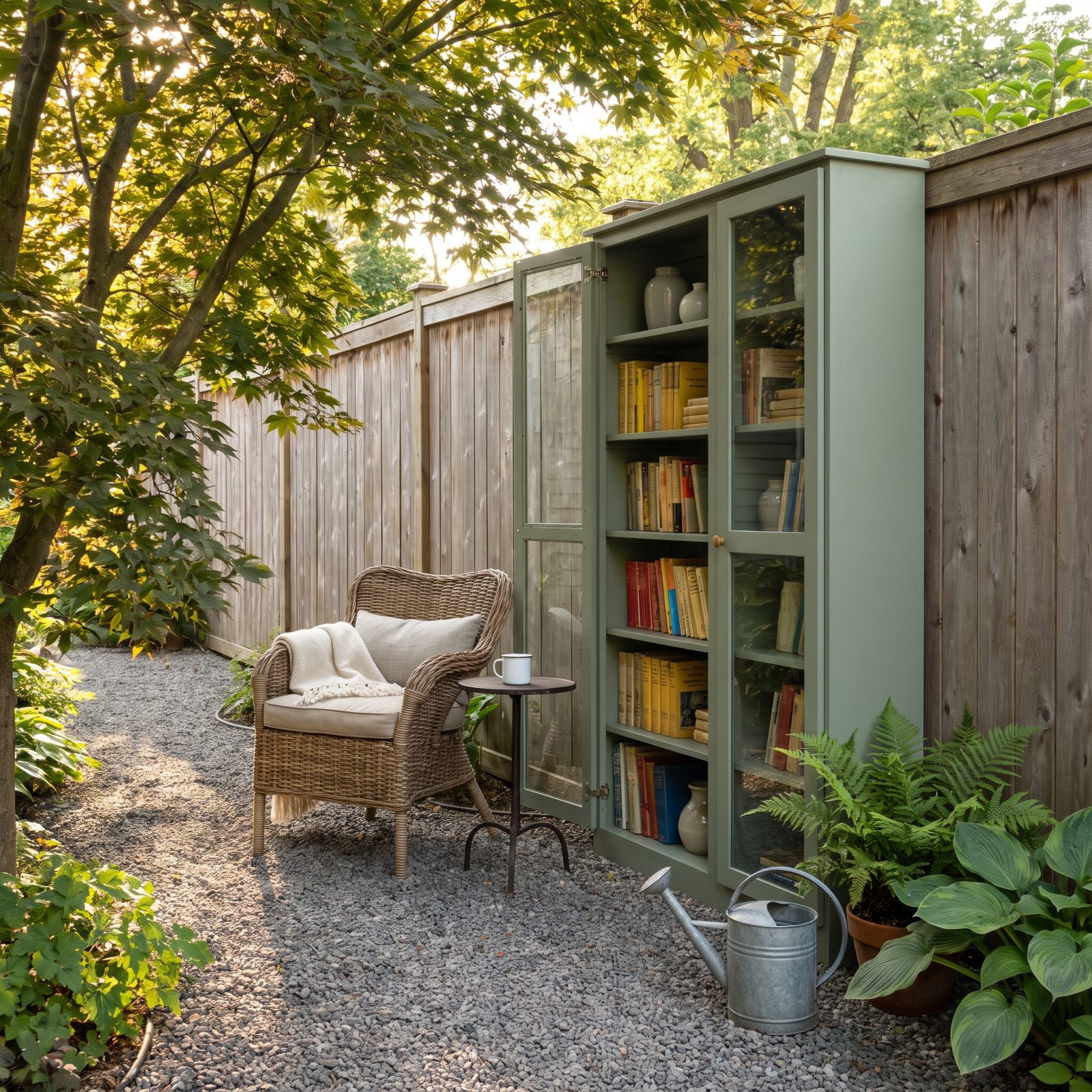
Books outdoors sounds like a recipe for mildew and sun-bleached spines, and left on an open shelf, it is. The fix is a sealed cabinet with glass doors and a rubber gasket, the kind built to keep moisture out. Set it in a shaded corner of the fence and suddenly the yard has a reading room.
Fill it with paperbacks you’d happily lose. Field guides earn their place too, because the answer to whatever just landed on the butterfly bush is now three steps away instead of back inside the house. Humidity is the real enemy here, not rain, so a couple of silica packs on the bottom shelf do more than they look like they should.
2. Tall Planters on Casters That Rearrange the Whole Yard
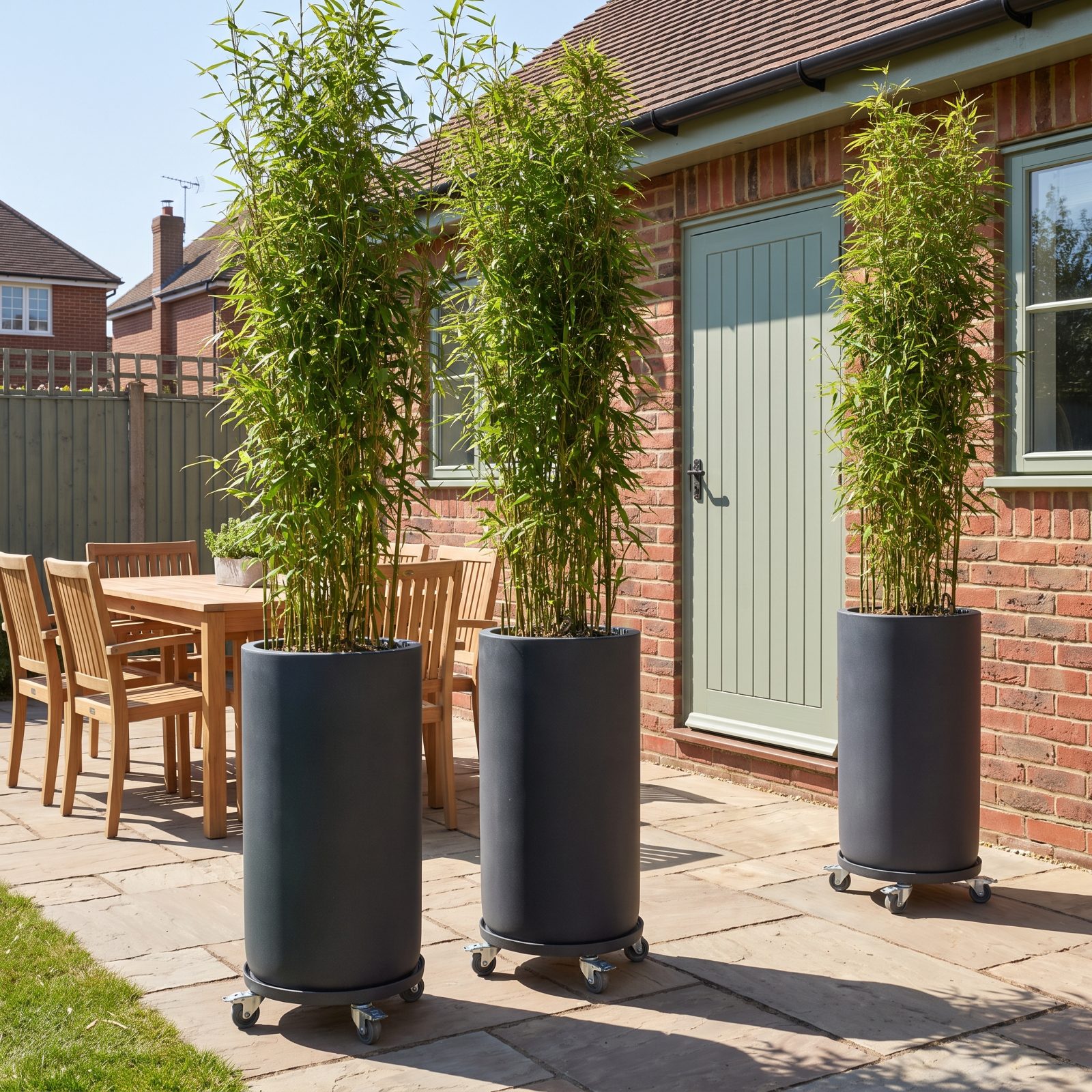
A six-foot bamboo in a pot weighs a ridiculous amount once the soil is wet. Which is exactly why most people plant their privacy screens in the ground, then regret the placement for a decade. Casters solve this.
Put tall planters on heavy-duty locking wheels and your yard gets a set of movable walls. Roll them together to block a neighbor’s new deck. Spread them out for a party, chase the sun in spring and the shade in August. The plants that hate your afternoon glare can simply leave.
1. A Dining Border That Only Wakes Up After Dark
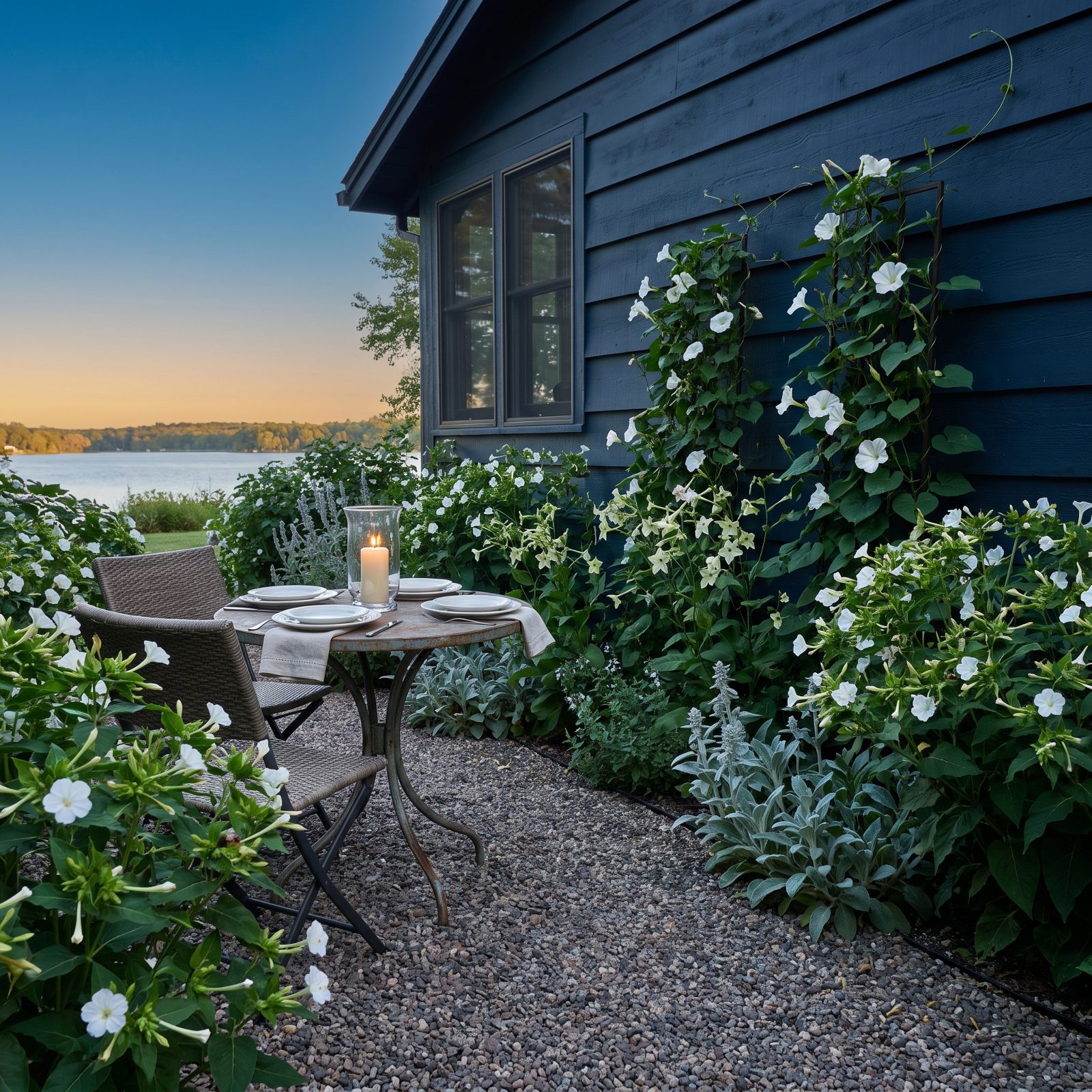
Daytime gardeners miss something entirely. Most of us actually sit outside after work, when the beds we fussed over all season have gone gray and invisible. So plant for the hour you’re actually there.
A border of night-bloomers around the dining table flips the whole math. Moonflower, white four o’clocks, flowering tobacco and evening primrose stay shut in the glare, then open at dusk, pale enough to read in low light and heavily scented right when you’ve sat down. Moonflower perfume will stop a conversation mid-sentence. Add silver-leaved lamb’s ear along the front edge and the foliage picks up candlelight, glowing without a single bloom.