
Twelve muffins, seven ingredients, two minutes of beating and twenty minutes in the oven. That is the whole recipe, printed in New York in 1917 by authors who never stopped to explain where the rise would come from. They didn’t need to, and the reason they didn’t is a story about chemistry, bribery and the end of waiting all night for bread.
Please note that some of the images in this article were created with the assistance of AI.
From A Thousand Ways to Please a Husband with Bettina’s Best Recipes, 1917
The Story Behind This Recipe
A big promise and a short recipe
The book’s title promises a lot: A Thousand Ways to Please a Husband with Bettina’s Best Recipes. Louise Bennett Weaver and Helen Cowles LeCron wrote it, and the Britton Publishing Company of New York brought it out in 1917. The text we have comes from an A. L. Burt printing of the same book.
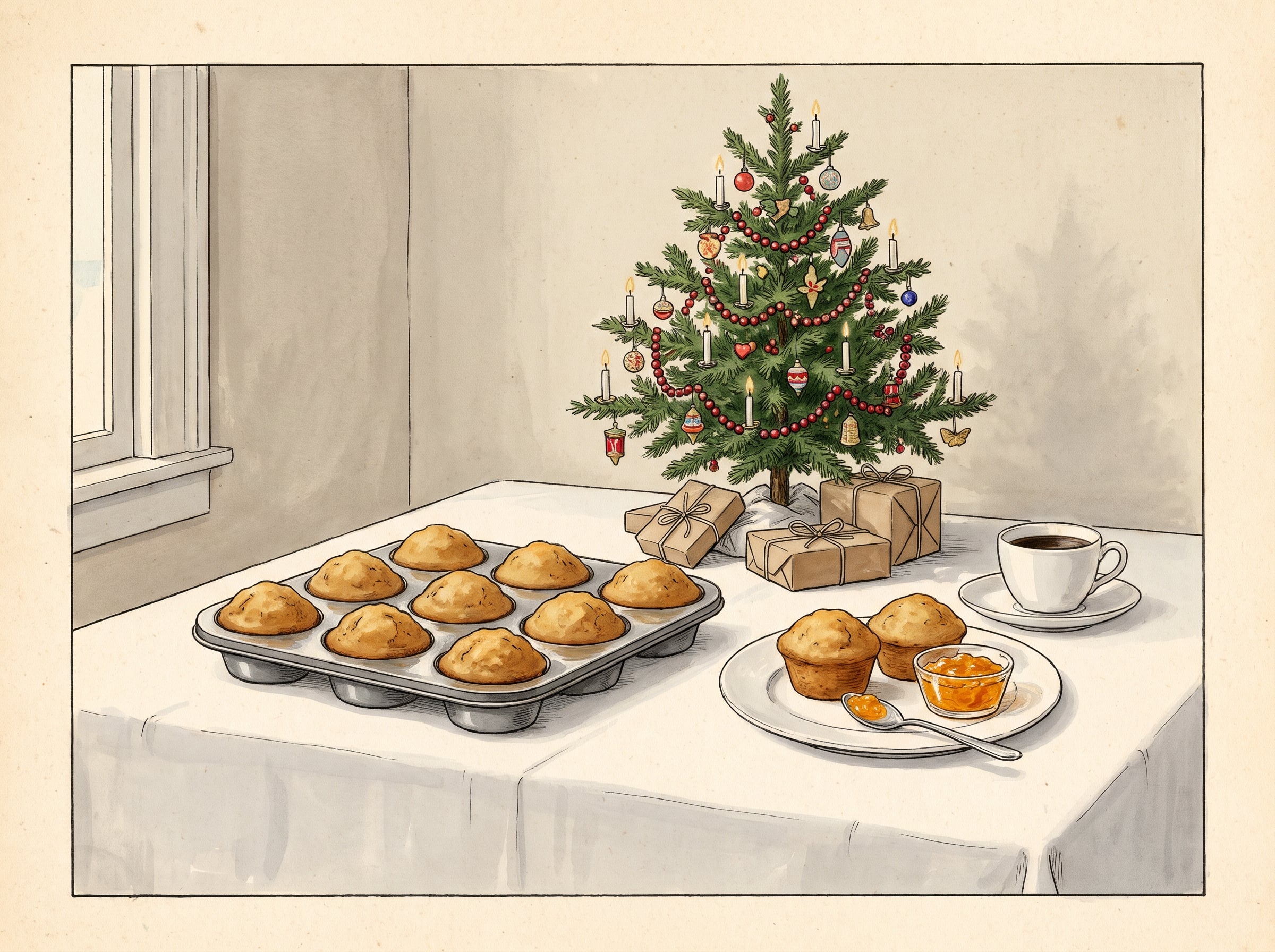
The recipe sits in a chapter called "A Christmas Breakfast." Bettina sets a tiny Christmas tree in the middle of a nine o’clock family breakfast table, with the gifts grouped around its base, and serves grapefruit with maraschino cherries, oatmeal and dates with whipped cream, ham cooked with milk, creamed potatoes, waffles with maple syrup, and these muffins with orange marmalade.
Among those thousand ways, this one is about as brisk as it gets. The measures are clipped to shorthand, "2 C-flour" and "4 t-baking powder," as if the cook were reading over the authors’ shoulders. There is no yeast, no sour milk and no overnight rest. You stir the dry things together, beat in an egg and a cup of milk, add a little melted butter and fill the pans halfway. That plainness is the interesting part, because it rests on an ingredient that had only recently become ordinary.
Two muffins, one name
The older English muffin is something quite different: a yeast-raised round cooked on a griddle. One food-history reference suggests that kind may go back to Wales in the 10th or 11th century. The American muffin took another route. It is a quick bread, made from a batter and baked in individual molds.
That route began at the end of the 18th century, when American cooks started raising batters with pearlash, a refined potash that releases carbon dioxide in dough. Amelia Simmons printed pearlash recipes in American Cookery in 1796. Commercial baking powder took until the 1850s to arrive. Our 1917 muffin comes straight from that American line: a batter, a pan and a rise that comes from a can.
The can that changed breakfast
Consider the alternative. A Smithsonian food historian describes yeast doughs that needed upwards of 12 hours to rise, and often nearer 24. Pearlash was hard to make, caustic and frequently smelly. Baking soda appeared in 1846, but it needed an acid, usually sour milk, and since nobody could say exactly how sour a given jug was, every batch was a small gamble. In 1856 the chemist Eben Norton Horsford patented the first modern baking powder. He later packed the acid and the soda into one container, with cornstarch to keep them dry, and sold it as Rumford.
Then the fight started. Royal made its powder with cream of tartar, and Calumet and Clabber Girl used alum, which was cheaper and stronger. Royal advertised its purity, and in 1899 it bribed the Missouri legislature into banning alum powders. When press coverage of the scandal spread, the state’s lieutenant governor had to resign. Price wars went on well into the next century. Meanwhile, family recipes still assumed acid and soda, so the powder companies printed their own cookbooks to teach the new method. By 1917, a recipe could simply say "4 t-baking powder" and move on. That one line tells us the new method had won.
1910s
Notes From the Era
The recipe · 1917
Muffins
From A Thousand Ways to Please a Husband with Bettina’s Best Recipes by Louise Bennett Weaver and Helen Cowles LeCron (1917). Every word of the recipe below is as printed.
Ingredients
- 2 C-flour
- 4 t-baking powder
- 1/3 C-sugar
- 1/2 t-salt
- 1 egg
- 1 C-milk
- 2 t-melted butter
Method
-
Mix the dry ingredients
Mix the flour, baking powder, sugar and salt.
-
Add egg and milk and beat
Add the egg, beaten, and milk, and beat two minutes.
-
Add the butter
Add the melted butter.
-
Fill the pans
Fill well-buttered muffin pans one-half full.
-
Bake
Bake twenty minutes in a moderate oven.
Our notes
Reading It Today
C and t. The capital C is a cup and the lowercase t is a teaspoon. The same t sits beside the baking powder, the salt and the butter, so as printed the butter comes to two teaspoons, not two tablespoons.
A moderate oven. The recipe gives no temperature, only "a moderate oven," so the cook had to judge the heat herself.
Lean and lightly sweet. Two cups of flour get only a third of a cup of sugar, one egg and two teaspoons of butter. From those amounts we would expect a plain, bread-like muffin with a mild flavor, closer to something you split and butter than to a cake.
Half-full cups. Filling the cups only half full leaves room for the baking powder to lift the batter. That suggests modest, neat muffins rather than tall, domed ones.
Source: Louise Bennett Weaver and Helen Cowles LeCron, A Thousand Ways to Please a Husband with Bettina’s Best Recipes (Britton Publishing Company, New York, 1917). Read the 1917 book at Project Gutenberg.
Sources for the history
- A Thousand Ways to Please a Husband with Bettina’s Best Recipes (Weaver & LeCron, Britton Publishing Company, 1917; Project Gutenberg text of the A. L. Burt printing), recipe text as printed
- Muffins, Origin and History (FoodReference.com)
- The Great Uprising: How a Powder Revolutionized Baking (Smithsonian Magazine)
- From the Homestead Kitchen: The "Rise" of Baking Powder and the History of Quick Breads (Homestead Museum Blog)
The original recipe text is from a work published in 1917 and is in the public domain in the United States. The history, notes and illustrations are Digstalk’s own. Brand names that appear in historic recipes are mentioned as historical fact only. Illustrations are AI-generated in a vintage style. The recipe is shown exactly as it was published in 1917; we have not photographed a test batch.