In 1920 a Philadelphia cookbook explained how to make sticky buns without a single egg or a pat of butter. The recipe gives the temperature of the milk to the exact degree, then sends the pan into "a moderate oven" with no number at all. Those small quirks say a good deal about how a city kitchen ran a century ago.
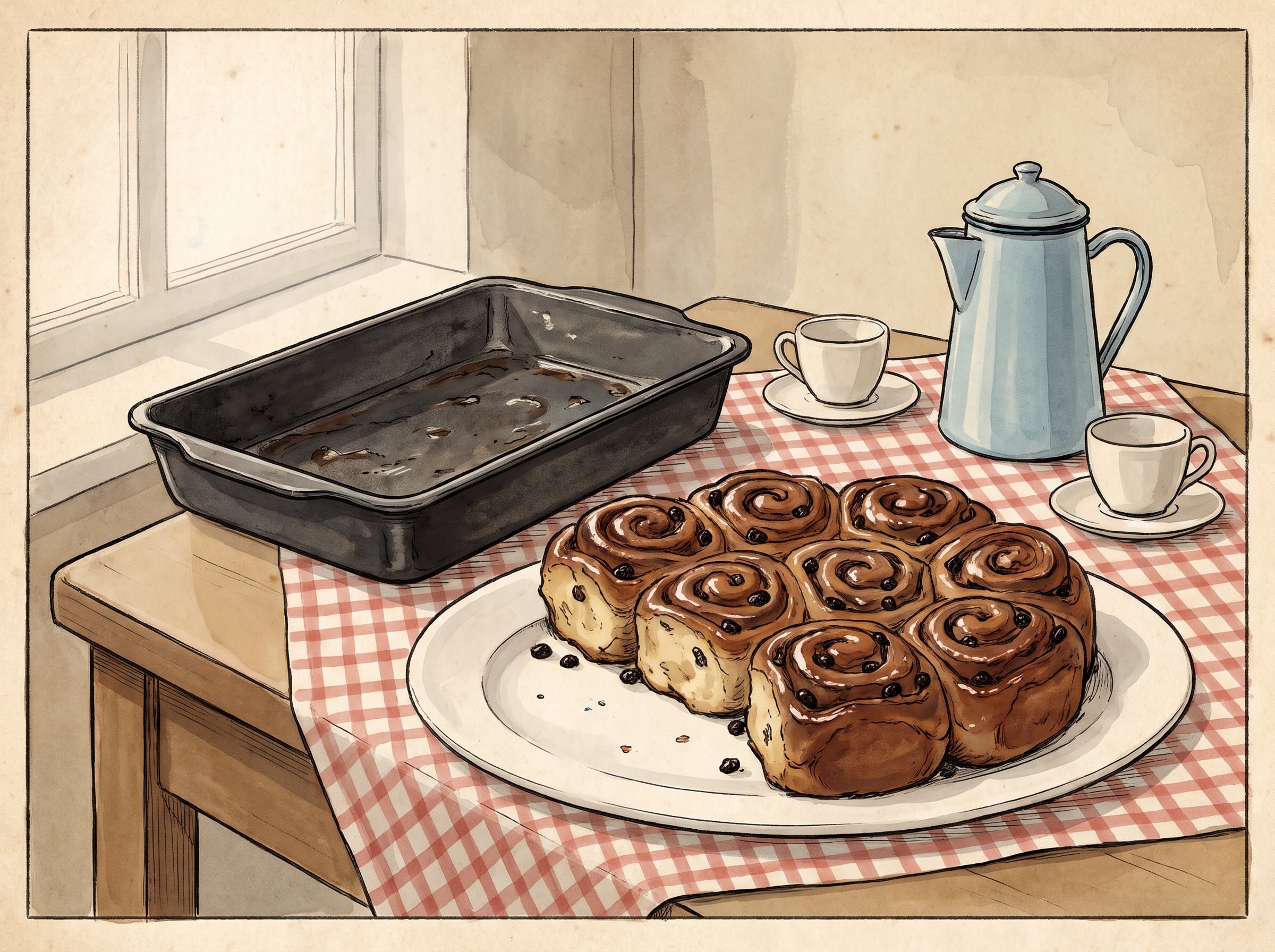
Please note that some of the images in this article were created with the assistance of AI.
From Mrs. Wilson’s Cook Book, 1920
The Story Behind This Recipe
Mrs. Wilson of Philadelphia
On January 9, 1920, readers of the Evening Public Ledger’s women’s page found six rules for thrifty shopping, and one of them asked them to go easy on eggs and butter. The advice came from Mrs. M. A. Wilson, who answered kitchen questions for the paper and printed menus and recipes for homemakers. Anyone with a cooking problem could write to her. Her column shared the page with short stories, reader advice and fashion notes.
That same year, J. B. Lippincott Company of Philadelphia published Mrs. Wilson’s Cook Book, by Mary A. Wilson. The name, the city and the year all match, and it is tempting to call them one woman. The sources we read never quite say so, though, and we would rather not claim more than we know. What we can say is that the cookbook’s sticky buns read as if someone had taken the columnist’s shopping rules to heart.
From Schnecken to sticky buns
The sticky bun spoke German first. It began as Schnecken, and the Pennsylvania Dutch brought it to the United States, which is why the bun has long been tied to Pennsylvania. The classic method has a bit of kitchen theater to it. The baker lines the pan with something sticky, usually brown sugar or honey and often nuts and raisins, sets the rolled and sliced dough on top, bakes it, and turns the whole thing out so the coating becomes a glossy topping.
Mrs. Wilson follows the first act closely. She greases her pan "very thickly with shortening," scatters a cup of brown sugar and half a cup of currants or small seedless raisins across the bottom, and nests the slices in it. The filling is the familiar swirl of melted shortening, brown sugar, two teaspoons of cinnamon and more currants, all rolled up "like a jelly-roll." The final flip, however, never appears in her text.
A thrifty bun with a slow rise
Run down the ingredient list and two things are missing. The dough gets its richness from milk and four tablespoons of shortening, with no butter and no eggs, both of which were costly in 1920. Mrs. Wilson’s cheese sauce from that year leaves out the butter too. Here the sweetness comes from brown sugar and dried fruit, so a household on a budget could still bring a sticky pan of buns to the table.
The yeast has its own story. "One-half yeast cake" meant half a cake of fresh, compressed yeast, wrapped in foil much like a bouillon cube. Charles Fleischmann helped build that trade, and Fleischmann’s promoted the cakes as a health food in a heavily advertised "Yeast for Health" campaign. Half a cake is a modest amount for six cups of flour, which likely explains the three-and-a-half-hour first rise. Mrs. Wilson brings both the milk and the yeast water to 80 degrees to keep the yeast working at a steady pace. Yet she leaves the oven at "moderate," and even early gas and electric ovens often had dials marked only low, medium and high. She also gives two baking times, forty minutes and thirty-five, so the cook’s eye had the final say.
1920s
Notes From the Era
The recipe · 1920
Sticky Cinnamon Buns
From Mrs. Wilson’s Cook Book by Mary A. Wilson (1920). Every word of the recipe below is as printed.
Ingredients
- one cup of milk
- Four tablespoonfuls of shortening
- One-half cupful of sugar
- One teaspoonful of salt
- one-half yeast cake
- one-half cupful of water 80 degrees Fahrenheit
- six cupfuls of flour
- melted shortening
- brown sugar, using about one cupful
- two teaspoonfuls of cinnamon
- one and one-half cupfuls of currants or small seedless raisins
- shortening
- one cupful brown sugar
- one-half cupful of currants or small seedless raisins
Method
-
Scald the milk and cool
Scald one cup of milk and then place
Four tablespoonfuls of shortening,
One-half cupful of sugar,
One teaspoonful of saltin the mixing bowl, and pour over it the scalded milk. Stir to thoroughly mix and then cool to 80 degrees Fahrenheit.
-
Add yeast and flour
Now dissolve one-half yeast cake in one-half cupful of water 80 degrees Fahrenheit, and when the milk is at the proper temperature, add six cupfuls of flour and work to a smooth dough.
-
Let the dough rise twice
Place in a well-greased bowl, turning the dough around in the bowl so that it will be thoroughly coated with shortening. Cover and let rise three and one-half hours. Now pull the sides of the dough into the centre and punch down, turning the dough over. Let rise again for one hour, then turn on a moulding board and divide the dough in half.
-
Shape, rest and roll out
Knead each piece into a ball. Cover and let rise or spring for ten minutes. Now roll out one-quarter inch thick, using a rolling pin.
-
Fill and roll up
Brush with melted shortening and sprinkle well with brown sugar, using about one cupful. Now dust with two teaspoonfuls of cinnamon and spread over the prepared dough one and one-half cupfuls of currants or small seedless raisins. Begin at the edge and roll like a jelly-roll.
-
Cut, rise and bake
Cut in pieces one and one-half inches thick and then place in prepared pans and let rise for one hour. Then bake in a moderate oven for forty minutes.
-
Prepare the pan
To prepare the pan for the cinnamon buns:
Grease the pan very thickly with shortening and then spread one cupful brown sugar and one-half cupful of currants or small seedless raisins evenly over the bottom of the pan. Place buns in pan and let rise for one hour in a warm place, then bake in a moderate oven for thirty-five minutes.
Our notes
Reading It Today
Yeast cakes and scalded milk. A yeast cake is fresh, compressed yeast, still sold in some stores as cake yeast. A standard cake weighs about 0.6 ounce and does roughly the work of one packet (about 2¼ teaspoons) of active dry yeast, so half a cake is a little over a teaspoon of dry yeast. To scald milk is to heat it until it is just short of boiling.
Moderate oven and moulding board. "A moderate oven" is generally taken to mean about 350 to 375°F. A moulding board is simply a board for kneading and shaping dough, the job a floured countertop or pastry board does today.
What these buns would be like. With no butter or eggs, the dough is leaner than most modern sweet doughs. Judging from the ingredients, it would be more bread-like and chewy than rich or cakey. The flavor would come mostly from brown sugar, cinnamon and the currants or raisins, with shortening adding tenderness but no buttery taste.
How they differ from today’s sticky buns. Many sticky buns today use butter and eggs in the dough, often add pecans to the pan, and are flipped out of the pan so the glaze sits on top. This version uses currants or raisins instead of nuts, relies on shortening throughout, and its directions do not mention turning the buns out.
Source: Mary A. Wilson, Mrs. Wilson’s Cook Book (J. B. Lippincott Company, Philadelphia, 1920). Read the 1920 book at Project Gutenberg.
Sources for the history
- Mrs. Wilson’s Cook Book, Mary A. Wilson (J. B. Lippincott Company, Philadelphia, 1920), Project Gutenberg
- Today in 1920: Mrs. Wilson’s Cheese Sauce — Rooted in Foods (Niki Davis)
- Sticky bun — Wikipedia
- The sticky bun’s rise from regional specialty to national treat — KDH News
- The Healing Power of Compressed Yeast — Science History Institute, Distillations (Catherine Price)
- Ignore Your Oven Dial: A Brief History of Oven Temperature — Slate (Brian Palmer)
The original recipe text is from a work published in 1920 and is in the public domain in the United States. The history, notes and illustrations are Digstalk’s own. Brand names that appear in historic recipes are mentioned as historical fact only. Illustrations are AI-generated in a vintage style. The recipe is shown exactly as it was published in 1920; we have not photographed a test batch.