
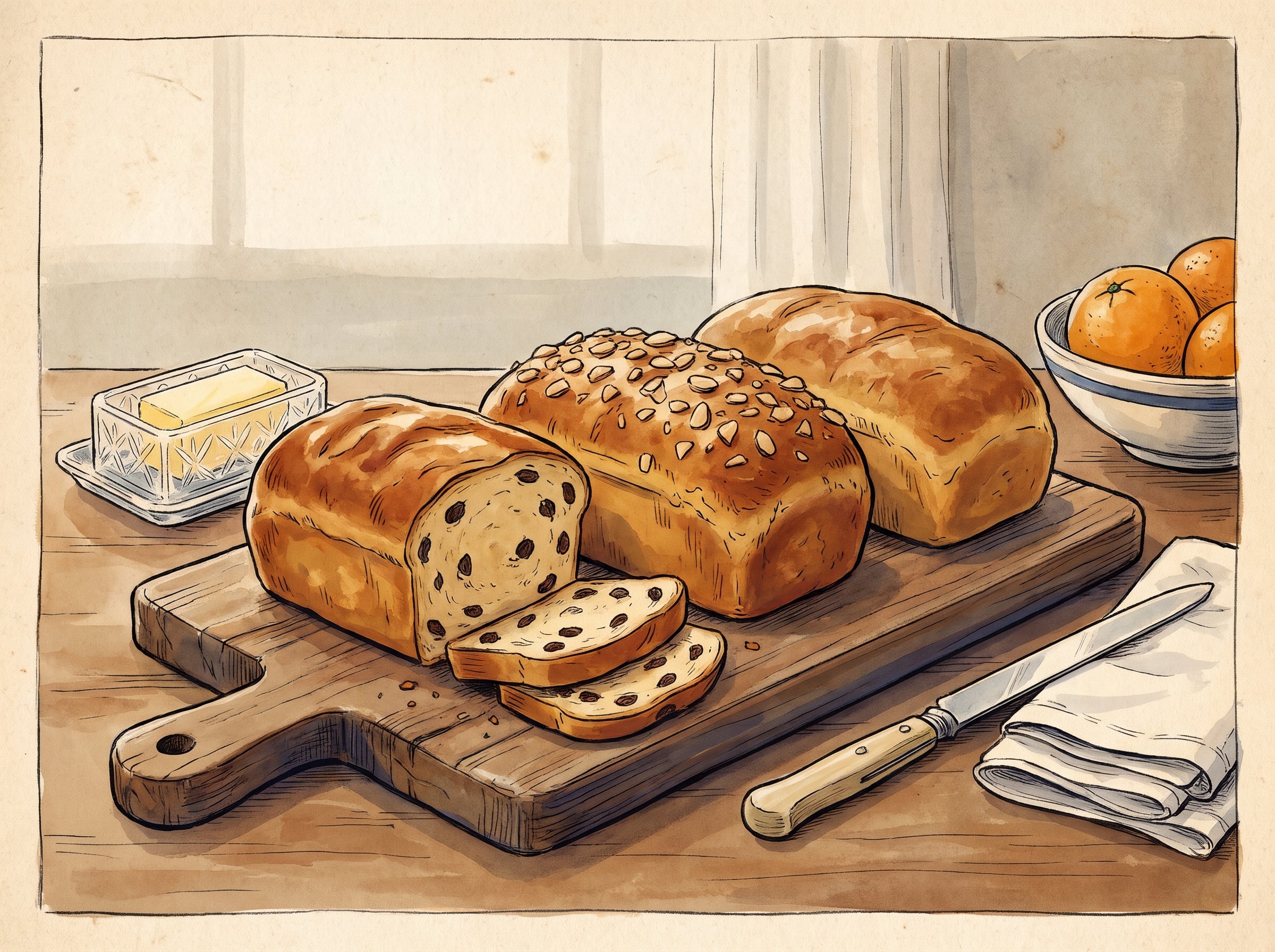
A cup of orange juice, warmed to exactly 80 degrees, goes into a plain white dough. By evening there are three loaves on the counter: one with raisins, one with almonds and one left alone. Mrs. Wilson printed this bread in Philadelphia in 1920, a continent away from the groves, and she used the oranges as if they were nothing special. By then, they weren’t.
Please note that some of the images in this article were created with the assistance of AI.
From Mrs. Wilson’s Cook Book, 1920
The Story Behind This Recipe
Mrs. Wilson answers the mail
In 1920, a Philadelphia cook with a bread problem could write to the newspaper about it. Mrs. M. A. Wilson handled cooking advice on the women’s page of the Evening Public Ledger, and readers mailed in their kitchen troubles. She answered with recipes, menus and shopping tips. That same year, J. B. Lippincott published her book, with a title that gets right to the point: ‘Mrs. Wilson’s Cook Book: Numerous New Recipes Based on Present Economic Conditions.’
Those conditions weren’t the Depression, which was still years away. They were the hard stretch right after the First World War. Wilson taught cooking, wrote cookbooks and helped lead the home economics movement. A modern publisher’s description says she taught Domestic Science at the University of Virginia Summer School. It also says she founded a school grandly named ‘Queen Victoria’s Cuisiniere,’ which later became Mrs. Wilson’s Cooking School in Philadelphia. Her preface opens with a case for ‘scientific cooking,’ which to her meant cutting waste and getting good food for the least cost and effort.
Oranges come east
By 1914, Americans were eating about forty oranges each a year. That was quite a jump for a fruit that had been an imported winter treat. Orange growing in California took off in the 1870s, railroads carried the fruit east, and growers sold together through the California Fruit Growers Exchange. The Exchange trademarked the name Sunkist and pitched oranges as health, a happy home, prosperity and respectability. Historian Kevin Starr wrote that a whole generation ‘would now encounter California’ as a crate of oranges at the market. To a Philadelphia cook, ‘California’ and ‘orange’ practically came as a pair.
Oranges were already turning up in dough. Food historian Sarah Wassberg Johnson traced orange rolls back to a 1916 Sunkist booklet. Its ‘Orange Pinwheels’ were baking-powder biscuits rolled up with butter, sugar, juice and zest. Ida Bailey Allen’s 1917 cookbook had yeast buns flavored with orange juice and candied peel. A 1918 book of recipes for fifty people rolled yeast dough around an orange-sugar butter, like cinnamon rolls. Mrs. Wilson skipped the swirl. She stirred the juice and grated rind straight into a plain bread dough.
One egg, three loaves, a long day
In January 1920, Mrs. Wilson’s column advised readers to go easy on eggs and butter. Both were very expensive after an egg shortage in 1919. It shows in this recipe. The bread uses melted shortening instead of butter, one egg for about eight cups of flour and only four tablespoons of sugar, and the oranges do the rest. Then the dough is split three ways, so a household gets a raisin loaf, an almond loaf and a plain one, all from one bowl.
It makes for a long day. The rises add up to about five and a half hours before baking. That was ordinary then: Allen put ‘5 Hours’ right in the name of her orange rolls. The exact numbers, 80 degrees for the liquids and 400 for the oven, are scientific cooking in action. We looked for a period source tying this bread to Christmas or any other holiday and found none. What the recipe does show is a full cup of juice and the rind of two oranges, used without a hint of ceremony.
1920s
Notes From the Era
The recipe · 1920
California Orange Bread
From Mrs. Wilson’s Cook Book by Mary A. Wilson (1920). Every word of the recipe below is as printed.
Ingredients
- the rind of two oranges
- One cup of orange juice, warmed to 80 degrees Fahrenheit
- Two tablespoonfuls of melted shortening
- Four tablespoonfuls of sugar
- One and a half teaspoonfuls of salt
- One egg
- one yeast cake
- one cup of water 80 degrees Fahrenheit
- sufficient flour to make a smooth elastic dough; usually about eight cups
- One-half cupful of seeded raisins
- One-half cupful of chopped almonds
Method
-
Combine the orange rind, juice and egg
Grate the rind of two oranges and then place in a bowl and add
One cup of orange juice, warmed to 80 degrees Fahrenheit,
Two tablespoonfuls of melted shortening,
Four tablespoonfuls of sugar,
One and a half teaspoonfuls of salt,
One egg. -
Add the yeast and flour
Beat to mix and then dissolve one yeast cake in one cup of water 80 degrees Fahrenheit, and add to the above mixture; then work in sufficient flour to make a smooth elastic dough; usually about eight cups.
-
Grease and let rise
Place in a greased bowl and turn the dough to thoroughly coat with grease. Cover and let rise for three hours.
-
Punch down and rise twice more
Pull the corners of the dough to the centre and punch down, turn over and let rise again for one hour. Repeat the punching down and then let rise for three-quarters of an hour.
-
Shape three loaves
Turn out on a moulding board and mould into three loaves, adding
One-half cupful of seeded raisins to one loaf,
One-half cupful of chopped almonds to second loaf,and keep the third loaf plain.
-
Pan and rise
Place in greased pans and let rise for three-quarters of an hour.
-
Bake
Bake in the hot oven for 40 minutes. The temperature of the oven should be 400 degrees Fahrenheit.
Our notes
Reading It Today
One yeast cake. A yeast cake was a small block of compressed fresh yeast. A standard 0.6-ounce cake is usually swapped for one packet (2¼ teaspoons) of active dry yeast. The 80°F water is just lukewarm, cooler than the temperatures often printed for dry yeast today.
Seeded raisins and a moulding board. ‘Seeded raisins’ means raisins with the seeds taken out, not raisins with seeds left in. A moulding board is simply a board or counter where the dough is turned out, kneaded and shaped into loaves.
What kind of bread this is. Judging from the ingredients, this is a plain, lightly enriched white loaf. Eight cups of flour meet one egg and four tablespoons of sugar, so expect a firm, sandwich-style crumb that is only mildly sweet. The grated rind should give the most orange fragrance, and the juice adds a little tang. The raisin loaf would be the sweetest of the three, and the almond loaf the crunchiest.
Not today’s orange bread. Most ‘orange bread’ recipes now are quick breads, raised with baking powder or soda, much sweeter and often glazed. This is a true yeast bread with long rises, closer to everyday sandwich bread. The ‘hot oven’ it calls for is 400°F.
Source: Mary A. Wilson, Mrs. Wilson’s Cook Book (J. B. Lippincott Company, Philadelphia, 1920). Read the 1920 book at Project Gutenberg.
Sources for the history
- Mary A. Wilson, Mrs. Wilson’s Cook Book (J. B. Lippincott Company, Philadelphia, 1920), Project Gutenberg
- Mrs. Wilson’s Cook Book by Mrs. Mary A. Wilson (Apple Books publisher description)
- Mrs. Wilson’s Cook Book Numerous New Recipes Based on Present Economic Conditions (Goodreads, with reader review)
- Today in 1920: Mrs. Wilson’s Cheese Sauce (Rooted in Foods)
- A Brief History of Midwestern Orange Rolls (The Food Historian)
- Airships and Oranges: The Commercial Art of the Second Gold Rush (Smithsonian Magazine)
The original recipe text is from a work published in 1920 and is in the public domain in the United States. The history, notes and illustrations are Digstalk’s own. Brand names that appear in historic recipes are mentioned as historical fact only. Illustrations are AI-generated in a vintage style. The recipe is shown exactly as it was published in 1920; we have not photographed a test batch.