
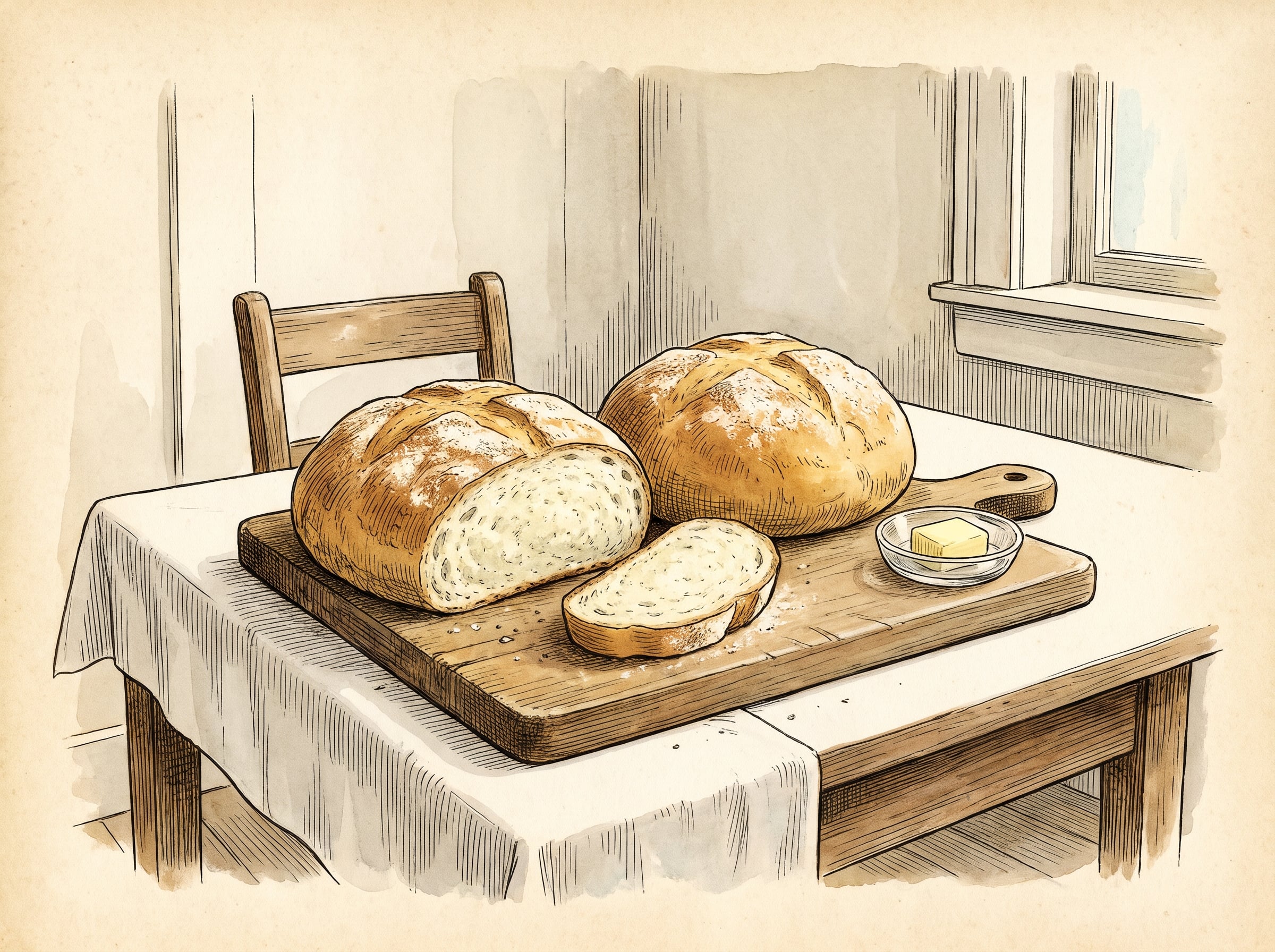
What’s been called the first Creole cookbook ever printed was put together by a newspaperman who left his name off the cover. Tucked among the famous dishes of 1880s New Orleans is a loaf so plain it almost hides: flour, mashed potato, a cup of yeast, and a closing line that makes the butter optional because the bread "is nice without."
Please note that some of the images in this article were created with the assistance of AI.
From La Cuisine Créole, 1885
The Story Behind This Recipe
A reporter in the kitchen
Lafcadio Hearn had already lived a few lives before he ever collected a recipe. He was born in 1850 on Lefkada, one of the Greek Ionian Islands, grew up in Dublin, and arrived in the United States at 19. He found work as a reporter in Cincinnati, and in 1877 the Cincinnati Commercial sent him to New Orleans to write about Louisiana politics. He stayed, writing for the Daily City Item and later the Times-Democrat. At the Item he carved nearly two hundred woodcuts of everyday city life, and the paper became the first in the South to run cartoons.
In 1885 two of his books appeared, both tied to Creole culture. One was Gombo Zhèbes, a little dictionary of Creole proverbs. The other was La Cuisine Créole, which came out without his name and is described as the first Creole cookbook ever printed. It gathered recipes from leading New Orleans chefs and from well-known Creole housewives. One Louisiana encyclopedia calls Hearn a gifted explainer of one culture to another, someone who helped Uptown and American readers make sense of downtown Creole life. Between his newspaper work and his pieces for Harper’s and Scribner’s, he helped shape the picture of New Orleans that outsiders still carry. He later moved to Japan, where he taught and wrote, and he died in Tokyo in 1904.
A loaf without a pedigree
Some recipes arrive with a family tree. This one shows up with a name and very little else. The sources we could read are about Hearn and his book, and none of them traces where potato yeast breads came from, how this loaf earned its modest title, or whether anyone in New Orleans set it out for the holidays. The recipe itself names no occasion, so we won’t invent one.
What we can say is where it sits. In a book known for the city’s Creole cooking, this bread asks only for flour, potato, milk, water, yeast, and salt. It shares the pages with the city’s best-known dishes, a plain loaf in very lively company.
Written for a cook who already knew
Read the recipe looking for an oven temperature and you’ll come up empty. There are no timings either. The one firm rule is a ratio: two parts flour to one part warm mashed potato, measured in "pounds or pints" as though the two were the same thing. The potato has to be "mealy," dry and floury rather than waxy, a detail that mattered enough to write down. The yeast comes by the cup. The milk and water come in no amount at all.
That leaves a lot to the cook’s hands. Knead it "very well," shape the loaves, set them in a pan to rise. Then comes the last line, which is the most generous in the recipe. A little lard or butter will make "a rich, short bread," but it "is nice without." The choice was left to the cook.
1880s
Notes From the Era
The recipe · 1885
A Very Nice Potato Bread
From La Cuisine Créole by Lafcadio Hearn (1885). Every word of the recipe below is as printed.
Ingredients
- two pounds or pints of flour
- one pound or pint of warm, mashed mealy Irish potatoes
- milk and water
- a cup of yeast
- a little salt
- a little lard or butter
Method
-
Combine flour and potatoes
To two pounds or pints of flour, add one pound or pint of warm, mashed mealy Irish potatoes.
-
Add liquids, yeast and salt
Add to this milk and water, a cup of yeast and a little salt.
-
Knead, shape and rise
Make it after kneading it very well, into loaves, and place them in a pan to rise.
-
Optional enrichment
If you desire a rich, short bread you may add a little lard or butter, but it is nice without.
Our notes
Reading It Today
Pounds, pints, and the ratio. A US pint is 2 cups, while a pound of flour is closer to 3½ cups, so the two measures don’t really match. The 2:1 ratio of flour to potato is the part to hold onto.
Mealy Irish potatoes. "Irish potatoes" means ordinary white potatoes, as opposed to sweet potatoes. "Mealy" means starchy and dry, like a russet, rather than a waxy potato that mashes up gluey.
What "short" means. A "short" bread is tender and a little crumbly, which comes from fat. Adding lard or butter would make it richer and softer. Without fat, expect a leaner, plainer loaf.
How it differs from today’s loaves. Most modern recipes give exact amounts, packaged yeast, and an oven temperature. This one gives a ratio and trusts the cook. A third of the flour-and-potato mix is mashed potato, so it should bake into a moist, soft crumb with a mild flavor.
Source: Lafcadio Hearn, La Cuisine Créole (F. F. Hansell & Bro., New Orleans (second edition, copyright 1885), 1885). Read the 1885 book at Project Gutenberg.
Sources for the history
- Lafcadio Hearn (compiler, published anonymously), La Cuisine Créole (F. F. Hansell & Bro., New Orleans, 2nd ed., ca. 1922; ©1885; first published New York: Will H. Coleman, 1885), ‘A Very Nice Potato Bread’
- La cuisine creole, second edition – UW-Madison Libraries catalog
- Lafcadio Hearn – Wikipedia
- Lafcadio Hearn – 64 Parishes (Louisiana Endowment for the Humanities)
- Lafcadio Hearn – Encyclopaedia Britannica
- Lafcadio Hearn’s Creole Cookbook – Goodreads
The original recipe text is from a work published in 1885 and is in the public domain in the United States. The history, notes and illustrations are Digstalk’s own. Brand names that appear in historic recipes are mentioned as historical fact only. Illustrations are AI-generated in a vintage style. The recipe is shown exactly as it was published in 1885; we have not photographed a test batch.