
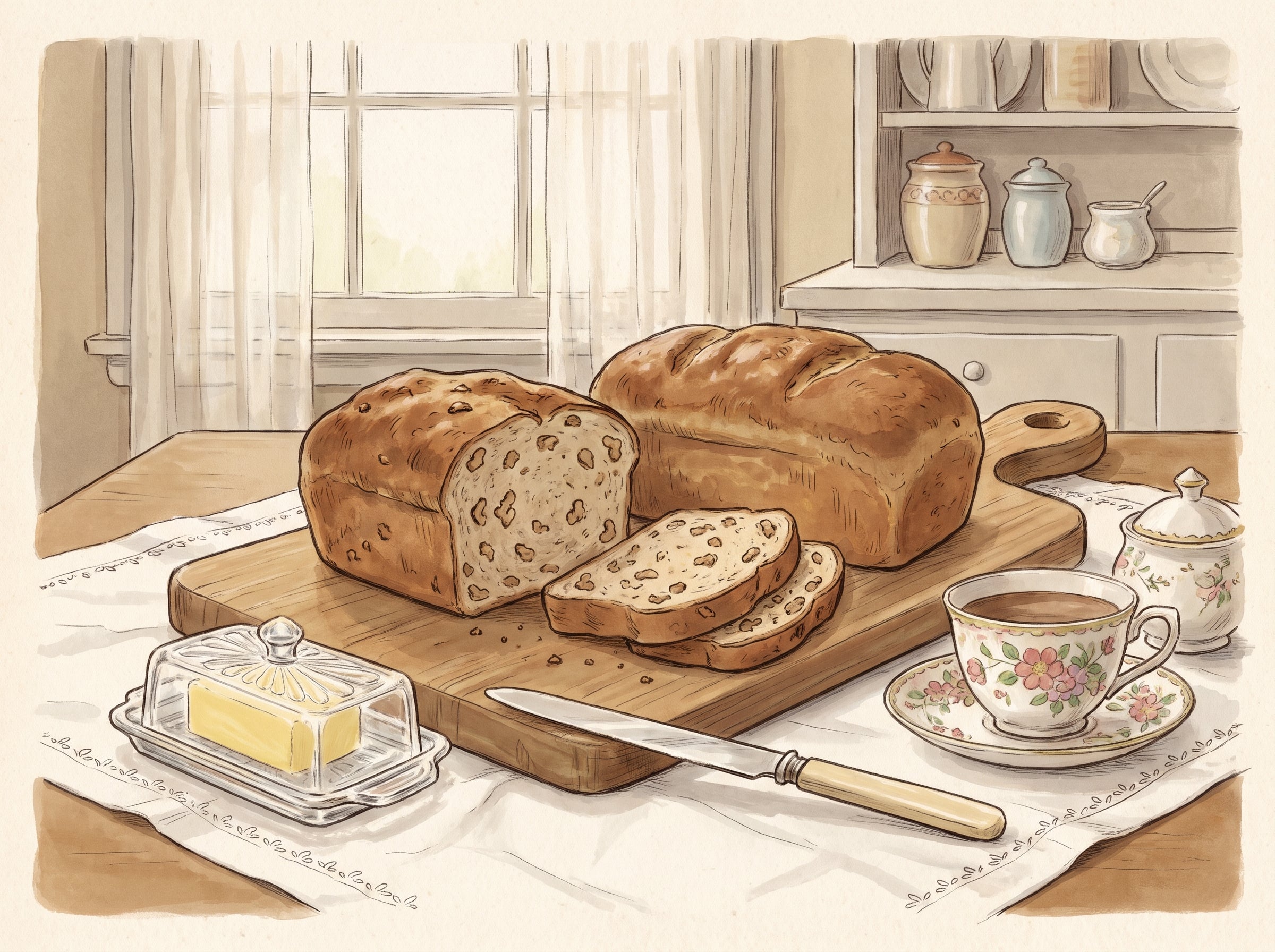
There is no yeast in this loaf, no butter, and no name attached to it. What it does have is eight teaspoonfuls of baking powder, a large cup of chopped walnuts and a twenty-minute rest, all set down in the 1916 edition of a Cincinnati cookbook. It is a modest recipe with a surprising amount of history tucked inside.
Please note that some of the images in this article were created with the assistance of AI.
From The Community Cook Book, 1916
The Story Behind This Recipe
A book with no author
Whoever wrote down this nut bread did not sign it. The Community Cook Book names no author at all, only a publisher: Powell & White of Cincinnati, Ohio. The copy that survives in digital form calls itself the third edition, dated 1916, with a copyright of 1914. Its title page carries a second place name as well, Haverhill, Massachusetts, a good distance from the Ohio River.
The missing name suits the recipe. It reads like something passed from one cook to another rather than composed to show off. There are seven ingredients and three short sentences of method, and none of them wastes a word. The writer trusted the reader to know what a moderate oven felt like and roughly how big a large cup ought to be.
Bread in a hurry
Look for the yeast and you will not find it. The rising comes from baking powder, and a generous helping of it: eight teaspoonfuls for four and a half cups of flour, with two well-beaten eggs lending a hand. Yeast dough would sit for hours. This batter rests for twenty minutes and goes straight into the oven. The book calls it a bread all the same.
That shortcut was still fairly young in 1916. The American chemist Eben Norton Horsford brought baking powder into use in the United States, and he patented his process in 1856. Once commercial baking powder reached kitchens in the later 1800s, a name followed for loaves raised this way. ‘Quick bread’ is first recorded in the early 1880s. A generation later, a loaf with no yeast at all could sit in a home cookbook without a word of explanation.
A kitchen of the 1910s
The recipe asks for ‘sweet milk,’ which sounds like a treat but simply meant fresh milk. Before refrigeration was common, cooks baked with fresh milk as well as with soured milk and buttermilk. They needed a plain way to say which one a recipe wanted. This loaf takes two cups of the fresh kind.
The oven gets the same easygoing treatment. There is no number, only ‘a moderate oven,’ one step on an old scale of words like slow, moderate and hot. Everything is measured in cups and teaspoonfuls, and nothing is weighed. The batter is divided between two tins and baked about forty-five minutes. One bowl yields two loaves, enough to slice one now and keep the other for later or give it away.
1910s
Notes From the Era
The recipe · 1916
Nut Bread
From The Community Cook Book by Anonymous (Powell & White) (1916). Every word of the recipe below is as printed.
Ingredients
- Four and one-half cups wheat flour
- eight teaspoonfuls baking powder
- one teaspoonful salt
- one cup sugar
- two cups sweet milk
- one large cup chopped walnuts
- two eggs well beaten
Method
-
Gather the ingredients
Four and one-half cups wheat flour, eight teaspoonfuls baking powder, one teaspoonful salt, one cup sugar, two cups sweet milk, one large cup chopped walnuts, two eggs well beaten.
-
Mix the batter
Stir all dry ingredients together thoroughly, add eggs and milk.
-
Let it stand
Stand twenty minutes before baking.
-
Bake the loaves
Bake in two tins about forty-five minutes in a moderate oven.
Our notes
Reading It Today
Sweet milk. This is plain fresh milk. It does not mean sweetened or condensed milk, and it does not mean buttermilk or soured milk.
A moderate oven. Modern conversion tables usually put a moderate oven at about 350–375°F (180–190°C).
The measures. Eight teaspoonfuls of baking powder equals 2 tablespoons plus 2 teaspoons, a large amount for the flour. ‘One large cup’ of walnuts suggests a full, slightly heaped cup rather than a precise measure.
What kind of loaf to expect. The batter has no butter, oil or shortening, so judging from the ingredients this would be a lean, fairly firm loaf with a close crumb. It would be mildly sweet and studded with walnuts, and it would suit slicing and spreading. Many nut and quick breads today add fat, which makes them richer and more cake-like.
Source: Anonymous (Powell & White), The Community Cook Book (Powell & White, Cincinnati, 1916). Read the 1916 book at Project Gutenberg.
Sources for the history
- Anonymous, The Community Cook Book (Powell & White, Cincinnati; third edition 1916, copyright 1914)
- The Community Cook Book – Loyal Books (title-page transcription)
- From the Homestead Kitchen: The ‘Rise’ of Baking Powder and the History of Quick Breads – Homestead Museum
- Quick bread – Wikipedia
- What To Do If An Old-School Recipe Calls For ‘Sweet Milk’ – The Takeout
- Oven temperatures – Wikipedia
The original recipe text is from a work published in 1916 and is in the public domain in the United States. The history, notes and illustrations are Digstalk’s own. Brand names that appear in historic recipes are mentioned as historical fact only. Illustrations are AI-generated in a vintage style. The recipe is shown exactly as it was published in 1916; we have not photographed a test batch.