
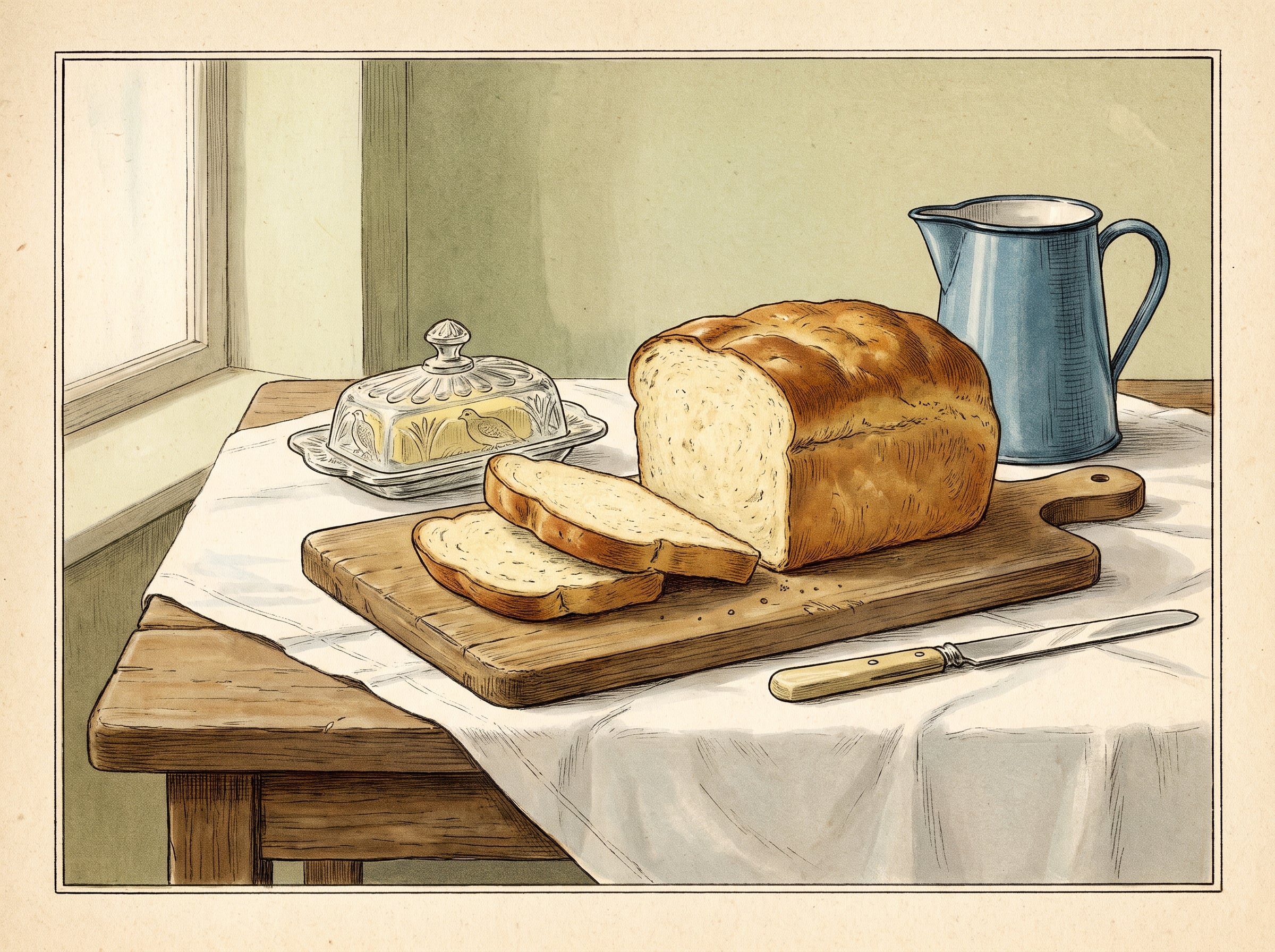
Most bread recipes begin with yeast. This one begins with a cup of scalded milk, some cornmeal and a night spent somewhere warm, waiting for the mixture to go sour on purpose. Printed in 1908 under the name of a contributor at a Virginia fort, it carries an old Appalachian way of baking without bought yeast, and then, in its final step, asks for half a cup of yeast anyway.
Please note that some of the images in this article were created with the assistance of AI.
From Famous Old Receipts Used a Hundred Years and More in the Kitchens of the North and the South, 1908
The Story Behind This Recipe
Recipes with a family tree
The book makes a big promise in its title: Famous Old Receipts Used a Hundred Years and More in the Kitchens of the North and the South. Jacqueline Harrison Smith gathered the recipes, and The John C. Winston Co. of Philadelphia published them in 1908. The appeal was heritage. These were family recipes said to have been in use for a century or longer, and library records describe them as sent in by descendants.
Smith printed a list of contributors, and this bread is credited to Houston Eldredge of Fortress Monroe, Virginia. That is where the trail goes quiet. We looked for solid accounts of Smith’s life and of how readers received her book, and found none we could rely on. Rather than invent a biography for her or for Eldredge, we’ll let the book speak for itself.
A loaf raised by the air
Without store-bought yeast to hand, early cooks in the Appalachian Mountains made a dense white loaf that rose with the help of bacteria. Researchers Genevieve Bardwell and Susan Ray Brown trace salt-rising bread in Appalachia back to the 1700s. A historical marker in Ronceverte, in what is now West Virginia, points to the earliest known recipe, one from Rena Scott of that town, dated 1778. Written and spoken accounts tie the bread to Kentucky, West Virginia, western Pennsylvania, northern Virginia and North Carolina, so the ‘Kentucky’ in this recipe’s name sits comfortably on the map.
The name is misleading. Salt doesn’t make the bread rise, and the loaf doesn’t taste salty. One explanation holds that a little salt in the starter keeps yeast in check and lets other microbes take charge. Another says the starter was kept warm in a bed of heated salt. Either way, the fermentation gives the bread a cheesy flavor and a pungent smell. Women often passed starter between neighbors, and families handed the recipes down.
Old method, one puzzling ingredient
The Eldredge recipe opens the old way. Scald a cup of sweet milk, add salt and cornmeal, and leave it somewhere warm overnight to sour. That is the stage the Ronceverte marker describes, with the ingredients set out the night before to catch microbes from the air. In the morning, warm water and flour make a batter, which becomes a sponge and then a dough, the same build in stages that bakers still describe today.
Then comes the surprise. The marker sums up the tradition as baking without yeast, yet the final step here calls for half a cup of ‘yeast,’ measured by the cup like milk, with no word on what kind. The address holds a smaller puzzle. ‘Fortress Monroe’ had stopped being the fort’s official name in 1832, but the book still uses it in 1908, a year after the Coast Artillery School was established there. The bread itself has outlasted the old name. Bakeries in Danville, Kentucky; Cuba, New York; and Mount Morris, Pennsylvania still make it.
1900s
Notes From the Era
The recipe · 1908
Kentucky Salt Rising Bread
From Famous Old Receipts Used a Hundred Years and More in the Kitchens of the North and the South by Jacqueline Harrison Smith (compiler) (1908). Every word of the recipe below is as printed.
Ingredients
- One cup sweet milk
- a pinch of salt
- enough corn meal to make a batter
- 1 pint of warm water
- enough flour to make a batter
- 3 sifters of flour
- 1 teaspoonful of salt
- 1 tablespoonful of lard
- ½ cup yeast
- lukewarm water
Method
-
Make the overnight corn meal starter
One cup sweet milk scalded; to this add a pinch of salt and enough corn meal to make a batter; put this in a warm place over night to sour.
-
Feed the starter and let it rise
In the morning put in this 1 pint of warm water, then add enough flour to make a batter and set in a warm place to rise; this will take about two hours.
-
Mix the sponge and let it rise
To 3 sifters of flour add 1 teaspoonful of salt, 1 tablespoonful of lard, and ½ cup yeast; work up into a sponge, adding lukewarm water; set this to rise, which will take about three hours.
-
Bake the bread
When it has risen, bake in a slow oven for about 40 or 50 minutes.
Our notes
Reading It Today
Sweet milk and a warm night. ‘Sweet milk’ is simply ordinary fresh milk, as opposed to buttermilk or soured milk. The irony is that the recipe then sets out to sour it. ‘A warm place’ is all the guidance given. Modern descriptions say a salt-rising starter wants more heat than sourdough, about 104°F, for roughly 6 to 16 hours.
Pints, sifters and a mystery yeast. The pint of warm water is 2 cups. The ‘3 sifters of flour’ has no fixed equivalent, because it depended on the size of the cook’s own sifter. The ‘½ cup yeast’ is the other open question. The book doesn’t say what kind it means, so the printed recipe gives a modern reader no exact match.
A slow oven. No temperature is given, only ‘a slow oven for about 40 or 50 minutes.’ In older cookbooks, ‘slow’ generally means a low oven, roughly 300 to 325°F. Cooks of the time judged it by the feel of their own stove.
Not your everyday sandwich loaf. Going by the ingredients and the tradition, expect a dense white bread with a close crumb rather than an airy one, a little richness from the lard, and the cheesy flavor and pungent smell that salt-rising bread is known for. It also asks for patience: an overnight starter, then about five more hours of rising before it reaches the oven.
Source: Jacqueline Harrison Smith (compiler), Famous Old Receipts Used a Hundred Years and More in the Kitchens of the North and the South (The John C. Winston Co., Philadelphia, 1908). Read the 1908 book at Project Gutenberg.
Sources for the history
- Famous Old Receipts Used a Hundred Years and More in the Kitchens of the North and the South (Jacqueline Harrison Smith, 1908) — recipe text
- The Online Books Page (University of Pennsylvania): Famous old receipts, by Jacqueline Harrison Smith
- WorldCat: Famous old receipts … contributed by descendants
- Salt-rising bread — Wikipedia
- Susan Ray Brown, "Salt Rising Bread: How an Appalachian Staple Acquired its Name and Related History," ASA Annual Conference 2017 (Marshall Digital Scholar)
- BREAD TRADITION historic marker, Ronceverte, WV — William G. Pomeroy Foundation
- Salt-Rising Bread — Gastro Obscura (Atlas Obscura)
- Classic American Salt-Rising Bread — King Arthur Baking
- A Brief History of Fort Monroe — North American Forts
The original recipe text is from a work published in 1908 and is in the public domain in the United States. The history, notes and illustrations are Digstalk’s own. Brand names that appear in historic recipes are mentioned as historical fact only. Illustrations are AI-generated in a vintage style. The recipe is shown exactly as it was published in 1908; we have not photographed a test batch.