In early New England, Election Day came with a party, and the party came with cake. Not a frosted layer cake, but a heavy, spiced, raisin-packed loaf raised on yeast, a recipe already more than a century old when Fanny Gillette printed this compact version in 1887. Her recipe has one curious omission, and it happens to be the flour.
Please note that some of the images in this article were created with the assistance of AI.
From The White House Cook Book, 1887
The Story Behind This Recipe
A famous title, a home cook’s manual
The title promises state dinners. Mostly, the book delivers good sense about running a house. Fanny Lemira Gillette was nearly 60 when The White House Cook Book first appeared in 1887, and no First Lady, past or present, had helped write it. Beyond photographs of First Ladies, plus menus and dinner-management notes in some editions, very little inside concerns the White House. It was sold as a household manual built on decades of practical housekeeping.
The White House flavor came largely from Hugo Ziemann, a White House steward who co-authored later editions and supplied the menus and the chapters on directing White House dinners. A Michigan State University library biography says he had earlier been caterer to the exiled son of Napoleon III and steward at the Hotel Splendide in Paris. Gillette went on to write several more cookbooks before her death in 1926, and her book kept getting revised, with an edition as late as 1996.
Thirty quarts of flour and a holiday
Picture thirty quarts of flour. That is how Amelia Simmons began her election cake in the 1796 second edition of American Cookery, followed by ten pounds of butter, fourteen pounds of sugar, twelve pounds of raisins and a quart of brandy. The dough was wet with milk overnight, and the fruit went in just before baking. Food historian Stephen Schmidt traced the dish to the ‘great cakes’ colonists baked for celebrations, huge fruited and spiced breads, and called Election Cake ‘simply a version of the great cake they baked on election day.’ Connecticut recipes date to 1771, the same year cake appeared in the colony’s itemized Election Day spending.
The occasion deserved it. Election Day was a genuine holiday in early New England, when voters came into Hartford to cast ballots and stayed to socialize. The cake gave women, who could not vote, a public way to show patriotism. It also traveled under other names, including ‘Lection cake, Oak Cake, and Training or Muster Cake, the last two from militia training days that packed towns with crowds. Botanist John Howard Redfield, raised in Connecticut, remembered it at weddings and high teas as well. The Hartford connection came later, in the 1830s, as the city’s Election Day parades and balls grew grander.
Where Gillette’s version fits
Gillette keeps the old rhythm. Milk, sugar and a full cup of yeast are stirred to a batter and left overnight. In the morning come more sugar, butter, three eggs, half a nutmeg, cinnamon, a pound of raisins and a gill of brandy, and the cake rises again in greased pans ‘until quite light before baking.’ It is close kin to the yeast-raised election cake in the 1833 edition of Lydia Maria Child’s The American Frugal Housewife.
Two details give away the date. Her half-teaspoon of soda nods to a century in which chemical leaveners pushed yeast cakes aside. And her batch fits a family kitchen, a long way from Simmons’s thirty quarts. Then there is the flour, which she never mentions. Readers were trusted to know how much it took to make ‘a batter,’ an assumption the same book makes about its huckleberry cake.
1880s
Notes From the Era
The recipe · 1887
Election Cake
From The White House Cook Book by F. L. Gillette and Hugo Ziemann (1887). Every word of the recipe below is as printed.
Ingredients
- Three cups milk
- two cups sugar
- one cup yeast
- two cups sugar
- two cups butter
- three eggs
- half a nutmeg
- one tablespoonful cinnamon
- one pound raisins
- a gill of brandy
- a half-teaspoonful of soda
- a tablespoonful of milk
Method
-
Make the batter overnight, then add the rest
Three cups milk, two cups sugar, one cup yeast; stir to a batter and let stand over night; in the morning add two cups sugar, two cups butter, three eggs, half a nutmeg, one tablespoonful cinnamon, one pound raisins, a gill of brandy.
-
Use brown sugar and add soda
Brown sugar is much better than white for this kind of cake, and it is improved by dissolving a half-teaspoonful of soda in a tablespoonful of milk in the morning.
-
Let rise in the pans and bake
It should stand in the greased pans and rise some time until quite light before baking.
Our notes
Reading It Today
A gill of brandy. A gill is a quarter of a pint, or half a US cup (4 fluid ounces). That is a generous pour, and it adds both flavor and moisture to the loaf.
Flour, amount unstated. The recipe says to ‘stir to a batter’ but never names flour. The cook was expected to add enough to reach the right consistency by feel. Her cups and spoons were also whatever the kitchen had on hand, so any modern version means making judgment calls about quantities.
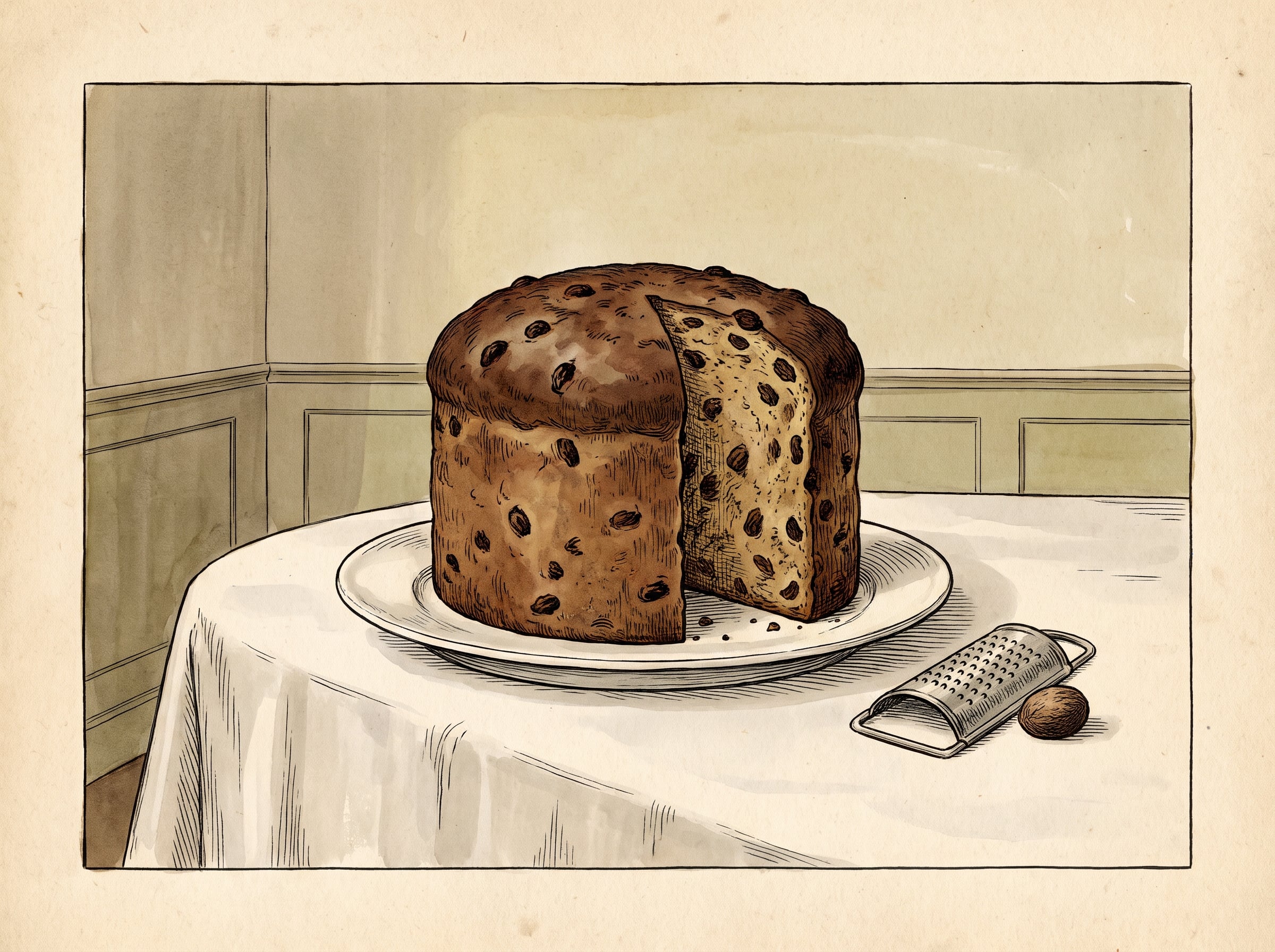
Bread, cake or both. Judging from the ingredients, this would be a dense, tender, bread-like loaf rather than a light, crumbly cake. The overnight yeast rise should give it a faintly tangy, fermented depth. Butter and eggs make it rich, brown sugar adds a molasses note, nutmeg and cinnamon carry the spice, and raisins and brandy bring fruit and warmth.
Not your everyday loaf. Unlike most breads today, this one starts as an overnight sponge, takes four cups of sugar and two of butter, and gets half a teaspoon of soda alongside the yeast. It also gives no oven temperature or baking time, because cooks of the day judged both by experience.
Source: F. L. Gillette and Hugo Ziemann, The White House Cook Book (Chicago, 1887). Read the 1887 book at Project Gutenberg.
Sources for the history
- F. L. Gillette and Hugo Ziemann, The White House Cook Book (Chicago, 1887)
- The White House Cook Book and The Struggles of Making Historical Recipes (Historical Foodways, Juneisy Hawkins)
- Fanny Lemira Gillette, White House Cook Book (Michigan State University Libraries, Feeding America)
- When Elections in Hartford Were a Piece of Cake (ConnecticutHistory.org, Gregg Mangan)
- Election cake (Wikipedia)
- Election Cake | History and Recipe (Yankee / NewEngland.com, Aimee Tucker)
- Hartford Election Cake (Atlas Obscura)
- Election Day Cake History and Recipe (What’s Cooking America)
- Gill (unit) (Wikipedia)
- Saleratus, Pudding and a Gill: How Old Words Reflect a Changing World (Teaching with Themes)
The original recipe text is from a work published in 1887 and is in the public domain in the United States. The history, notes and illustrations are Digstalk’s own. Brand names that appear in historic recipes are mentioned as historical fact only. Illustrations are AI-generated in a vintage style. The recipe is shown exactly as it was published in 1887; we have not photographed a test batch.