
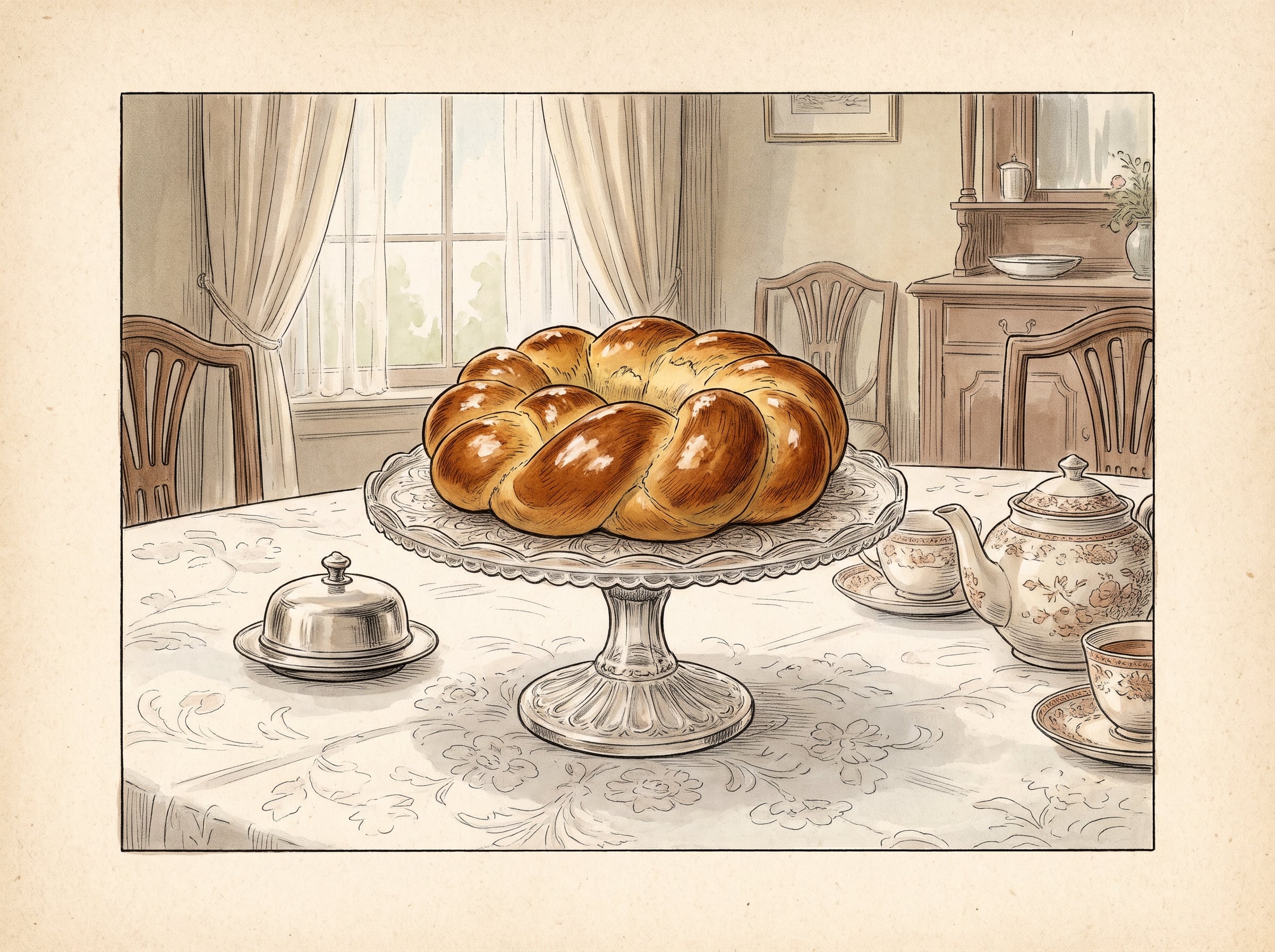
This brioche needs a cake of factory yeast, a block of ice and a cook willing to beat dough by hand for a very long time. It comes from an American cookbook written under a borrowed name, and it has to be started the day before. At the end of all that, it comes out of the oven as a twisted crown of rich French bread, and we think it’s worth getting to know why.
Please note that some of the images in this article were created with the assistance of AI.
From The Century Cook Book, 1901
The Story Behind This Recipe
The woman behind Mary Ronald
Mary Ronald was a pen name. The author of The Century Cook Book was Augusta Foote Arnold (1844–1904), who also wrote a companion volume, Luncheons: A Cook’s Picture Book. The Century Co. of New York first published the cookbook in 1895, and this recipe comes from the 1901 printing.
Arnold’s introduction to brioche is meant to reassure. It is "a kind of light bun mixture much used in France," she writes, and it "will not be found difficult or troublesome to make after the first trial." She then lists what it can become: plain brioche cakes, buns, rings, baba, savarins, cabinet puddings and fruit timbales, with a note sending readers to another page for the timbales. She presents brioche as a working base dough that a cook learns once and keeps using, not as a single showpiece.
Blessed bread from butter country
The word brioche shows up in French in 1404. By 1611 a French-English dictionary was describing it to English readers as "a rowle, or bunne, of spiced bread" from Normandy. The name is usually traced to brier, a Norman word meaning to knead dough, which is itself a form of broyer, "to grind, pound." English speakers had adopted the word by 1824.
French historians trace the bread back to the church, to the pain bénit, or blessed bread, which grew richer over the centuries. Butter made the difference. The most admired brioches came from Gisors and Gournay, two towns with big butter markets, so the finest brioche came straight out of butter-market country.
Yeast in a cake, dough on the ice
The recipe opens with "1 cake of compressed yeast," a product that was then only about a generation old. In 1868 Charles and Maximilian Fleischmann and their partner James Gaff built a yeast plant in Cincinnati, where they produced and patented a compressed yeast cake. A model Vienna bakery at Philadelphia’s Centennial Exposition in 1876 made the name famous. Dry yeast that could do without refrigeration would not arrive until World War II.
Ronald’s method takes some stamina. A small ball of yeasted paste goes into a pan of warm water, where it sinks and later rises to the top "full of bubbles." Meanwhile the cook works butter, eggs and flour together by hand on a platter, adds the leaven and keeps beating, because "the longer it is beaten the better and the finer will be the grain." After a rise of four to five hours, the dough goes "on the ice" for twelve to twenty-four hours. Brioche bakers still use this cold rest today, because it builds flavor and firms up the dough for shaping. The recipe ends with a crown: the dough is rolled into a round, cut, twisted into a rope-like ring, brushed with egg and baked. Ronald doesn’t link it to any holiday. Crowns do have a festive history, though: in the south of France, the Epiphany gâteau des rois is a crown-shaped brioche topped with candied fruit and coarse sugar.
1900s
Notes From the Era
The recipe · 1901
Brioche
From The Century Cook Book by Mary Ronald (1901). Every word of the recipe below is as printed.
Ingredients
- 1 cake of compressed yeast.
- 1/4 cupful of lukewarm water.
- 1 quart of flour.
- 7 eggs.
- 3/4 pound of butter.
- 1/2 teaspoonful of salt.
- 2 teaspoonfuls of sugar.
Method
-
Make the leaven ball
Dissolve the yeast-cake in a quarter of a cupful of lukewarm water. Stir it so it will be thoroughly mixed, then add enough flour to make a very soft ball of paste.
-
Let the leaven rise in warm water
Drop this ball into a pan of warm water (the water must not be hot, or it will kill the yeast plant). Cover, and set it in a warm place to rise, which will take about an hour. This is for leaven to raise the brioche. The ball of paste will sink to the bottom of the water at first, but will rise to the top later, and be full of bubbles.
-
Work the butter, eggs and flour
Put the rest of the flour on a platter, and make a well in the center of it. Into this well put the butter, salt, sugar, and four eggs. Break the eggs in whole, and have the butter rather soft. Work them together with the hand, gradually incorporating the flour, and adding two more eggs, one at a time. Work and beat it with the hand until it loses its stickiness, which will take some time.
-
Add the leaven and beat
When the leaven is sufficiently light, lift it out of the water with a skimmer, and place it with the dough. Work them together, add one more egg, the last of the seven, and beat it for a long time, using the hand. The longer it is beaten the better and the finer will be the grain.
-
Rise and chill overnight
Put the paste in a bowl, cover, and let it rise to double its size, which will take four to five hours; then beat it down again, and place it on the ice for twelve or twenty-four hours. As beating and raising the paste require so much time, the work should be started the day before it is to be used.
-
Handle the chilled paste
After taking the paste from the ice, it will still be quite soft, and have to be handled delicately and quickly. It softens more as it becomes warm.
-
Shape the ring and bake
Roll the paste into a ball, roll it down to a thickness of half an inch, keeping the form round. Cut it several times through the middle, and twist the paste into a rope-like ring. Let it rise, brush the top with egg, and bake in a well-heated oven for about half an hour.
Our notes
Reading It Today
A cake of yeast. Compressed yeast is fresh yeast, sold as a moist, pressed block rather than the dry granules in today’s packets. Ronald dissolves it in lukewarm water, works in flour to make a soft ball, and floats that ball in a pan of warm water to rise. She notes that the water must not be hot, "or it will kill the yeast plant."
Quarts and pounds. A quart is 4 cups, so the flour here is measured by volume. The butter is given by weight: three-quarters of a pound is 3 sticks. Seven eggs and that much butter against a little over a pound of flour make a very rich dough. It is far richer than the cheaper French pain brioché, which used about four parts flour to one part butter.
"On the ice". Today that means the refrigerator. Ronald warns that the chilled dough is still soft and softens further as it warms, so it should be shaped quickly and with a light touch. She also gives no oven temperature, only "a well-heated oven for about half an hour."
What to expect. Judging from the ingredients, we’d expect a tender, golden, fine-grained bread that tastes strongly of butter and egg. With only two teaspoons of sugar, it would be just lightly sweet. With all that butter and seven eggs, it sits far from the lean pain brioché, and its day-before schedule shows how much patience it asks of the cook.
Source: Mary Ronald, The Century Cook Book (The Century Co., New York, 1901). Read the 1901 book at Project Gutenberg.
Sources for the history
The original recipe text is from a work published in 1901 and is in the public domain in the United States. The history, notes and illustrations are Digstalk’s own. Brand names that appear in historic recipes are mentioned as historical fact only. Illustrations are AI-generated in a vintage style. The recipe is shown exactly as it was published in 1901; we have not photographed a test batch.