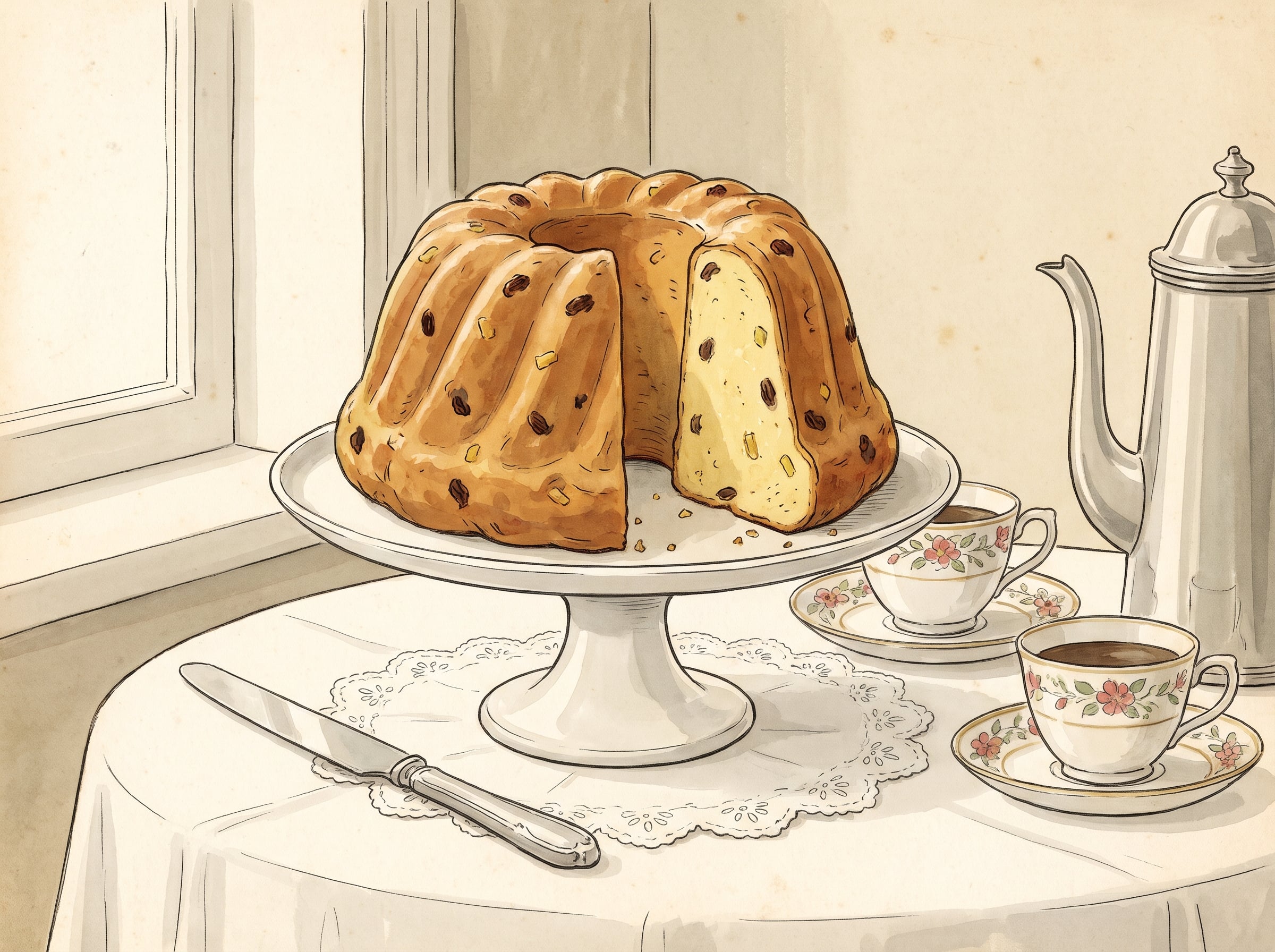
In 1919 a New York cook could open Florence Kreisler Greenbaum’s cookbook, find a cake with a German name, and start it the old way, with a little yeast and milk set ‘back of the stove’ to rise. The cake was a kugelhopf: tall, ring-shaped, dotted with raisins and citron. It reached that page by way of Viennese breakfast tables, and its shape is old enough that Romans camped near Vienna knew it.
Please note that some of the images in this article were created with the assistance of AI.
From The International Jewish Cook Book (second edition), 1919
The Story Behind This Recipe
Sixteen hundred recipes and the rules for kashering
Some books tell you their whole plan on the title page. Greenbaum’s promised 1600 recipes ‘According to the Jewish Dietary Laws with the Rules for Kashering,’ then kept going, offering the favorite recipes of America, Austria, France, Poland, Roumania and more. It was a kosher kitchen with its windows open to half of Europe. The New York Public Library’s list of Jewish cookbooks records a 1918 New York edition of 419 pages, a 1924 Jewish Cook Book under her name, and a reprint as recent as 2009. Our recipe comes from the second edition, published by Bloch in New York in 1919.
She had company on the shelf. ‘Aunt Babette’s’ Cook Book came out of Cincinnati in 1889, and The Settlement Cook Book, first printed in Milwaukee in 1901, kept being reissued for decades. As for Mrs. Greenbaum herself, the sources we could find say far more about her book than about her, so her life story will have to wait.
A hat, a hop and an emperor’s breakfast
Ask where the name comes from and you’ll start an argument. One popular theory joins the Middle High German Gugel, a hood (from the Latin cucullus), with Hupf, ‘to hop.’ The Viennese cookbook author F. G. Zenker wrote in 1817 that the hop was the cake rising. The oldest known recipe, in Marx Rumpolt’s cookbook of 1581, simply describes a ‘Hat Cake,’ a fair name for something shaped like a tall hood.
The shape is older still. Austria’s agriculture ministry points to excavations at Carnuntum, a Roman army camp near Vienna, showing that the Romans knew it some 2,000 years ago. The cake’s golden age came in 19th-century Vienna, where cookbooks filled up with Gugelhupf recipes, and Emperor Franz Joseph is said to have liked a raisin one at breakfast or with afternoon coffee. The ministry still calls it essential to the Viennese breakfast, especially on Sundays, and to the Kaffeejause, the afternoon coffee break. In Alsace it was tied to weddings, Christian and Jewish alike.
A Viennese cake in a New York kitchen
Even the yeast here had an Austrian accent. According to Fleischmann’s, brothers Charles and Maximilian Fleischmann left Austria-Hungary, built a yeast plant in Cincinnati and patented a compressed yeast cake there. In 1876 they showed a Model Vienna Bakery at the Philadelphia Centennial Exposition, and the whole country heard about their yeast. Refrigerated rail cars carried fresh yeast nationwide during a home-baking boom. By 1920, though, store-bought bread had eaten into home baking, and a from-scratch holiday kugelhopf was becoming a deliberate choice.
The word ‘abgeruehrter’ points to stirring, and the method earns it. A small starter rises at the back of the stove. Butter and sugar are creamed as for a cake, the yolks go in one at a time, and the batter is beaten until it ‘forms blisters and leaves the bowl clean.’ The stiff whites go in last. Gugelhupf is classically a yeast cake, though plain pound or marble cakes baked in the same mould sometimes borrow the name. This one sits right between the two.
1910s
Notes From the Era
The recipe · 1919
Abgeruehrter Kugelhopf
From The International Jewish Cook Book (second edition) by Florence Kreisler Greenbaum (1919). Every word of the recipe below is as printed.
Ingredients
- one-half ounce of yeast or one cake compressed yeast
- a very little lukewarm milk
- a pinch of salt
- one tablespoon of sugar
- a scant cup of butter
- a scant cup of powdered sugar
- the yolks of four eggs
- the grated peel of a lemon
- two cups of flour
- one cup of lukewarm milk
- one-half cup of cleaned and seeded dark raisins
- some citron
- more flour
- the stiffly-beaten whites of the eggs
Method
-
Start the yeast
Soak one-half ounce of yeast or one cake compressed yeast in a very little lukewarm milk; add a pinch of salt and one tablespoon of sugar, stir it up smooth and set back of the stove to rise.
-
Cream the butter, sugar and yolks
In the meantime rub a scant cup of butter and a scant cup of powdered sugar to a cream, add gradually the yolks of four eggs, one at a time and add also the grated peel of a lemon.
-
Make the light batter
Sift two cups of flour into a bowl, make a depression in the centre, pour in, the yeast, one cup of lukewarm milk, and make a light batter of this.
-
Beat in the creamed mixture
Add the creamed butter and eggs and stir until it forms blisters and leaves the bowl clean.
-
Add the raisins and citron
Take one-half cup of cleaned and seeded dark raisins and cut up some citron very fine. Dredge flour over them before adding, and if necessary, add more flour to the dough, which should be of the consistency of cup cake batter.
-
Fold in the egg whites
Last add the stiffly-beaten whites of the eggs.
-
Rise and bake
Place in a well-greased long or round pan with tube in centre; let rise until double in bulk, and bake in moderate oven until browned and thoroughly done.
Our notes
Reading It Today
Scant cups and a moderate oven. A ‘scant’ cup is just under full, so level it and then hold back a spoonful or so. A ‘moderate oven’ is usually taken to mean about 350°F. Greenbaum gives no baking time, only ‘until browned and thoroughly done,’ so the cook was expected to judge by color and feel.
One cake of yeast. The ‘cake compressed yeast’ is fresh yeast pressed into a small moist block, still sold in some stores as fresh or cake yeast. A standard 0.6-ounce cake is generally replaced by one packet (2¼ teaspoons) of active dry yeast.
More cake than bread. Judging from the ingredients, expect a tender, fine, buttery crumb rather than a chewy one. Creamed butter, four yolks and folded-in whites push it toward cake, while the yeast adds a mild bready flavor. Lemon peel, dark raisins and finely cut citron supply the brightness and sweetness.
Batter, not dough. Unlike most breads today, this is never kneaded or shaped. It is beaten like a batter as thick as ‘cup cake batter,’ poured into a greased tube pan and left to rise once before baking. ‘Seeded’ raisins meant picking out seeds by hand, a step modern seedless raisins skip. Tossing the fruit in flour helps keep it from sinking.
Source: Florence Kreisler Greenbaum, The International Jewish Cook Book (second edition) (Bloch Publishing Company, New York, 1919). Read the 1919 book at Project Gutenberg.
Sources for the history
- Florence Kreisler Greenbaum, The International Jewish Cook Book (2nd ed., Bloch Publishing Company, 1919), recipe for Abgeruehrter Kugelhopf
- Gugelhupf – Wikipedia
- Gugelhupf – Austrian Federal Ministry (traditional foods register)
- Die Geschichte des Gugelhupfs – Mehlspeiskultur
- Kugelhopf Cakes – CooksInfo
- The Healing Power of Compressed Yeast – Science History Institute
- History of Fleischmann’s Yeast – Breadworld (Fleischmann’s)
- Charles Louis Fleischmann – Wikipedia
- Books on Jewish Cookery in the New York Public Library
- Jewish cookery books – Researching Food History
- Florence Kreisler Greenbaum – Goodreads author page
The original recipe text is from a work published in 1919 and is in the public domain in the United States. The history, notes and illustrations are Digstalk’s own. Brand names that appear in historic recipes are mentioned as historical fact only. Illustrations are AI-generated in a vintage style. The recipe is shown exactly as it was published in 1919; we have not photographed a test batch.