
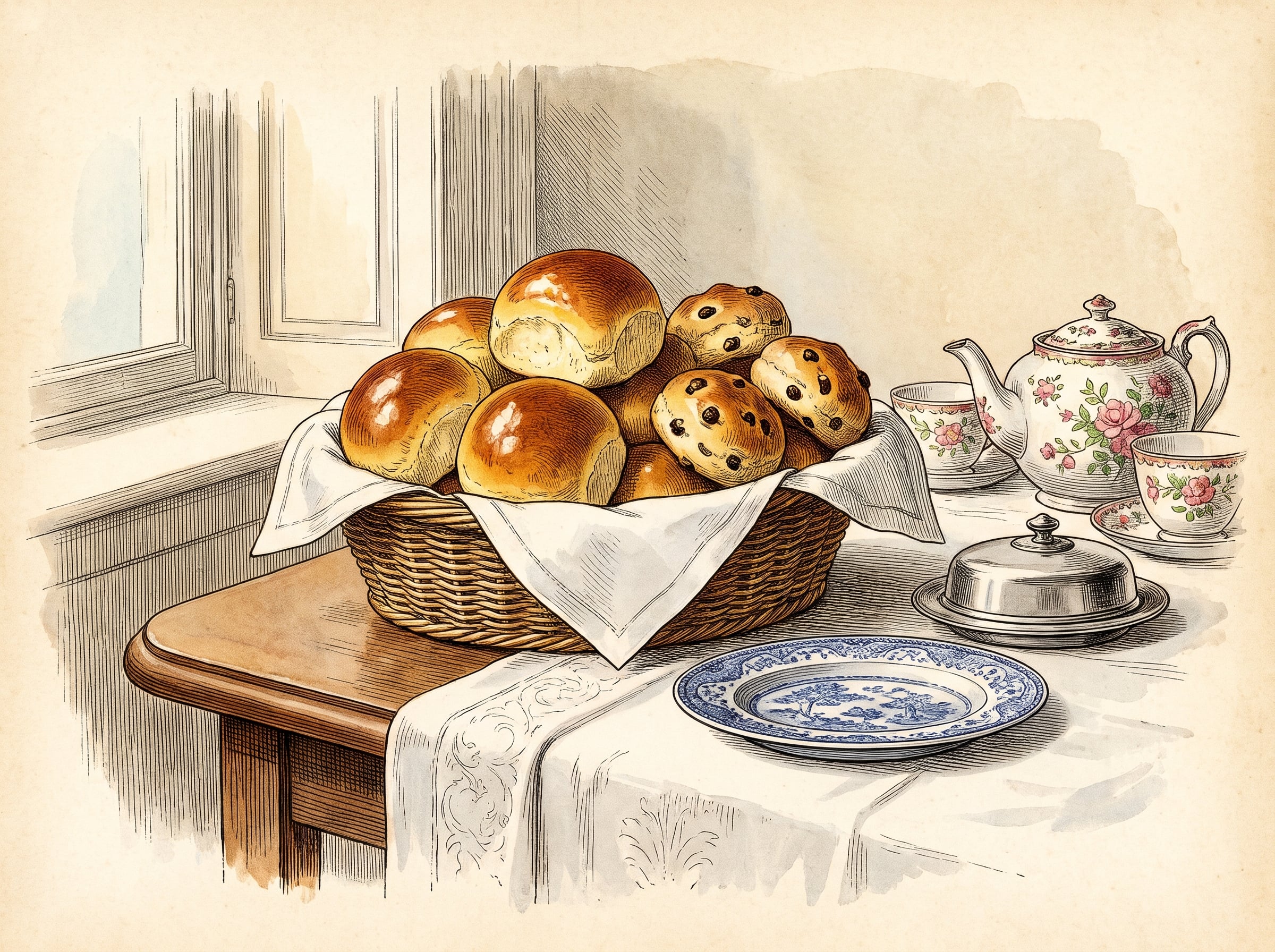
Eliza Acton’s Geneva rolls start out as a modest bread: flour, a little butter, milk, eggs, and a splash of saffron water for a golden color. Then, in a single sentence near the end, she turns them into something richer. Sugar, currants, lemon, and candied peel make ‘excellent buns’ from the same dough.
Please note that some of the images in this article were created with the assistance of AI.
From Modern Cookery for Private Families, 1855
The Story Behind This Recipe
A poet who turned to cookery
Before she ever told anyone how to rub butter into flour, Eliza Acton wrote poetry. She was born in 1799 in Battle, Sussex, the daughter of a Hastings brewer, and only later turned her attention to cookery. The change worked out well. Modern Cookery for Private Families appeared in 1845, was an instant success, and stayed in print long after Acton died in 1859, right up until 1914.
Our recipe comes from the revised edition that Longman, Brown, Green, and Longmans first published in London in 1855, ten years into the book’s life. The Project Gutenberg transcription is of an 1882 reprint of that same edition. That later reprint shows how long the book stayed in print.
Bread first, buns as a bonus
Acton never says where the ‘Geneva’ in the name comes from, and we won’t guess. She is very clear about everything else. The recipe is mainly for rolls. Two pounds of flour get three ounces of butter rubbed in ‘into very small crumbs.’ A sponge of solid yeast and new milk rises for a full hour. Then beaten eggs, warmed with hot milk, bring everything together ‘to a light, lithe dough.’
The buns come almost as an afterthought. Add six ounces of sugar, three more ounces of butter, half a pound or more of currants, the grated rind of a large lemon, and a couple of ounces of candied orange peel, and the everyday roll becomes a treat. One dough serves both purposes, and the extras cost only a sentence.
Saffron for color, and a summary at the end
The most striking ingredient is the one Acton cares least about. Saffron goes in as ‘strong saffron water,’ but if the flavor ‘is not liked, omit it altogether.’ Even when it is used, she wants only enough to ‘give a rich colour to the bread.’ Her closing summary calls for a teaspoonful of saffron steeped in less than a quarter pint of water. For her, the spice was mainly there for its color.
That closing line is a practical touch. After the method, Acton repeats the essentials in one compact list: two pounds of flour, three ounces of butter, a pint of new milk, an hour or more for the first rise, three-quarters of an hour for the second, and 20 to 30 minutes in the oven. She gives times but no oven temperature. The rolls get a brush of beaten egg yolk and go in, and the cook was trusted to know her own fire.
1850s
Notes From the Era
The recipe · 1855
Geneva Rolls, or Buns
From Modern Cookery for Private Families by Eliza Acton (1855). Every word of the recipe below is as printed.
Ingredients
- two pounds of flour
- three ounces of butter
- a little salt
- a large tablespoonful of solid yeast
- a pint of new milk
- a tablespoonful or more of strong saffron water
- a couple of well-beaten eggs
- as much hot milk as will render them lukewarm
- beaten yolk of egg
- six ounces of good sugar
- three of butter
- half a pound or more of currants
- the grated rind of a large lemon
- a couple of ounces of candied orange-rind
Method
-
Make, rise, shape and bake the rolls
Break down into very small crumbs three ounces of butter with two pounds of flour; add a little salt, and set the sponge with a large tablespoonful of solid yeast, mixed with a pint of new milk, and a tablespoonful or more of strong saffron water; let it rise for a full hour, then stir to a couple of well-beaten eggs as much hot milk as will render them lukewarm, and wet the rolls with them to a light, lithe dough; leave it from half to three-quarters of an hour longer, mould it into small rolls, brush them with beaten yolk of egg, and bake them from twenty minutes to half an hour.
-
Turn the rolls into buns
The addition of six ounces of good sugar, three of butter, half a pound or more of currants, the grated rind of a large lemon, and a couple of ounces of candied orange-rind, will convert these into excellent buns.
-
Adjust the saffron
When the flavour of the saffron is not liked, omit it altogether. Only so much should be used at any time as will give a rich colour to the bread.
Our notes
Reading It Today
New milk and an English pint. ‘New milk’ simply means fresh whole milk. Acton’s pint is the British imperial pint of 20 fluid ounces, about 2½ US cups, so the dough takes more milk than an American pint would suggest.
Solid yeast by the spoonful. Acton measures her yeast by the tablespoon, not by the packet, and her ‘solid yeast’ was not the dry granules sold today. A modern reader would need to substitute fresh or dried yeast and adjust the amount.
A soft, lightly rich roll. Judging from the ingredients, these rolls would be tender and soft. The butter rubbed into the flour, the eggs, and all that milk make the dough richer than plain bread. The plain version has no sugar at all, so it is plain rather than sweet. With saffron, the crumb would be a warm golden yellow.
Two rises and no thermometer. This recipe starts with a yeasted sponge, then adds the eggs and remaining milk after the first rise. Acton gives no oven temperature at all. A modern baker would have to choose one for small enriched rolls baked in 20 to 30 minutes.
Source: Eliza Acton, Modern Cookery for Private Families (Longman, Brown, Green, and Longmans, London; online text from the 1882 Longmans, Green reprint, 1855). Read the 1855 book at Project Gutenberg.
Sources for the history
- Eliza Acton, Modern Cookery for Private Families (revised edition first published by Longman, Brown, Green, and Longmans, London, 1855; Project Gutenberg text from the 1882 Longmans, Green, Reader, and Dyer reprint)
- Eliza Acton – Historica Wiki
- Acton, Eliza – Dictionary of National Biography, 1885–1900 (Wikisource)
- Eliza Acton: Victorian Cookbook Author – CooksInfo
The original recipe text is from a work published in 1855 and is in the public domain in the United States. The history, notes and illustrations are Digstalk’s own. Brand names that appear in historic recipes are mentioned as historical fact only. Illustrations are AI-generated in a vintage style. The recipe is shown exactly as it was published in 1855; we have not photographed a test batch.