
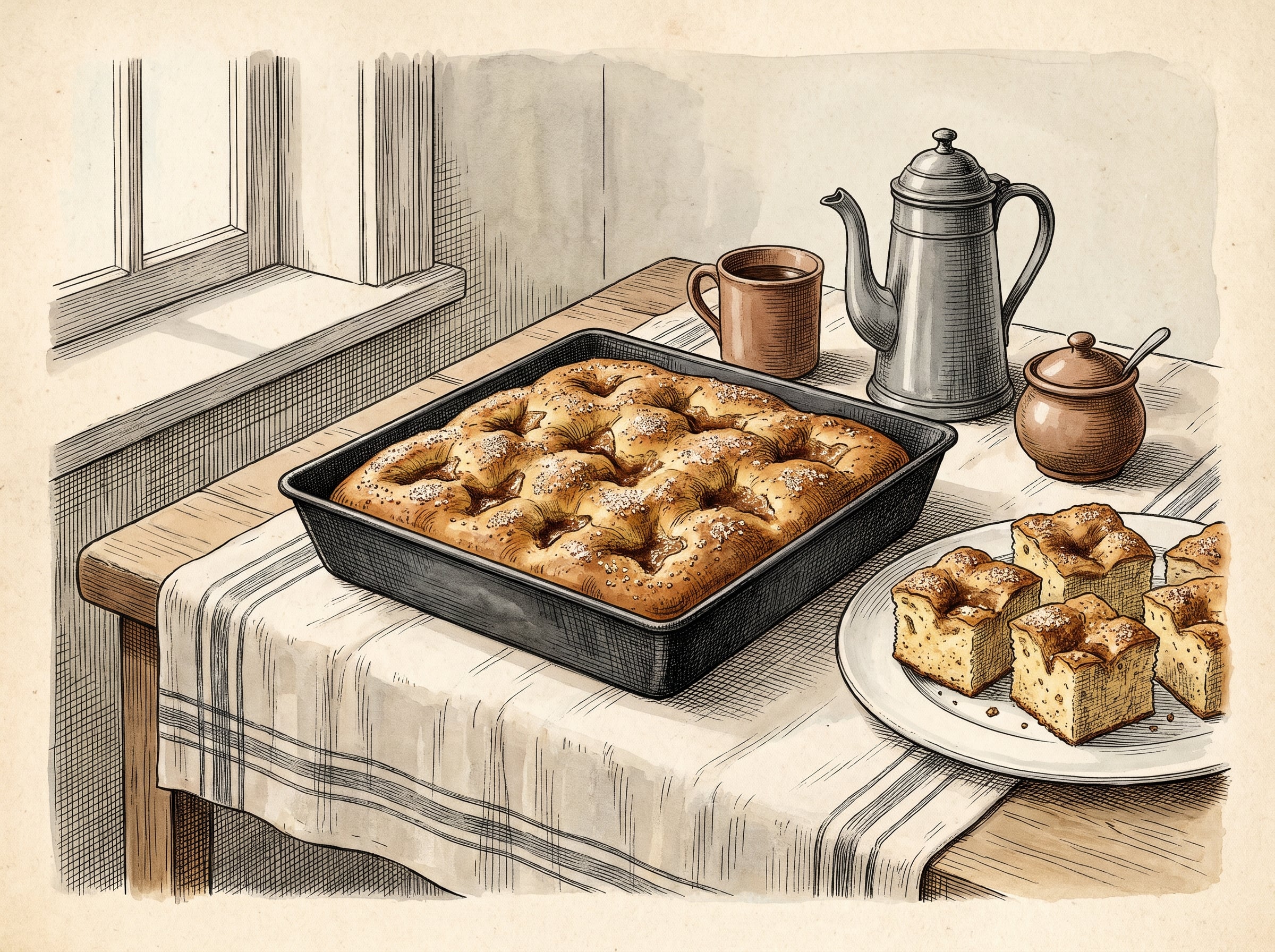
Most recipes end with a serving suggestion. Eliza Leslie ended this one with a warning: "do not attempt it unless you have excellent yeast." Behind that stern line sits a buttery, cinnamon-soaked cake often traced back to Bohemia, which came to America with the Moravians and turned up in a Philadelphia cookbook in 1840.
Please note that some of the images in this article were created with the assistance of AI.
From Directions for Cookery, in Its Various Branches (tenth edition), 1840
The Story Behind This Recipe
Miss Leslie Has a Warning
That closing warning tells you something about its author. Eliza Leslie (1787–1858), often called simply Miss Leslie, wrote popular American cookbooks in the nineteenth century. She wrote them for ordinary home cooks, and her advice here is practical, brisk and a little stern.
This recipe comes from the tenth edition of her Directions for Cookery, in Its Various Branches, printed in Philadelphia by E. L. Carey & A. Hart in 1840. A book does not reach a tenth edition by gathering dust, so plenty of kitchens were clearly keeping it within reach. She calls this "a very good plain cake" in the same breath that she warns readers off it. She knew how much rode on the yeast.
A Cake That Changed Its Name
Long before it reached Miss Leslie’s page, this cake had already traveled. It is often traced to the butterkuchen the Moravians baked in Bohemia, and it has close German cousins in the Zuckerkuchen, or "sugar cake," of Berlin and the Butterkuchen, or "butter cake," of Lüneburg. Moravians settled in Pennsylvania and North Carolina in the 1700s and founded Salem, North Carolina, in 1766. Their customs came with them.
The cake didn’t always have its sweet name. Joanna Roberts of Old Salem has explained that it was once called a "Great Cake," a label for any cake made with yeast, eggs, milk and butter. "Sugar Cake" came along in the nineteenth century, which fits Leslie’s 1840 title neatly. It was a regular at Moravian lovefeasts, gatherings where social rank was set aside for fellowship, held at Christmas and for birthdays. In Forsyth County, North Carolina, it has become a holiday staple and the favorite at Old Salem’s Winkler Bakery.
Yeast, Fire and a Good Eye
Almost everything here depends on things the cook couldn’t measure. The yeast was brewer’s yeast, and its strength varied enough that Leslie would only promise the dough "will most probably be light in two hours." The dough sat covered "near the fire to rise," then rose again in the pan, and the cook judged by eye when it was "quite light." The oven was simply "brisk," and the cake baked for "twenty minutes to half an hour, or more," depending on its thickness.
A modern sugar cake fan might notice what’s missing. Today’s versions usually lean on potatoes, and Roberts noted that sugar cake often contained them historically too. Leslie’s dough has none, just milk, butter, flour, yeast, salt, one egg and a spoonful of cinnamon. The topping is instantly familiar, though: brown sugar, butter and cinnamon pressed into "deep incisions" across the dough, the holes pinched partly shut, more sugar strewn on top, and squares cut once it cools.
1840s
Notes From the Era
The recipe · 1840
Moravian Sugar Cake
From Directions for Cookery, in Its Various Branches (tenth edition) by Eliza Leslie (1840). Every word of the recipe below is as printed.
Ingredients
- a quarter of a pound of butter
- a pint of rich milk
- three quarters of a pound of flour (or a pint and a half)
- a large table-spoonful of the best brewer’s yeast
- a salt-spoonful of salt
- a well-beaten egg
- three quarters of a pound more of sifted flour
- a table-spoonful of powdered cinnamon
- five ounces or a large coffee-cup of fine brown sugar
- two ounces of butter
- two table-spoonfuls of powdered cinnamon
- some sugar
Method
-
Warm the butter in the milk
Cut up a quarter of a pound of butter into a pint of rich milk, and warm it till the butter becomes soft; then stir it about in the milk so as to mix them well.
-
Make the dough and let it rise
Sift three quarters of a pound of flour (or a pint and a half) into a deep pan, and making a hole in the middle of it, stir in a large table-spoonful of the best brewer’s yeast in which a salt-spoonful of salt has been dissolved; and then thin it with the milk and butter. Cover it, and set it near the fire to rise. If the yeast is sufficiently strong, it will most probably be light in two hours.
-
Work in the egg, flour and cinnamon
When it is quite light, mix with the dough a well-beaten egg and three quarters of a pound more of sifted flour; adding a table-spoonful of powdered cinnamon, and stirring it very hard.
-
Pan the dough for a second rise
Butter a deep square baking pan, and put the mixture into it. Set it to rise again, as before.
-
Mix the sugar filling
Mix together five ounces or a large coffee-cup of fine brown sugar; two ounces of butter; and two table-spoonfuls of powdered cinnamon.
-
Fill the dough
When the dough is thoroughly light, make deep incisions all over it, at equal distances, and fill them with the mixture of butter, sugar and cinnamon; pressing it hard down into the bottom of the holes, and closing the dough a little at the top to prevent the seasoning from running out.
-
Bake, cool and cut
Strew some sugar over the top of the cake; set it immediately into the oven, and bake it from twenty minutes to half an hour, or more, in a brisk oven, in proportion to its thickness. When cool, cut it into squares. This is a very good plain cake; but do not attempt it unless you have excellent yeast.
Our notes
Reading It Today
The measures. A quarter of a pound of butter is one stick, or half a cup, and a pint of milk is 2 cups. Leslie gives the flour both ways: three quarters of a pound, or a pint and a half (3 cups by volume), used twice. The topping’s five ounces of brown sugar is what she reckons "a large coffee-cup" holds. A salt-spoonful was the tiny spoon that went with a salt cellar, so it means only a small amount.
Brewer’s yeast. In 1840 this meant live yeast taken from beer brewing, sold or shared as a thick liquid, with a strength that varied from batch to batch. It is not the same as the "brewer’s yeast" sold today as a nutritional supplement, which is inactive and won’t raise dough.
A brisk oven. "Brisk" means a hot oven. Leslie gives no temperature, only a time range, and she leaves it to the cook to judge doneness by how thick the cake is and how it looks.
What to expect. Judging from the ingredients, this is a soft, enriched yeast cake with cinnamon running through the dough itself, not just the top, and buttery pockets of melted brown sugar where the incisions were filled. Without potatoes it would likely be less moist and pillowy than most sugar cakes baked today. It would be closer to a plain, lightly enriched bread, with the sweetness concentrated where the topping went.
Source: Eliza Leslie, Directions for Cookery, in Its Various Branches (tenth edition) (E. L. Carey & A. Hart, Philadelphia, 1840). Read the 1840 book at Project Gutenberg.
Sources for the history
- Eliza Leslie, Directions for Cookery, in Its Various Branches, 10th ed. (Philadelphia: E. L. Carey & A. Hart, 1840)
- Eliza Leslie – Cookbook author (ckbk) [search-result text only; page not fetched]
- Moravian sugar cake (Wikipedia) [fetched; quote taken from search-result text of this page]
- Family History Recipe: Moravian Sugar Cake (New York State Library) [fetched; quote taken from search-result text of this page]
- Moravian Sugar Cake Mix (Old Salem Museums & Gardens) [search-result text only; page not fetched]
- Moravian Sugar Cake | Recipes from American History (Compass Classroom) [fetched]
- Forsyth County: Moravian Sugar Cake (The Gastronome’s Table) [fetched]
The original recipe text is from a work published in 1840 and is in the public domain in the United States. The history, notes and illustrations are Digstalk’s own. Brand names that appear in historic recipes are mentioned as historical fact only. Illustrations are AI-generated in a vintage style. The recipe is shown exactly as it was published in 1840; we have not photographed a test batch.