
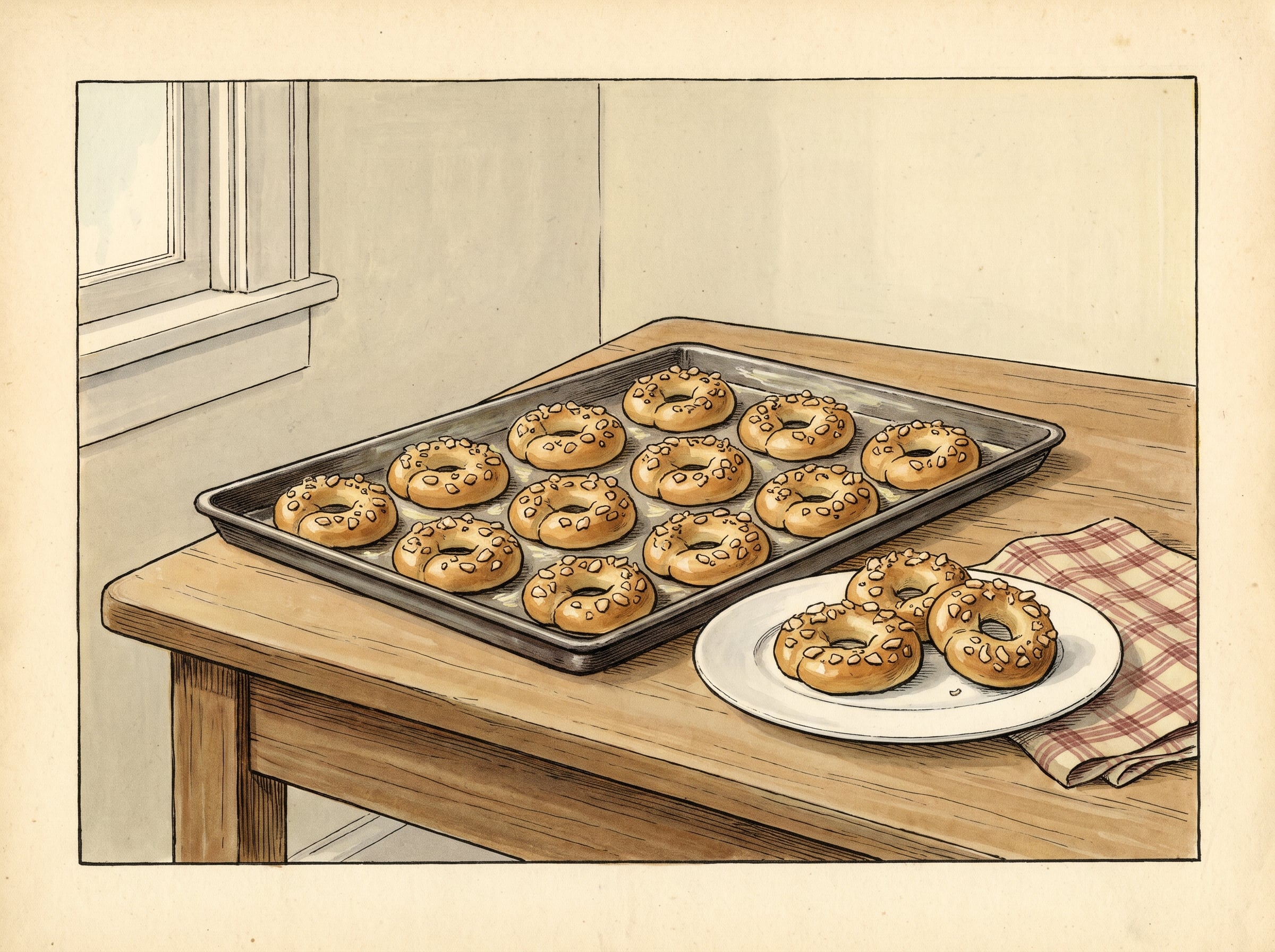
In 1915, a Pittsburgh cookbook sold with a slogan that was also an argument: "The Best Cooks Are Suffragists." Tucked among its recipes is a short one that turns a cup of ordinary bread dough into small almond-crusted rings and calls them "Swedish Wreathes." It takes five short sentences to tell, and those five sentences carry a Norse word, a political campaign and a household that baked its own bread.
Please note that some of the images in this article were created with the assistance of AI.
From The Suffrage Cook Book, 1915
The Story Behind This Recipe
The best cooks are suffragists
On the cover of The Suffrage Cook Book, Uncle Sam holds a scale with men on one side and women on the other, perfectly level. The book was published in Pittsburgh in 1915 by the Equal Franchise Federation of Western Pennsylvania and compiled by Mrs. L. O. Kleber, about whom we know very little. A rare-book dealer, quoting the Guardian, calls her a little-known member of the Pittsburgh suffrage society. Her work is easier to see than her life. She wrote to dozens of leading women and men in the movement in Britain and the United States and asked them to contribute, so the book could raise money for the campaign for the women’s vote.
Recipes came from group members and from famous names, including Jane Addams, Jack London and Charlotte Perkins Gilman. Short political pieces sat between the recipes, so a cook looking up a dish ran into the case for the vote on the way. The Library of Congress counts at least six American suffrage cookbooks published between 1886 and 1920. They raised money, drew in members and answered a stubborn fear that women with the vote would neglect the home. A reliable recipe made a quiet rebuttal.
A ring by any other name
The Scandinavian baking word kringla goes back to Old Norse and means a ring or circle. In Swedish, kringlor are pretzel-shaped cookies or breads, and the name describes a shape rather than one fixed recipe. Cajsa Warg’s household book, first printed in 1755, already gave several versions, some made with sweetened yeast dough and others with a simpler butter dough. Today Swedes eat kringlor as small pastries with coffee. The well-known sockerkringla is an enriched yeast dough flavored with cardamom and dipped in sugar.
The Pittsburgh recipe falls somewhere between Warg’s two kinds of dough. It starts with yeast bread dough, then works a quarter cup each of butter and lard into that one cup. After that it skips the twist altogether: the dough is rolled into sticks and the ends are simply closed into rings.
Bread dough, dressed up
Next to its Scandinavian relatives, this version is plain. It has no sugar, no cardamom, no filling and no glaze, only blanched almonds that are chopped, salted and pressed onto the top of each ring. It is also thrifty, because it borrows a cup from dough already on hand for the family’s bread. Swedish names on American recipes often have their own stories. Food writer Fanny Zanotti traces the glazed Midwestern "Swedish kringle" back to walesbröd, a choux pastry baked in strips. Our 1915 rings are an earlier example and have no connection to it.
Were they holiday baking? The sources we found don’t say, and the book doesn’t either. Rings do turn up across Nordic baking, from the filled Danish kringle to Norway’s wreath of joined cinnamon buns, and the sockerkringla is often eaten at Swedish fika, especially around the holidays. A tray of these would look at home among them, but the 1915 page only promises rings baked "until brown."
1910s
Notes From the Era
The recipe · 1915
Swedish Wreathes
From The Suffrage Cook Book by Mrs. L. O. Kleber (compiler) (1915). Every word of the recipe below is as printed.
Ingredients
- 1 cup of bread dough
- 1/4 cup butter
- 1/4 cup lard
- enough flour to prevent sticking
- blanched almonds that have been chopped and salted
- buttered baking sheets
Method
-
Work the dough with butter and lard
Work 1 cup of bread dough, 1/4 cup butter and 1/4 cup lard, using the hands.
-
Knead on a floured board
When thoroughly blended, toss on floured board and knead, using enough flour to prevent sticking.
-
Shape the rings and top with almonds
Cut off pieces and roll like bread stick; shape into rings, dip upper surface in blanched almonds that have been chopped and salted.
-
Arrange on baking sheets
Arrange on buttered baking sheets.
-
Bake
Bake in hot oven until brown.
Our notes
Reading It Today
"1 cup of bread dough". The recipe begins with dough that is already made and never explains how to make it. It assumes a plain yeast bread dough was already in the kitchen. Any basic risen bread dough fits the description. The measure is by volume, so the cook scoops out a cupful.
"Hot oven". No temperature or time is given. In older cookbooks, a "hot oven" usually meant roughly 400 to 450°F. The only signal for doneness is color, so the cook takes the rings out once they are brown.
What the rings would be like. Half a cup of fat worked into a single cup of bread dough makes these far richer than ordinary bread. Judging from the ingredients, they would be tender and short rather than chewy, with a savory edge from the lard and a salty, toasty almond crust on top.
Not a sweet bread. Many Scandinavian kringlor are finished with sugar or glaze, like the sugar-dipped sockerkringla. These rings have no sugar at all, and the salted almonds push them toward a nibble to eat with coffee or alongside a meal. Shaping is simple too: roll a rope and close it into a circle, with no braiding or twisting.
Source: Mrs. L. O. Kleber (compiler), The Suffrage Cook Book (The Equal Franchise Federation of Western Pennsylvania, Pittsburgh, 1915). Read the 1915 book at Project Gutenberg.
Sources for the history
- The Suffrage Cook Book (Mrs. L. O. Kleber, comp., 1915), recipe "Swedish Wreathes"
- "The Best Cooks Are Suffragists" – Shall Not Be Denied: Women Fight for the Vote, Library of Congress
- Suffrage Cook Book First Edition – Bauman Rare Books
- Kringle – Wikipedia
- The Swedish kringle that wasn’t – Fanny Zanotti, The bakers’ cottage
The original recipe text is from a work published in 1915 and is in the public domain in the United States. The history, notes and illustrations are Digstalk’s own. Brand names that appear in historic recipes are mentioned as historical fact only. Illustrations are AI-generated in a vintage style. The recipe is shown exactly as it was published in 1915; we have not photographed a test batch.