
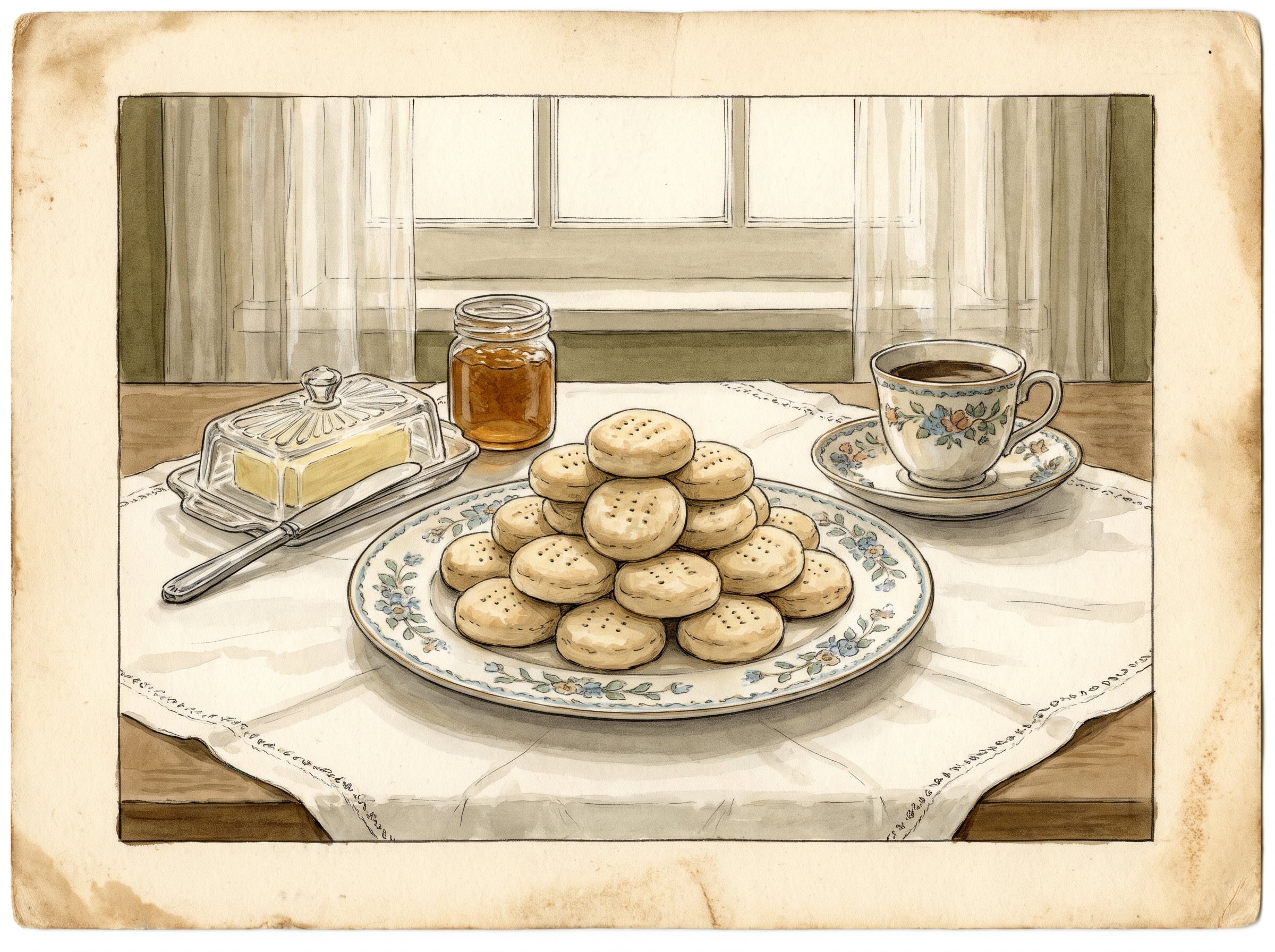
A hundred blows of a mallet, and not a pinch of baking powder. That is the whole secret of this 1913 Southern biscuit, which rises on nothing but air pounded into a stiff dough of flour, lard, salt and ice water. Even its author, Martha McCulloch-Williams, labeled it ‘Old Style,’ as if she were catching it on its way out the door.
Please note that some of the images in this article were created with the assistance of AI.
From Dishes & Beverages of the Old South, 1913
The Story Behind This Recipe
A cook who explains herself
Most old recipes give orders. Martha McCulloch-Williams stops to tell you why. Partway through her beaten biscuit instructions, she explains that all that pounding exists to spread air through the dough. In the oven’s heat that air swells and lifts the biscuit. It is the kind of aside you would get from a seasoned cook standing at your elbow, and it turns a chore into something closer to a lesson.
The recipe comes from her book Dishes & Beverages of the Old South, published in New York in 1913 by McBride, Nast & Company. She headed it ‘Beaten Biscuit: (Old Style.)’, and that small parenthesis says a lot. By 1913 there was a newer way to make biscuits, and she wanted the older one on record. She knows exactly how the dough should feel when it is ready: firm, smooth and very elastic. She is frank about the oven, too. Too hot, and the biscuits scorch and blister. Too cool, and they come out hard and clammy. Her advice is to aim for what she calls the Irishman’s ‘middle exthrame.’
Cousin to hardtack
Forget the tall, fluffy biscuit on a modern breakfast plate. The beaten biscuit belongs to another branch of the family, one closer to hardtack. In New England a similar bread went by ‘sea biscuit,’ a staple aboard whaling ships, and Maryland is known for beaten biscuits too. The dish is most closely tied to the American South, where it goes back to the 19th century.
The classic dough was a short list: flour, salt, sugar, lard and cold water. McCulloch-Williams trims it further by leaving out the sugar. There is no baking powder either, though some modern cooks add it. Otherwise she follows the standard routine for the dish. The dough takes a hard beating, the rounds are cut smaller than an everyday biscuit, and each one is pricked before it goes into the oven.
A hundred strokes, and whose arms
Nobody agreed on how long the beating should last. Recipes called for anything from at least 15 minutes to 30 or even 45, and the tools ranged from a rolling pin to a hammer to the side of an axe. One cookbook demanded at least 200 blows and suggested putting boys to work on it. Next to that, McCulloch-Williams’s hundred strokes, with the dough folded over whenever it spreads thin, sound almost modest. The work also had a darker history. As Smithsonian Magazine has noted, this ‘prolonged and violent’ labor often fell to enslaved cooks. The sheer effort is a big reason the biscuit slowly fell out of favor, and it only became practical again once food processors arrived.
Inventors looked for a way to save the labor. On December 7, 1880, James Ignatius Lednum of Denton, Maryland, patented a ‘Kneading Machine,’ which the Denton Journal advertised as a faster way to make biscuits. It was a roller mounted on a hardwood or marble slab, and the cook fed the dough through as the roller turned. Machines like it came to be called biscuit brakes. Thirty-odd years later, McCulloch-Williams still assumes a cook with a floured block or marble slab and a strong arm. The payoff was a sturdy little biscuit that could keep for months in an airtight container. Split, buttered and filled with country ham, it became the ham biscuit, a traditional Southern party bite. It was sometimes known by a gentler name: Sunday biscuits.
1910s
Notes From the Era
The recipe · 1913
Beaten Biscuit (Old Style)
From Dishes & Beverages of the Old South by Martha McCulloch-Williams (1913). Every word of the recipe below is as printed.
Ingredients
- a quart of flour
- half a teaspoon salt
- a teacup of very cold lard
- cold water–ice water is best
- flour (for dredging)
Method
-
Mix a very stiff dough
Sift a quart of flour into a bowl or tray, add half a teaspoon salt, then cut small into it a teacup of very cold lard. Wet with cold water–ice water is best–into a very stiff dough.
-
Beat the dough
Lay on a floured block, or marble slab, and give one hundred strokes with a mallet or rolling pin. Fold afresh as the dough beats thin, dredging in flour if it begins to stick.
-
Know why you beat
The end of beating is to distribute air well through the mass, which, expanding by the heat of baking, makes the biscuit light. The dough should be firm, but smooth and very elastic.
-
Roll, cut, prick and bake
Roll to half-inch thickness, cut out with a small round cutter, prick lightly all over the top, and bake in steady heat to a delicate brown.
-
Mind the oven heat
Too hot an oven will scorch and blister, too cold an one make the biscuit hard and clammy. Aim for the Irishman’s "middle exthrame."
Our notes
Reading It Today
A quart and a teacup. A quart is about 4 cups (a little more if she meant a dry quart), so the recipe starts with about 4 cups of flour, sifted. The teacup of lard is a household measure with no fixed size, since teacups varied from kitchen to kitchen. The half teaspoon of salt is the only ingredient measured by the spoon.
The ‘middle exthrame’. There is no oven temperature, only ‘steady heat’ and a warning against extremes in either direction. ‘Middle exthrame’ is a joke for a moderate heat. For comparison, one modern recipe bakes beaten biscuits at 325°F for about 20 minutes. Some bakers prefer them pale rather than browned.
What the texture would be. With no yeast, soda or baking powder, and only beaten-in air to lift it, this dough would bake into something dense and fine-grained. Expect a firm, close crumb and a crisp outside, more like a rich cracker than a soft roll. With no sugar, the flavor would be plain and savory, lightly salted and rich from the lard. The pricked tops are part of the standard method for the dish.
Not your breakfast biscuit. A typical biscuit today rises quickly on baking powder. This one is small, firm and made to last for months if kept airtight. It was split, buttered and filled with country ham.
Source: Martha McCulloch-Williams, Dishes & Beverages of the Old South (McBride, Nast & Company, New York, 1913). Read the 1913 book at Project Gutenberg.
Sources for the history
- Martha McCulloch-Williams, Dishes & Beverages of the Old South (McBride, Nast & Company, 1913), Project Gutenberg
- Beaten biscuit – Wikipedia
- Maryland Biscuit Worker – "A Labor of Love": Baking Traditions Across the Eastern Shore of Maryland, Nabb Research Center Online Exhibits, Salisbury University
- Historians Say They’ve Solved the Mystery of a Curious 100-Year-Old Contraption Discovered in Storage – Smithsonian Magazine
The original recipe text is from a work published in 1913 and is in the public domain in the United States. The history, notes and illustrations are Digstalk’s own. Brand names that appear in historic recipes are mentioned as historical fact only. Illustrations are AI-generated in a vintage style. The recipe is shown exactly as it was published in 1913; we have not photographed a test batch.