
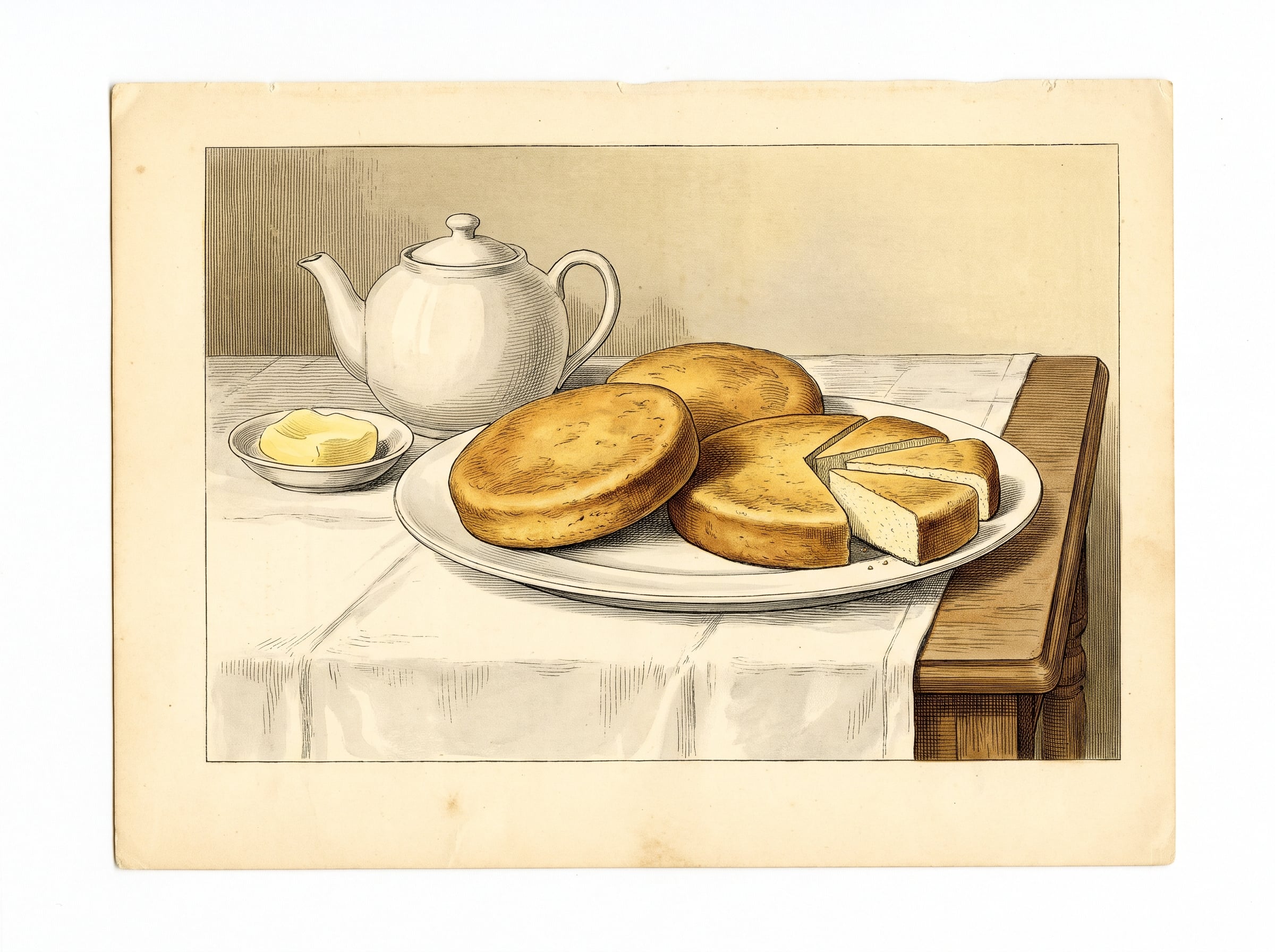
Most Sally Lunns take their time, rising slowly on yeast the way a proper English teacake should. This one, from an 1859 Boston household manual, skips the yeast entirely and comes out of the oven in about twenty minutes. It catches a moment when American home cooks were learning to make bread rise with a spoonful of soda and a little cream of tartar.
Please note that some of the images in this article were created with the assistance of AI.
From The Young Housekeeper’s Friend (Revised and Enlarged), 1859
The Story Behind This Recipe
A minister’s daughter with advice to give
In 1810 a girl from Goshen, Connecticut, named Mary Ann Hooker was a student at the Litchfield Female Academy. She was born on April 17, 1796, to the Rev. Asahel Hooker and Phoebe Edwards Hooker, so a life among ministers came naturally. In 1818 she married one, Elias Cornelius, who had trained at Yale. The next year he became associate pastor of the Tabernacle Church in Salem, Massachusetts. The couple had six children. In 1831 Elias was named secretary of the American Board of Commissioners for Foreign Missions, but he fell ill and died in February 1832.
Mary was already a writer by then. Her religious tracts included one on how a Christian mother should guide her young children. In 1849 she turned to the household with The Young Housekeeper’s Friend, and the book kept going. A revised and enlarged edition was still being printed ten years later, and our recipe comes from that 1859 version. She died in Newton, Massachusetts, on October 17, 1880.
A bun from Bath, a legend from nowhere
In 1780 a Bath guidebook described visitors to the spa finishing their glass of mineral water and then eating "Sally Lunns or hot spungy rolls." The name had already appeared in an Irish poem of 1776, but nobody knows for sure where it came from. In England a Sally Lunn was a large bun or teacake made from a yeast dough rich with cream and eggs, a near relative of French brioche. One theory hears the French soleil et lune, sun and moon, in the name, for the golden top and pale inside. A tea room in Bath tells of a Huguenot refugee called Solange Luyon, but no record of her turns up before the 20th century.
The French had their own version. The Parisian chef Carême published a warm brioche called the solilem in 1815, and in 1845 Eliza Acton gave English cooks a "Solimemne," which she described as a rich French breakfast cake or Sally Lunn. Dickens put Sally Lunns beside muffins and crumpets in The Chimes (1844). British colonists had already carried the recipe across the Atlantic, where Americans kept reworking it.
Soda, cream of tartar and a few minutes’ stirring
Mrs. Cornelius kept the familiar base of flour, butter, eggs, milk and a little sugar, and dropped the yeast. Her cook scatters cream of tartar into the flour, adds the eggs unbeaten, dissolves saleratus in the second cup of milk, and stirs "steadily a few minutes." Three plate-sized pans bake in fifteen or twenty minutes. One bread historian dates baking powder breads in America to the 1830s, but ready-made powder was still new, so this cook measures out her own soda and acid.
Speed was only part of the appeal. Many Americans believed sour foods upset the stomach, and soda breads were recommended for "dyspeptics." A Sally Lunn like this one could also be ready for an afternoon or holiday tea at short notice. An 1892 newspaper even said the Sally Lunn had been called "Washington’s breakfast bread." Cornelius’s last line shows how close it sat to dessert: add spice, double the sugar, and "you have a good plain cake for the cake-basket."
1850s
Notes From the Era
The recipe · 1859
Sally Lunn
From The Young Housekeeper’s Friend (Revised and Enlarged) by Mary Hooker Cornelius (1859). Every word of the recipe below is as printed.
Ingredients
- A quart of flour
- a piece of butter the size of an egg
- three table-spoonfuls of sugar
- two eggs
- two teacups of milk
- two teaspoonfuls of cream of tartar
- one of saleratus
- a little salt
Method
-
Gather the ingredients
A quart of flour, a piece of butter the size of an egg, three table-spoonfuls of sugar, two eggs, two teacups of milk, two teaspoonfuls of cream of tartar, one of saleratus, and a little salt.
-
Mix the batter
To mix it, scatter the cream of tartar, the salt, and the sugar into the flour; add the eggs without having beaten them, the butter melted, and one cup of the milk; dissolve the saleratus in the remaining cup, and then stir all together steadily a few minutes.
-
Bake in three pans
Bake in three pans the size of a breakfast plate, fifteen or twenty minutes.
-
Make less for a small family
For a family of four or five, make half the measure.
-
Turn it into a plain cake
Add spice, and twice the measure of sugar, and you have a good plain cake for the cake-basket.
Our notes
Reading It Today
Saleratus and cream of tartar. Saleratus is baking soda. Cream of tartar is the acid that makes it fizz. Two parts cream of tartar to one part soda is essentially a homemade baking powder, mixed by hand before boxed powders were common.
Quarts, teacups and eggs of butter. A quart of flour is 4 cups by volume. A teacup was smaller than today’s measuring cup, often reckoned at about three-quarters of a cup. Butter "the size of an egg" is usually taken as about 1/4 cup (2 oz). A breakfast plate suggests a shallow round pan somewhat smaller than a dinner plate.
What the bread would be like. Judging from the ingredients, expect a tender, cake-like crumb, golden from the eggs and only lightly sweet. With no yeast there is no yeasty tang. It would be closer to a soft shortcake or plain coffee cake than to a chewy loaf, and best eaten warm with butter.
How it differs from bread today. The classic English Sally Lunn is a yeasted bun that has to be left to rise. This one has no kneading and no rising time: just stir, pan and bake. That makes it a quick bread, like muffins or soda bread, and a very fast one at that.
Source: Mary Hooker Cornelius, The Young Housekeeper’s Friend (Revised and Enlarged) (Taggard and Thompson, Boston, 1859). Read the 1859 book at Project Gutenberg.
Sources for the history
- Mary Hooker Cornelius, The Young Housekeeper’s Friend (Revised and Enlarged), Taggard and Thompson, Boston, 1859
- Mary Ann Hooker Cornelius – Litchfield Ledger, Litchfield Historical Society
- Mrs. Cornelius’ New York Ginger Snaps (1849) – Erin E. Moulton
- Elias Cornelius – Wikipedia
- Sally Lunn bun – Wikipedia
- The Squishy History of Bath’s Buns – Smithsonian Magazine
- The solilème or "Sally Lunn" – napoleon.org (Fondation Napoléon)
- American Bread Recipes from the 19th Century – William Rubel
The original recipe text is from a work published in 1859 and is in the public domain in the United States. The history, notes and illustrations are Digstalk’s own. Brand names that appear in historic recipes are mentioned as historical fact only. Illustrations are AI-generated in a vintage style. The recipe is shown exactly as it was published in 1859; we have not photographed a test batch.