
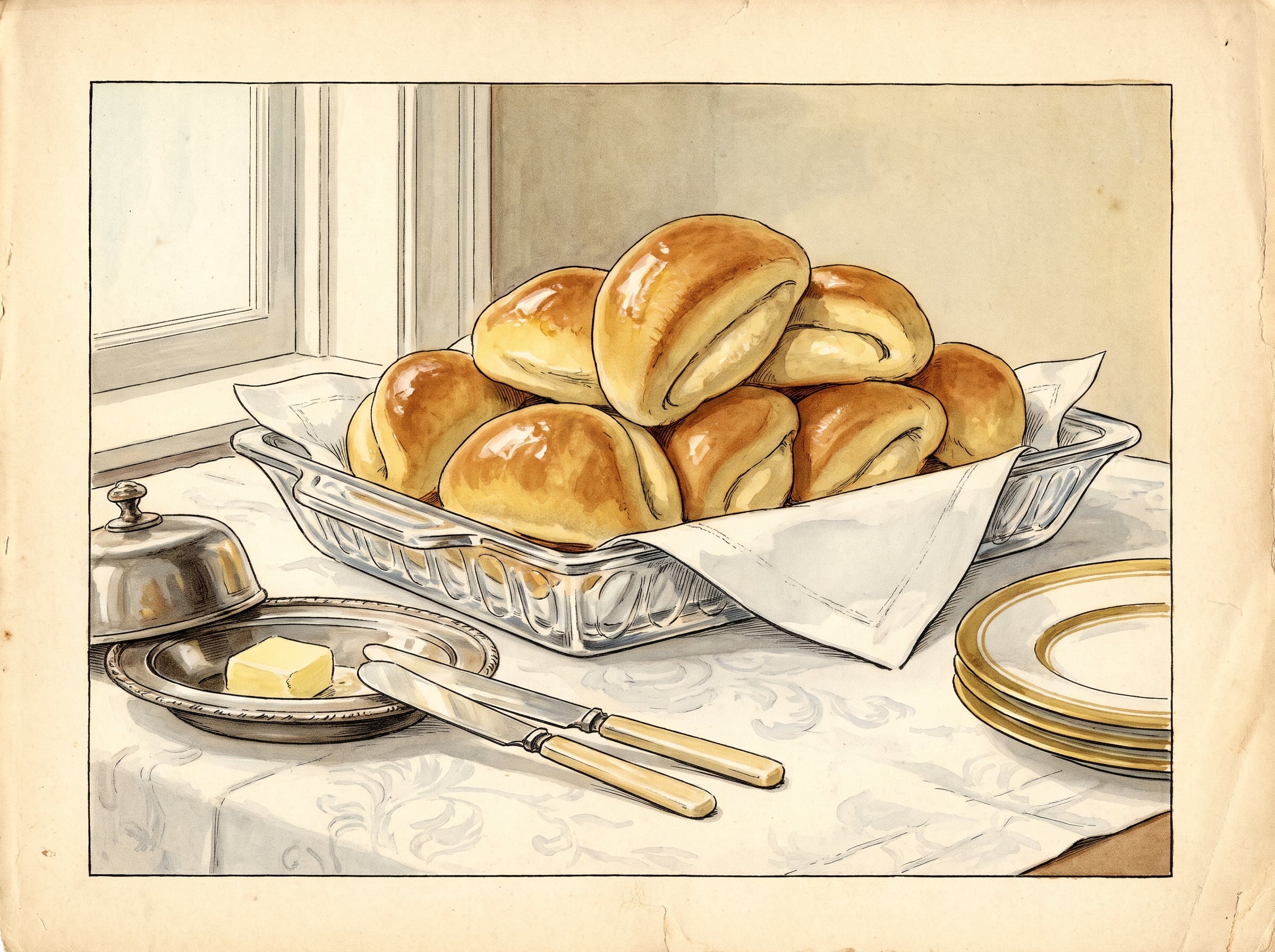
Most family recipes reach the kitchen through a grandmother. This one came from a Boston hotel that kept its own version secret for decades. Fannie Farmer printed one anyway, with level measurements, a floured knife handle and a buttered fold that lets each roll open slightly as it rises.
Please note that some of the images in this article were created with the assistance of AI.
From The Boston Cooking-School Cook Book, 1910
The Story Behind This Recipe
The cook who leveled the spoon
At 16, Fannie Merritt Farmer lost her hopes of more schooling to an illness that paralyzed her left leg. She recovered, but she walked with a limp for the rest of her life. Born in Boston on March 23, 1857, and raised mostly in nearby Medford, she found her direction while working as a mother’s helper for Mrs. Charles Shaw. Shaw noticed how well she cooked and urged her toward the Boston Cooking School, which trained both future professional cooks and people cooking for their own families. Farmer enrolled in 1887, graduated two years later, stayed on as assistant principal and was running the school by 1891.
In 1896 she published The Boston Cooking-School Cook Book. Little, Brown doubted it would sell and printed only 3,000 copies. According to the Boston Public Library, Farmer paid for that first printing herself and kept the copyright. It was a good bet. The book was an immediate success, and in 1902 it helped pay for Miss Farmer’s School of Cookery, with four kitchens, 10 teachers and students ranging from aspiring cooks and waitresses to housewives, housemaids and nurses. She went on to lecture at Harvard Medical School before she died in Boston in 1915.
A roll with a hotel address
By one account, the composer Jacques Offenbach stayed at Boston’s Parker House in 1876 and praised its rolls at dinner. They were fairly new then. Harvey D. Parker had opened the hotel in 1855 on the "European Plan," which meant guests paid for their rooms and their meals separately. The hotel’s history says this arrangement pushed its chefs to invent new dishes. Two of those inventions still carry the name of the city or the hotel: Boston cream pie and the Parker House roll.
Who made the first one depends on which story you hear. Many accounts place it in the 1870s, and one credits a German baker named Ward. The best-known legend has an angry baker throwing unfinished rolls into the oven. Whatever happened, the hotel knew it had something. It sold the rolls to other restaurants, hotels and stores, and it kept the exact recipe secret until 1933. That year Franklin and Eleanor Roosevelt asked for it, and the hotel gave it to them.
Out of the hotel, into the home oven
The secret didn’t stop anyone. By the 1880s cookbooks were printing their own Parker House rolls, including one by Mary Johnson Lincoln, the Boston Cooking School’s first principal. Farmer’s 1910 version shows her usual style. Older books often trusted the cook’s judgment. She gives exact amounts instead: 2 cups of milk, 3 tablespoons of butter, 1 teaspoon of salt. That habit earned her the nickname "Mother of Level Measurements." Even the flour, which has no amount in the ingredient list, gets counted in the method.
Other details belong to her era. The "yeast cake" was compressed yeast, the kind Charles and Max Fleischmann patented at their Cincinnati plant and showed off at the 1876 Centennial Exposition in Philadelphia. Unlike today’s dry yeast, it needed to be kept cold. The oven is simply "hot," with no number, in a book that started its lessons with how to prepare a fire. We don’t know much about how families served these rolls at holidays around 1910. Today, though, the hotel’s bakery still takes private orders for them at Thanksgiving and Christmas.
1910s
Notes From the Era
The recipe · 1910
Parker House Rolls
From The Boston Cooking-School Cook Book by Fannie Merritt Farmer (1910). Every word of the recipe below is as printed.
Ingredients
- 2 cups scalded milk
- 3 tablespoons butter
- 2 tablespoons sugar
- 1 teaspoon salt
- 1 yeast cake dissolved in
- ¼ cup lukewarm water
- Flour
Method
-
Mix the milk, yeast and first flour
Add butter, sugar, and salt to milk; when lukewarm, add dissolved yeast cake and three cups of flour.
-
Beat, rise and add more flour
Beat thoroughly, cover, and let rise until light; cut down, and add enough flour to knead (it will take about two and one-half cups).
-
Rise again, knead and roll out
Let rise again, toss on slightly floured board, knead, pat, and roll out to one-third inch thickness.
-
Cut the rounds
Shape with biscuit-cutter, first dipped in flour.
-
Crease, butter and fold
Dip the handle of a case knife in flour, and with it make a crease through the middle of each piece; brush over one-half of each piece with melted butter, fold, and press edges together.
-
Final rise and bake
Place in greased pan, one inch apart, cover, let rise, and bake in hot oven twelve to fifteen minutes. As rolls rise they will part slightly, and if hastened in rising are apt to lose their shape.
Our notes
Reading It Today
Scalded, then lukewarm. Scalded milk is milk heated until it is just below boiling, when small bubbles form around the edge of the pan. Farmer stirs in the butter, sugar and salt while the milk is hot. She waits until it cools to lukewarm before adding the yeast, because heat can kill yeast.
The yeast cake. A yeast cake is a small block of fresh compressed yeast. It is soft and moist, and it has to be refrigerated. Fresh yeast is still sold in some stores. The recipe dissolves the cake in a quarter cup of lukewarm water before adding it to the milk.
A hot oven and a thin roll. Cookbooks of this period used "hot oven" to mean roughly 400 to 450°F. The dough is rolled to one-third inch thick before it is cut and folded, and the rolls bake in just twelve to fifteen minutes.
What kind of bread this is. Milk, butter and a little sugar should give these rolls a soft, tender crumb and a mild sweetness. A lean loaf made only of flour, water, salt and yeast would be chewier and crustier. The recipe uses no eggs. The butter brushed inside the fold keeps the two halves from fully sticking together, so each roll pulls apart easily along the crease.
Source: Fannie Merritt Farmer, The Boston Cooking-School Cook Book (Little, Brown, and Company, Boston, 1910). Read the 1910 book at Project Gutenberg.
Sources for the history
- Fannie Merritt Farmer, The Boston Cooking-School Cook Book (Little, Brown, and Company, Boston, 1910)
- Fannie Farmer (1857-1915), Massachusetts Women’s History Center
- Fannie Farmer: Boston’s Cooking Icon, Boston Public Library
- Fannie Merritt Farmer (1857-1915), Mount Auburn Cemetery
- The Boston Cooking-School Cook Book, Wikipedia
- Boston Cooking School, Wikipedia
- Parker House roll, Wikipedia
- Parker House Rolls, CooksInfo
- History of Omni Parker House, Historic Hotels of America
- Our History, Fleischmann’s Yeast
The original recipe text is from a work published in 1910 and is in the public domain in the United States. The history, notes and illustrations are Digstalk’s own. Brand names that appear in historic recipes are mentioned as historical fact only. Illustrations are AI-generated in a vintage style. The recipe is shown exactly as it was published in 1910; we have not photographed a test batch.