
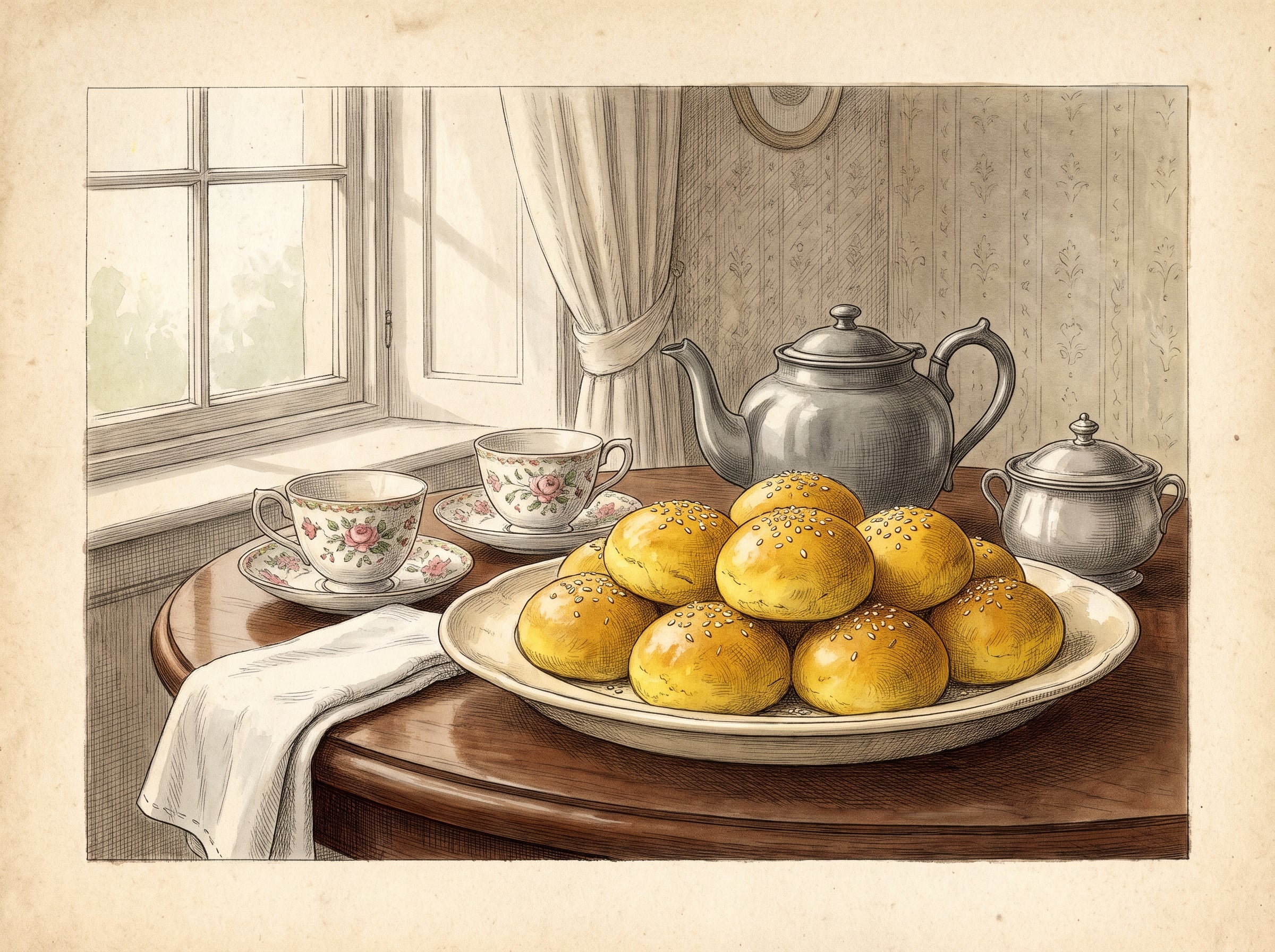
Eliza Leslie’s Bath buns turn gold before they ever reach the oven, tinted with a saffron tea and finished with a scatter of sugared caraway. She printed them in Philadelphia in 1840. They are an English bun worked out in an American kitchen, with the dough set to rise by the fire. She also had one firm rule: eat them the day they’re baked.
Please note that some of the images in this article were created with the assistance of AI.
From Directions for Cookery, in Its Various Branches (tenth edition), 1840
The Story Behind This Recipe
Miss Leslie of Philadelphia
Her readers didn’t need her first name. To them she was simply Miss Leslie. Eliza Leslie was born in Philadelphia on November 15, 1787, the daughter of Lydia Baker and Robert Leslie. She lived to 70 and died on New Year’s Day, 1858, in Gloucester City, New Jersey.
This recipe comes from her Directions for Cookery, in Its Various Branches. The copy we’re reading is the tenth edition, printed in Philadelphia by E. L. Carey & A. Hart in 1840.
An English bun, dyed gold
It starts with a pinch of saffron and a pot of water. Leslie boils the two together until the liquid turns bright yellow, then strains it and lets it cool. That golden tea is there for one reason, and she states it plainly: ‘to colour it yellow.’ The bun is English, but here it’s being made in an American kitchen, with a Philadelphia cook giving the orders.
This is no plain dinner roll. Half a pound of fresh butter gets rubbed into a pound of sifted flour. Four well-beaten eggs bind it, and ‘a large wine glass of the best and strongest yeast’ gives it lift. Then comes caraway, twice over. Two or three spoonfuls of seeds can go into the dough if you like, but the topping isn’t optional. Every bun gets a strewing of caraway comfits before it’s baked.
Fire, loaf sugar and a deadline
Picture the pan sitting by the hearth with a cloth over it. Leslie’s instruction is to ‘set it before the fire to rise,’ and no clock is involved. The cook watched until the dough was ‘quite light’ and trusted her eyes. Even the yeast called for judgment, since it was measured by the wine glass and was only as good as its strength.
The sugar came with its own chore. It came off a solid loaf, so someone had to break it, powder it and sift it before a quarter pound could join the dough, along with an entire grated nutmeg. All of that goes in only after the first rise. Next the dough is rolled into a thick sheet and cut into rounds with a cutter, so the buns come out tidy and even. They bake on well-buttered flat tins. Leslie’s last word is a deadline: the buns ‘should be eaten the day they are baked, as they are not good unless quite fresh.’ These were meant for that day’s table, not for tomorrow’s bread box.
1840s
Notes From the Era
The recipe · 1840
Bath Buns
From Directions for Cookery, in Its Various Branches (tenth edition) by Eliza Leslie (1840). Every word of the recipe below is as printed.
Ingredients
- a little saffron
- sufficient water to cover it
- half a pound of fresh butter
- a pound of sifted flour
- four eggs that have been well beaten
- a large wine glass of the best and strongest yeast
- a quarter of a pound of powdered and sifted loaf-sugar
- a grated nutmeg
- two or three spoonfuls of carraway seeds
- carraway comfits
Method
-
Make the saffron infusion
Boil a little saffron in sufficient water to cover it, till the liquid is of a bright yellow; then strain it, and set it to cool.
-
Mix the dough
Rub half a pound of fresh butter into a pound of sifted flour, and make it into a paste with four eggs that have been well beaten, and a large wine glass of the best and strongest yeast; adding the infusion of saffron to colour it yellow.
-
Let the dough rise
Put the dough into a pan, cover it with a cloth, and set it before the fire to rise.
-
Add sugar, nutmeg and seeds
When it is quite light, mix into it a quarter of a pound of powdered and sifted loaf-sugar; a grated nutmeg; and, if you choose, two or three spoonfuls of carraway seeds.
-
Roll and cut the buns
Roll out the dough into a thick sheet, and divide it into round cakes with a cutter.
-
Top with comfits and bake
Strew the top of each bun with carraway comfits, and bake them on flat tins buttered well.
-
Eat them fresh
They should be eaten the day they are baked, as they are not good unless quite fresh.
Our notes
Reading It Today
A wine glass of yeast. As a kitchen measure, a wineglass usually meant about 2 fluid ounces, or a quarter cup, and Leslie’s ‘large’ suggests a little more. This is liquid yeast, not dry granules from a packet, so the amount doesn’t convert directly to modern yeast.
Loaf sugar and comfits. Loaf sugar was refined white sugar sold as a hard block or cone. Once it was powdered and sifted, it was close to today’s superfine sugar. Caraway comfits are caraway seeds coated in layers of hard sugar, a crunchy, sweet little topping.
The measures in cups. A pound of flour is roughly 3½ cups, half a pound of butter is 1 cup (two sticks), and a quarter pound of sugar is about ½ cup. A whole nutmeg grated gives a generous 2 to 3 teaspoons, so the spice is meant to stand out.
What kind of bun this is. Judging from the ingredients, these would be rich and tender, more like brioche than sandwich bread. They’d be golden from saffron and egg, warm with nutmeg, and sharp with caraway on top. The dough uses no milk, gets its sugar only after rising, and is cut rather than shaped.
Source: Eliza Leslie, Directions for Cookery, in Its Various Branches (tenth edition) (E. L. Carey & A. Hart, Philadelphia, 1840). Read the 1840 book at Project Gutenberg.
Sources for the history
The original recipe text is from a work published in 1840 and is in the public domain in the United States. The history, notes and illustrations are Digstalk’s own. Brand names that appear in historic recipes are mentioned as historical fact only. Illustrations are AI-generated in a vintage style. The recipe is shown exactly as it was published in 1840; we have not photographed a test batch.