
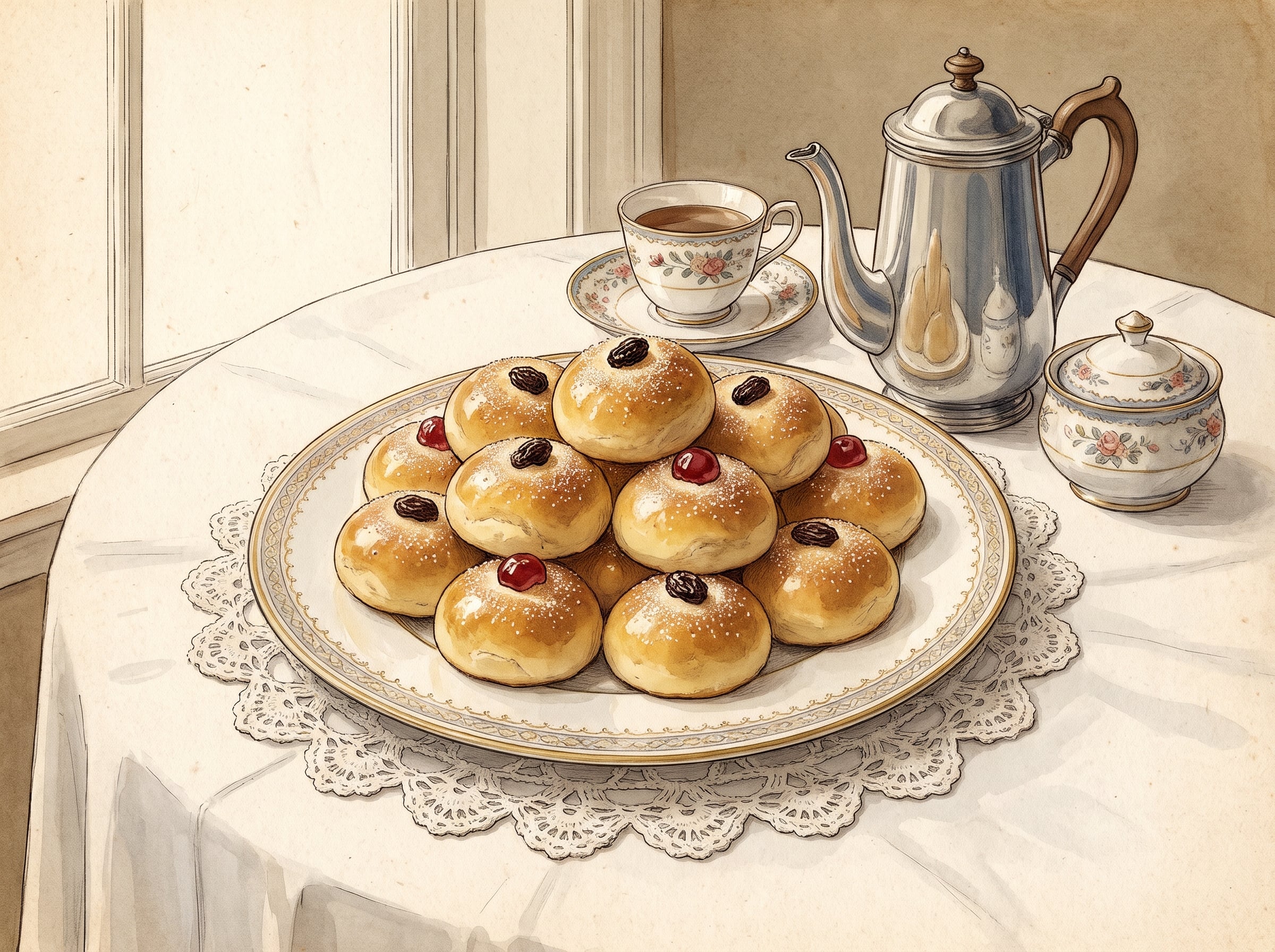
Somewhere between a Czech holiday pastry and a quick drop bun sits this little cake from a 1919 New York cookbook. It asks for yeast by the cake, an oven that is simply "hot," and a cook who knows "light" dough when she sees it. Then it crowns each one with a single raisin or cherry.
Please note that some of the images in this article were created with the assistance of AI.
From The International Jewish Cook Book (second edition), 1919
The Story Behind This Recipe
A Hunter College graduate and a kosher cookbook
Florence Kreisler Greenbaum had a Hunter College degree and, by 1918, a cookbook with her name on the cover. The International Jewish Cook Book came out that year from the Bloch Publishing Company in New York. The second edition, the one our recipe comes from, followed in 1919. Bloch sold it with a bold claim: the first strictly kosher cookbook printed in English in the United States. That wasn’t quite true, but publishers have rarely let a small detail spoil a good blurb.
Tucked among its pages is "Sour Cream Kolatchen." The spelling may look unfamiliar, but the pastry is an old friend under a new arrangement of letters. Kolatchen sits alongside kolacky, kolach, klobasnek and kolache, all names for a sweet pastry filled with fruit or meat. Greenbaum’s spelling adds one more name to a long list and shows a Bohemian bake settling into an American Jewish kitchen.
Born round
Ask what a kolache looks like and the answer starts with a shape. The name comes from "kolo," the Czech word for circle. Recipes shift from region to region, but every Czech kolache is round. The usual fillings are apricot, plum, poppy seed or cream cheese. Many wear a crumbly hat of posypka, a mix of flour, sugar and butter.
These were not everyday buns. Families usually saved them for Christmas and Easter, christenings and weddings, though better-off households managed them nearly every Sunday. Wedding kolaches were made tiny, so one celebration could call for a hundred or more. Greenbaum’s teaspoon-sized drops fit that tradition of small, festive bites. Her dough is rich enough for any party: five yolks, half a cup of butter and a cup of thick sour cream.
The no-fuss kolache
Plenty of kolache recipes ask for patience. One modern Smithsonian-adapted version chills its dough overnight, then cuts it into squares and folds each one around apricot filling. Greenbaum skips all of that. You stir the dough, drop it from a teaspoon onto greased pans and let it rise once somewhere warm. Then you add the raisin or cherry, brush on egg white, sprinkle with sugar and bake for ten minutes. There’s no rolling pin, no cutter and no filling to spoon in.
The wording is a snapshot of a 1919 kitchen. Yeast came in cakes, and Greenbaum wants two of them, or an ounce, softened in lukewarm milk with a little sugar. Fleischmann’s, the big name in American yeast, sold it in exactly that form, and its sales tripled between 1917 and 1924. The oven gets no number, just "hot," where the modern Smithsonian-adapted recipe calls for 350 degrees. The rise ends when the cakes look "light," and that call was left to the cook’s eye.
1910s
Notes From the Era
The recipe · 1919
Sour Cream Kolatchen
From The International Jewish Cook Book (second edition) by Florence Kreisler Greenbaum (1919). Every word of the recipe below is as printed.
Ingredients
- one-half cup of butter
- five yolks
- two tablespoons of sugar
- grated rind of a lemon
- one cup of thick sour cream
- one ounce or two cakes of yeast
- a little sugar
- two tablespoons of lukewarm milk
- three cups of flour
- a raisin or cherry
- beaten white of egg
- sugar
Method
-
Make the batter base
Cream one-half cup of butter, add five yolks, two tablespoons of sugar, grated rind of a lemon, one cup of thick sour cream and one ounce or two cakes of yeast dissolved with a little sugar in two tablespoons of lukewarm milk.
-
Add flour and drop onto pans
Stir all together and add three cups of flour; mix and drop from end of teaspoon on well-greased pans.
-
Let the cakes rise
Let rise until light in a warm place.
-
Top and bake
Place a raisin or cherry on the top of each cake, spread with beaten white of egg, sprinkle with sugar and bake ten minutes in a hot oven.
Our notes
Reading It Today
Two cakes of yeast. A cake of yeast was a small, moist block of compressed fresh yeast. The recipe itself tells us two cakes weigh one ounce. Fresh yeast is still sold in some stores. If you use active dry instead, the usual swap is about two-fifths of the fresh weight, which comes to roughly 11 grams, or about 3½ teaspoons, here.
A "hot oven". Old recipes describe heat instead of giving numbers. A "hot oven" generally means about 400 to 450°F. That fits the short ten-minute bake for small cakes.
What these would be like. With egg yolks, butter and sour cream doing most of the work, expect a soft, tender, almost cakey crumb with a gentle tang and a bright lemon note. The egg white and sugar on top should bake into a thin, crackly, sweet shell, a little like a meringue crust, around the raisin or cherry.
Not your usual yeast bread. Most yeast doughs today are kneaded, shaped and often given two rises. This one is a soft, sticky dough stirred together, dropped from a spoon and risen just once. It also leaves out the fruit or cheese filling of a typical kolache. The only fruit is the single piece pressed on top.
Source: Florence Kreisler Greenbaum, The International Jewish Cook Book (second edition) (Bloch Publishing Company, New York, 1919). Read the 1919 book at Project Gutenberg.
Sources for the history
- Florence Kreisler Greenbaum, The International Jewish Cook Book (2nd ed., Bloch Publishing Company, New York, 1919)
- Czech Kolaches, Czech-American TV (Katie Schon)
- Czech-inspired kolache pastries full of flavor, history, Oklahoma Gazette (Angela Botzer, 2015)
- Books on Jewish Cookery in the New York Public Library (NYPL)
- The International Jewish Cook Book, Barnes & Noble book description
- The Healing Power of Compressed Yeast, Science History Institute
The original recipe text is from a work published in 1919 and is in the public domain in the United States. The history, notes and illustrations are Digstalk’s own. Brand names that appear in historic recipes are mentioned as historical fact only. Illustrations are AI-generated in a vintage style. The recipe is shown exactly as it was published in 1919; we have not photographed a test batch.