
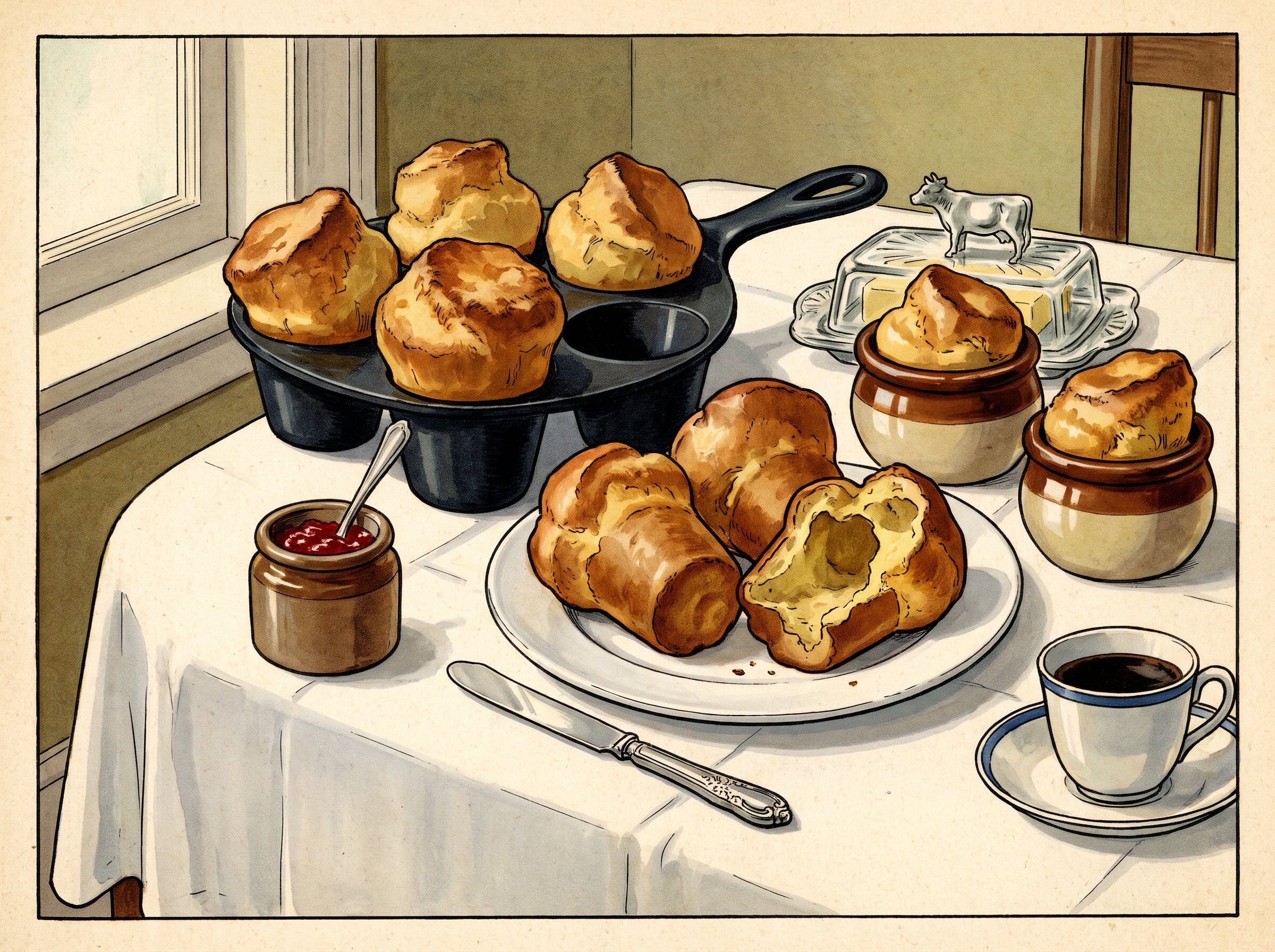
Five ingredients, one brand name, one patented gadget and a pan of hissing-hot gem cups: Elizabeth O. Hiller’s popovers pack a lot into a few lines. They were printed in 1913 in a cookbook published by a shortening company, at a time when American cooks were learning to measure milk down to the eighth of a cup but were still left to judge the oven for themselves.
Please note that some of the images in this article were created with the assistance of AI.
From Fifty-two Sunday Dinners, 1913
The Story Behind This Recipe
A teacher who worked for a living
In 1905, The Woman’s Home Companion invited six well-known cooks to compete for a regular column. Elizabeth O. Hiller was one of them. Fannie Farmer got the job. Hiller, born around 1856, had trained at the Pratt Institute in Brooklyn and at the Boston Cooking School, graduating with the class of 1898, and she later became principal of the Chicago Domestic Training School. The rest of her career kept her busy. She wrote recipes for the Chicago Tribune that ran in newspapers around the country, lectured at shows, to clubs and over the radio, and appeared in advertisements for products like gas ranges.
Fifty-two Sunday Dinners belongs to that working life. Its publisher was the N. K. Fairbank Company of Chicago, maker of Cottolene shortening, and many books like it were written to promote the product. That is why Cottolene appears by name in a recipe that calls for just one teaspoon of fat. Hiller died in 1941 at a daughter’s home in Park Ridge, Illinois.
Pudding under the roast
Long before anyone baked a popover, cooks in northern England had a thrifty habit. As meat roasted, its fat dripped into a pan below, and they poured a batter into that pan so a pudding cooked under the meat. A recipe for ‘dripping pudding’ was in print by 1737, and the 18th-century cookbook writer Hannah Glasse was the first to call it ‘Yorkshire pudding’ in print.
The American popover keeps that egg batter but gives each portion its own cup, away from the roast. The name describes what happens in the oven: the batter swells and pops up over the rim of the tin. The earliest known mention of popovers dates to 1850, and the first cookbook recipe appeared in 1876, in Mary F. Henderson’s Practical Cooking and Dinner Giving. By the time Hiller’s book came out, popovers had been in American cookbooks for nearly forty years.
Brand names, gadgets and a hot oven
Hiller’s batter is the familiar one: flour, salt, milk and eggs ‘beaten very light.’ What dates it is the hardware and the labels. The fat is melted Cottolene, a shortening of beef suet and cottonseed oil sold from the late 1880s, which led its market until Procter & Gamble brought out Crisco. The beating is done ‘with a Dover egg beater,’ a name stamped on a beater patented in 1870 that became the everyday word for any beater of its kind. The batter then goes into gem cups, cast-iron pans with separate cups and open spaces between them to let heat move around, a design one collector dates to about 1867. Hiller wants them ‘hissing-hot.’
Then there are the numbers. Seven-eighths of a cup of milk is the kind of exact measure the Boston Cooking School taught, and Fannie Farmer, who ran that school in the 1890s, is credited with helping standardize American kitchen measurements. The oven gets no such care. It is simply ‘a hot oven’ for thirty to thirty-five minutes, with no temperature given. The book was built around Sunday dinner, the biggest family meal of the week, and a hot batter bread descended from Yorkshire pudding suited that table well. We found nothing tying popovers to a particular holiday, so we leave them at the week’s best meal.
1910s
Notes From the Era
The recipe · 1913
Popovers
From Fifty-two Sunday Dinners by Elizabeth O. Hiller (1913). Every word of the recipe below is as printed.
Ingredients
- 1 cup flour.
- 1/4 teaspoon salt.
- 7/8 cup milk.
- 1 teaspoon melted Cottolene.
- 2 eggs beaten very light.
Method
-
Mix the batter
PROCESS: Sift flour and salt together, add milk gradually, beating continuously. Add melted Cottolene and beaten eggs.
-
Beat until smooth and bubbly
Beat batter with a Dover egg beater three or four minutes until it is perfectly smooth, creamy and full of bubbles.
-
Fill the hot cups and bake
Pour into hissing-hot, well-greased gem cups and bake in a hot oven thirty to thirty-five minutes.
-
Or use custard cups
They may also be baked in earthen custard cups. When baked in the latter vessel they will have a glazed appearance.
Our notes
Reading It Today
Seven-eighths of a cup. 7/8 cup of milk is 14 tablespoons, or one cup minus 2 tablespoons. The 1/4 teaspoon of salt is a level quarter teaspoon, as the Boston Cooking School style of measuring assumes.
Cottolene and the Dover beater. Cottolene is no longer sold. Since the recipe uses only a teaspoon of it, melted vegetable shortening or melted butter fills the same small role. A Dover egg beater is a hand-turned rotary beater. A whisk or an electric mixer does the same job of making the batter smooth and bubbly.
Gem cups and a hot oven. A gem pan is a cast-iron pan of separate cups. The nearest modern pans are a popover pan or a muffin tin, and earthen custard cups are much like today’s ceramic ramekins. ‘A hot oven’ in old recipes is usually taken to mean roughly 400 to 450°F.
What kind of bread this is. There is no yeast, no baking powder and no sugar here. The eggs and the heat of the oven do all the lifting, so there is no rising time. Judging from the ingredients, expect a tall, hollow roll with a crisp brown shell and a soft, slightly eggy inside, mild in flavor and best eaten hot. That makes it closer to Yorkshire pudding than to a dinner roll.
Source: Elizabeth O. Hiller, Fifty-two Sunday Dinners (The N. K. Fairbank Company, Chicago, 1913). Read the 1913 book at Project Gutenberg.
Sources for the history
- Fifty-two Sunday Dinners, Elizabeth O. Hiller (N. K. Fairbank Co., 1913), recipe text
- Elizabeth O. Hiller – Wikipedia
- Home Helps – Science History Institute Digital Collections
- Cottolene – Wikipedia
- Popover – Wikipedia
- Yorkshire pudding – Wikipedia
- The Dawn of the Egg Beater – Victorian Passage
- Cooking History – Meet the Gem Pan – sloCooking
- Fannie Farmer – Wikipedia
The original recipe text is from a work published in 1913 and is in the public domain in the United States. The history, notes and illustrations are Digstalk’s own. Brand names that appear in historic recipes are mentioned as historical fact only. Illustrations are AI-generated in a vintage style. The recipe is shown exactly as it was published in 1913; we have not photographed a test batch.