Marion Harland’s raisin bread fits in a single paragraph and asks for eight hours of patience. It comes from a writer whose first household book sold more than a million copies, and it trusts the reader to recognize a ‘good batter’ on sight.
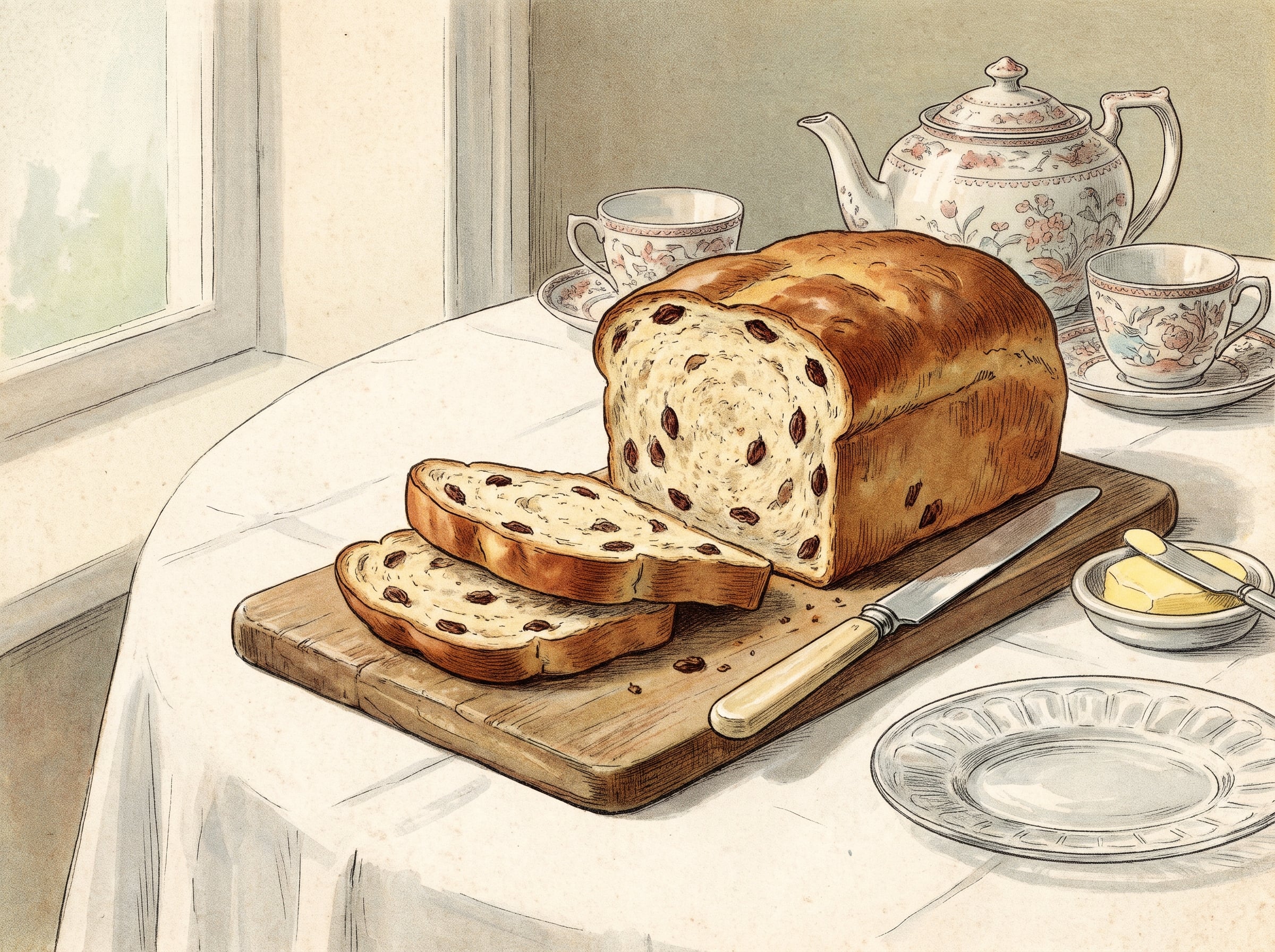
Please note that some of the images in this article were created with the assistance of AI.
From Marion Harland’s Complete Cook Book, 1906
The Story Behind This Recipe
The minister’s wife who wrote the manual she needed
In 1859 a young minister’s wife moved to Newark, New Jersey, and found herself doing her own cooking and cleaning for the first time. She was Mary Virginia Hawes Terhune, born in 1830 to a merchant family in Amelia County, Virginia, and educated at a Presbyterian girls’ school in Richmond. In 1856 she had married Edward Payson Terhune, a Presbyterian minister. In that Newark kitchen she learned how badly a beginner needed detailed, practical help, and how little of it the books of the day offered.
So she wrote her own. Common Sense in the Household came out in 1871 under the name Marion Harland. It sold more than a million copies and stayed in print for fifty years. Readers trusted it because it sounded like a real housewife and mother, with a Virginia upbringing behind her and recipes they could actually follow. Her manuals have been called practical, witty, sarcastic, encouraging and kind, and through them she argued that running a home was an honorable profession. She kept writing for decades and produced more than seventy-five volumes, along with a syndicated women’s column that ran for over eighteen years. This recipe comes from the 1906 Bobbs-Merrill printing of her Complete Cook Book, a title dated to 1903.
Older than its name
Ask around Concord, Massachusetts, and someone may tell you Henry David Thoreau invented raisin bread. He didn’t. Recipes for bread with raisins were in print by 1671, and European bakers were making raisin breads in the 15th century. The name arrived later than the bread. The earliest ‘raisin bread’ the Oxford English Dictionary can find is in an 1845 article in Blackwood’s Edinburgh Magazine. In England, the loaf became a regular part of high tea in the second half of the 1800s.
Many of its relatives were made for special days, such as German stollen at Christmas, Russian kulich at Easter, Italian panettone, and raisin challah for Shabbat and Jewish holidays. Harland’s loaf is the plain one in that family. It calls for milk, a little butter, salt, yeast, flour and raisins, with no sugar, eggs or spice. It is an everyday bread, the kind people often slice and toast for breakfast.
Half a cake and a long wait
The yeast in this recipe came as a cake. In the 1860s the Fleischmann brothers began selling standardized cakes of compressed yeast made in Cincinnati, and by the early 1900s factory yeast was easy to find. Many cookbooks of the period called for enough of it to raise a loaf in under two hours, and food historians say bread grew lighter, softer and blander as a result.
Harland took the slow route. Her method calls for half a yeast-cake and eight hours in a warm room, followed by a hard beating, another cupful of flour, and a second rise ‘until light.’ Much of it depends on the cook’s eye. Most of the flour has no measure at all, only ‘enough to make a good batter.’ The raisins took work too. They had to be seeded and halved, then coated generously in flour before going into the dough.
1900s
Notes From the Era
The recipe · 1906
Raisin Bread
From Marion Harland’s Complete Cook Book by Marion Harland (1906). Every word of the recipe below is as printed.
Ingredients
- a pint of milk
- a teaspoonful of melted butter
- one of salt
- half a yeast-cake
- a half-cupful of warm water
- enough flour to make a good batter
- a cupful of flour
- a cupful of halved and seeded raisins
- flour
Method
-
Scald the milk and add butter and salt
Scald a pint of milk and beat into it a teaspoonful of melted butter and one of salt.
-
Add the yeast and make a batter
When the mixture is lukewarm add half a yeast-cake, dissolved in a half-cupful of warm water, and beat in enough flour to make a good batter.
-
Let the batter rise
Set in a warm room to rise for eight hours.
-
Add flour and the floured raisins
Beat hard, add a cupful of flour and work in a cupful of halved and seeded raisins, plentifully dredged with flour.
-
Rise again and bake
Set to rise until light, then bake.
Our notes
Reading It Today
Pints, cupfuls and scalding. A pint of milk is 2 cups (16 fluid ounces). A teaspoonful is a teaspoon, a half-cupful is ½ cup, and a cupful is 1 cup. To scald milk means to heat it until it is just below boiling, with small bubbles at the edge. It then has to cool to lukewarm before the yeast goes in.
Half a yeast-cake. A yeast-cake was a block of compressed yeast. Half a cake is a small amount for a pint of milk’s worth of dough. That is why the recipe needs an eight-hour first rise and then a second rise.
What the loaf would be like. Judging from the ingredients, this is a soft, mild, lightly salted bread. The milk would give it a tender crumb, since there is only a teaspoonful of butter. With no sugar or spice, all the sweetness comes from the raisins, and the long rise tends to give the bread a fuller flavor than a quick loaf.
How it differs from today’s raisin bread. Most raisin bread sold today is sweetened and often swirled with cinnamon. This loaf is closer to a plain sandwich bread with fruit in it. Modern raisins are usually seedless, so the seeding and halving step can be skipped. Coating the raisins in flour still helps keep them from clumping together in the dough.
Source: Marion Harland, Marion Harland’s Complete Cook Book (The Bobbs-Merrill Company, Indianapolis, 1906). Read the 1906 book at Project Gutenberg.
Sources for the history
- Marion Harland, Marion Harland’s Complete Cook Book (Bobbs-Merrill, Indianapolis, 1906), recipe for Raisin bread
- Mary Virginia Hawes Terhune, Virginia Changemakers (Library of Virginia)
- Marion Harland (1830–1922), Encyclopedia Virginia
- Raisin bread, Wikipedia
- The Food Timeline: history notes, bread (Lynne Olver)
The original recipe text is from a work published in 1906 and is in the public domain in the United States. The history, notes and illustrations are Digstalk’s own. Brand names that appear in historic recipes are mentioned as historical fact only. Illustrations are AI-generated in a vintage style. The recipe is shown exactly as it was published in 1906; we have not photographed a test batch.