
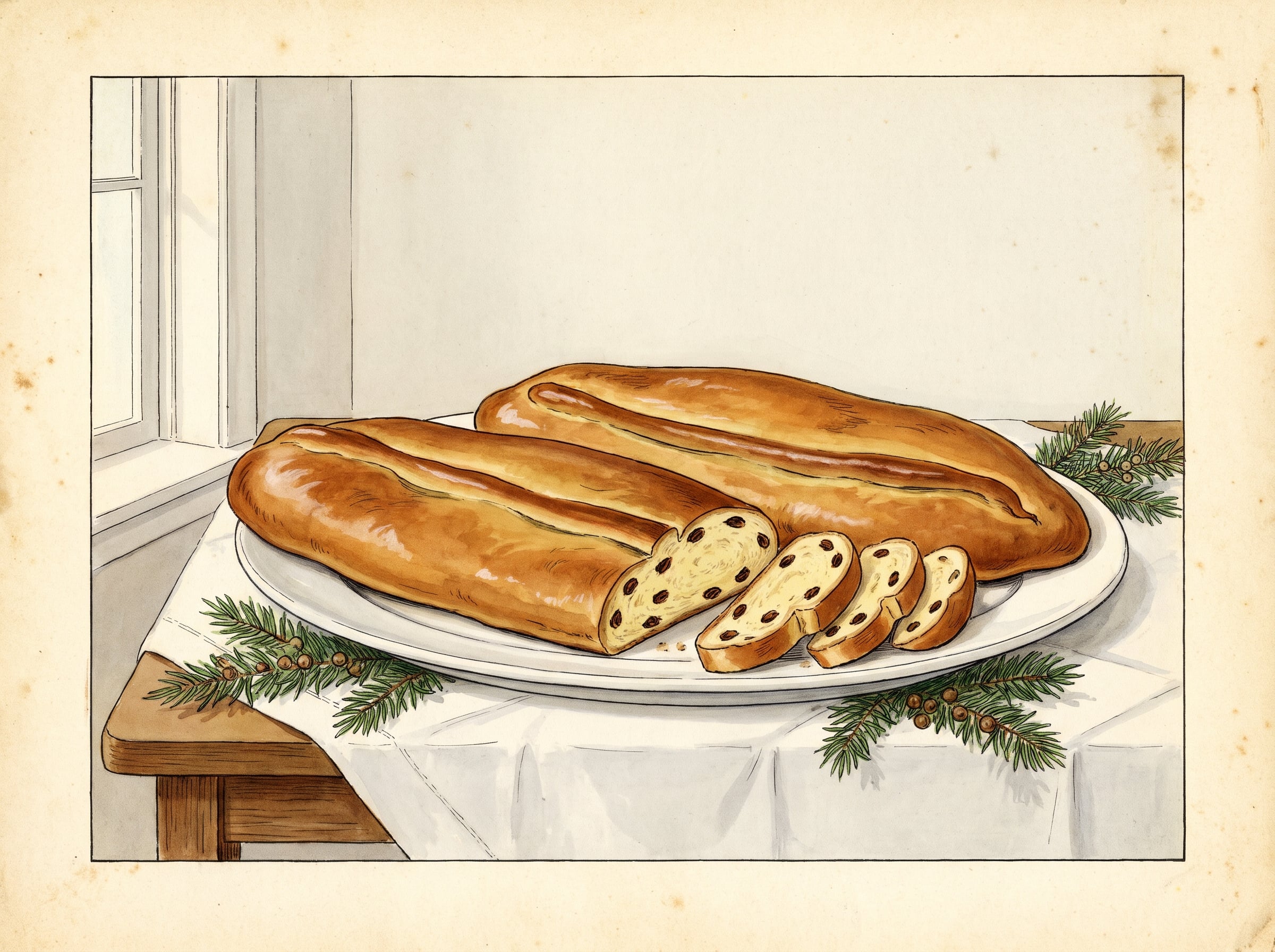
In 1919 a kosher cookbook printed in New York handed its readers a Saxon Christmas bread and trusted them to know what to do with it. There is no oven temperature and no yeast weight, just a cake of yeast, a moderate oven and a fold down the middle. What comes out is stollen with the candied peel, the spice and the sugar coat left behind.
Please note that some of the images in this article were created with the assistance of AI.
From The International Jewish Cook Book (second edition), 1919
The Story Behind This Recipe
Sixteen hundred recipes and the rules for kashering
The subtitle alone could fill an index card. It promises 1600 recipes "according to the Jewish dietary laws with the rules for kashering," plus favorites from America, Austria, Germany, Russia, France, Poland, Roumania and elsewhere. The book carries Florence Kreisler Greenbaum’s name, and Bloch Publishing Company in New York brought out the second edition in 1919. Two more titles appear under her name, King Solomon’s Banquet Table and My Banquet Table. Past that, our sources say little about her life, so we won’t invent one.
The recipes speak for her instead. This kosher book made room for well-loved Central European baking, and its stollen is a dairy bread through and through, made with butter, milk and four egg yolks.
Two long white loaves for the bishop
The first stollen on record was part of a deal. In return for their guild privilege, the bakers of Naumburg owed their bishop "two long white loaves called Stollen" every Christmas Eve. The name itself is a puzzle. Germany’s national digital library offers two candidates: the Germanic "stulno," meaning large and mighty, or the Old High German "stollo," a post or pillar.
Dresden’s bakers trace their own loaf to a 1474 hospital invoice. Back then it was a fasting bread of flour, yeast and water, because the Church banned butter during Advent. Elector Ernst of Saxony and his brother Albrecht appealed to Rome, and the "Butterbrief" arrived in 1491. Spices, dried fruit and sugar came much later. For a long time only a few people could afford them, and they reached middle-class homes as prices fell and Christmas customs spread.
A Saxon loaf in an American kitchen
In Germany the bread is Weihnachtsstollen or Christstollen, one of the shaped breads made for church holidays. Its form and white color are said to recall the infant Jesus wrapped in swaddling cloths. Greenbaum keeps the shape: press down the center, fold the dough over double and form "one or two long loaves, narrow at the end." Dresden treated the bread as a matter for the court. Its bakers once carried a 36-pound Christmas stollen through the city to their ruler, and Augustus the Strong had a giant one baked in 1730, which the Stollenfest still remembers. That tradition "ended only in 1918 with the fall of the monarchy," a year before this edition appeared. It was later revived.
Today’s official Dresden stollen has candied lemon and orange peel, sweet and bitter almonds, clarified butter, a secret spice blend and a powdered-sugar coat. Beside it, the 1919 loaf is plain. It keeps the core of butter, raisins, almonds and lemon, but uses grated fresh peel and powdered almonds. The method is its own too. The cook sets a sponge first, then beats the rich dough "with the hands, not kneading." The dough rises at least three hours and gets a brush of melted butter before its last rise. The book never calls it a Christmas bread. The name brings that connection with it.
1910s
Notes From the Era
The recipe · 1919
Stollen
From The International Jewish Cook Book (second edition) by Florence Kreisler Greenbaum (1919). Every word of the recipe below is as printed.
Ingredients
- two pounds of flour
- one cake of compressed yeast
- one teaspoon of salt
- one pint of lukewarm milk
- one tablespoon of sugar
- one-half pound of creamed butter
- a quarter of a pound of seeded raisins
- one-quarter of a pound of sugar
- yolks of four eggs
- four ounces of powdered almonds
- the grated peel of a lemon
- melted butter
Method
-
Set the sponge
Sift two pounds of flour into a bowl and set a sponge in it with one cake of compressed yeast, one teaspoon of salt, one pint of lukewarm milk and one tablespoon of sugar.
-
Add the butter, fruit and flavourings
When this has risen, add one-half pound of creamed butter, a quarter of a pound of seeded raisins and one-quarter of a pound of sugar, yolks of four eggs, four ounces of powdered almonds, and the grated peel of a lemon.
-
Beat the dough by hand
Work all well, beating with the hands, not kneading.
-
Rise, fold and shape the loaves
Let this dough rise at least three hours, roll, press down the centre and fold over double, then form into one or two long loaves, narrow at the end.
-
Butter, rise again and bake
Brush the top with melted butter, let rise again and bake three-quarters of an hour in a moderate oven.
Our notes
Reading It Today
One cake of compressed yeast. Compressed yeast is fresh yeast, sold in small pressed cakes. The standard small cake weighs about 0.6 ounce. Bakers usually treat it as equal to one packet (2¼ teaspoons) of active dry yeast.
A moderate oven. Cookbooks of this period used "moderate" to mean roughly 350 to 375°F. The recipe bakes the loaves for three-quarters of an hour, or 45 minutes.
Seeded raisins, powdered almonds and a pint of milk. Seeded raisins are raisins with the seeds taken out. They are not a seedless variety. Powdered almonds are almonds ground very fine, close to today’s almond flour or almond meal. A pint is 2 cups, and four ounces is a quarter pound.
What kind of bread this is. Judging from the ingredients, this should be a rich, tender, lightly sweet loaf. The butter, yolks and hand-beating would give it a soft crumb, and the almond and fresh lemon would flavor it. It has no spice, candied peel or sugar coat. Its only butter outside the dough is a brush on top before the final rise. That makes it milder and less sweet than the stollen sold today, and probably not built to keep for weeks the way German stollen is.
Source: Florence Kreisler Greenbaum, The International Jewish Cook Book (second edition) (Bloch Publishing Company, New York, 1919). Read the 1919 book at Project Gutenberg.
Sources for the history
- Florence Kreisler Greenbaum, The International Jewish Cook Book (2nd ed., Bloch Publishing Company, New York, 1919), Project Gutenberg
- Florence Kreisler Greenbaum, author page, Goodreads
- Stollen: Von Brot, Privilegien und Weihnachtszauber, Deutsche Digitale Bibliothek (Theresa Rodewald, 5 December 2024)
- Stollen, Wikipedia
- Dresdner Christstollen, Schutzverband Dresdner Stollen e. V.
The original recipe text is from a work published in 1919 and is in the public domain in the United States. The history, notes and illustrations are Digstalk’s own. Brand names that appear in historic recipes are mentioned as historical fact only. Illustrations are AI-generated in a vintage style. The recipe is shown exactly as it was published in 1919; we have not photographed a test batch.