
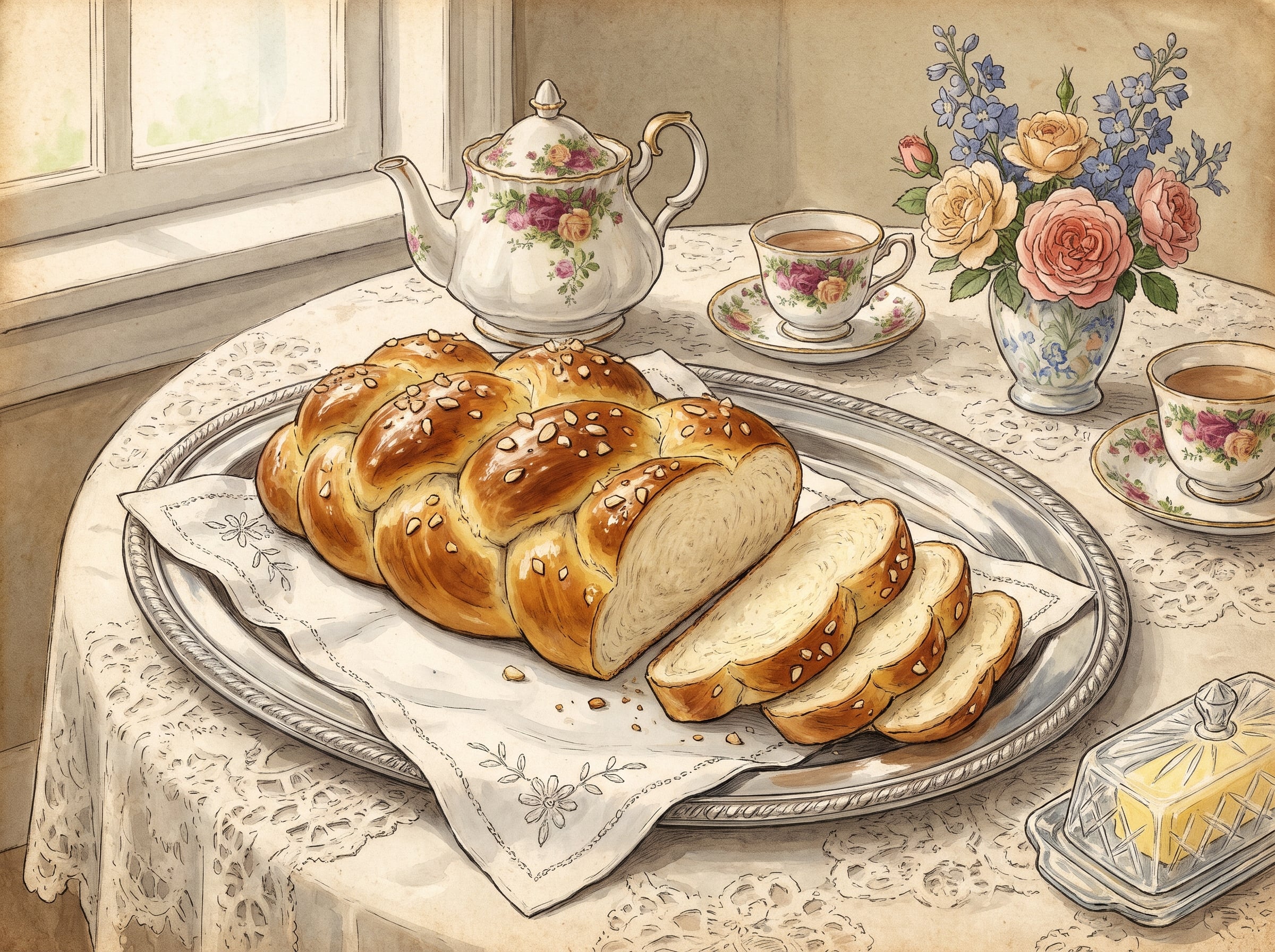
In 1910 a Boston cook could pull a golden three-strand braid from the oven, glossy with egg yolk and scattered with chopped almonds. The recipe comes from Fannie Merritt Farmer, the woman who taught America to level off its measuring cups, and nearly every line of it carries the habits of her kitchen.
Please note that some of the images in this article were created with the assistance of AI.
From The Boston Cooking-School Cook Book, 1910
The Story Behind This Recipe
The teacher who measured everything
Fannie Merritt Farmer was supposed to go to college. She was born in Boston on March 23, 1857, and as a teenager she was struck by paralysis, which ended that plan. While she recovered, she cooked for her family and for the boarders they took in, and the kitchen stuck. She enrolled at the Boston Cooking School, which, as the Boston Public Library describes it, trained working-class women to work as cooks and servants in upper- and middle-class homes. She graduated in 1889 and became assistant to the principal, Carrie M. Dearborn. When Dearborn died, Farmer took over as director. In 1902 she opened Miss Farmer’s School of Cookery, which taught housewives, and she lectured to nurses, women’s clubs and the Harvard Medical School.
Her cookbook appeared on January 7, 1896. Her publisher, Little, Brown, doubted it would sell, so Farmer paid for the first 3,000 copies herself. It was an immediate success and made her financially independent. Its big idea was exactness. There were no pinches and no butter ‘the size of an egg,’ only level cups and spoons, and that earned her the title ‘the mother of level measurements.’ The 1910 printing that holds this recipe came out in her final years. Strokes kept her in a wheelchair for the last seven years of her life, yet she kept writing and lecturing until shortly before her death in 1915.
So what makes it Swedish?
Here we have to be straight with you. The sources we could reach don’t say where Farmer found this recipe, why she called it Swedish, or whether Boston families baked it for Christmas. We would rather not invent a backstory. Luckily, the recipe tells a good deal on its own.
This is a patient dough. It begins with a small sponge of yeast, half a cup of milk and half a cup of flour, left to rise. Next comes more milk and a big heap of flour, followed by another rise. Only after that do the butter, sugar, beaten egg, salt and almond extract go in, and then the dough is kneaded and left to rise a third time. The only flavoring is almond. The cook could shape it as a ‘Tea Ring I or II’ or as the Swedish Tea Braid. For the braid, three hand-rolled strands are plaited together, brushed with yolk thinned with cold water and sprinkled with finely chopped blanched almonds.
The little foil-wrapped block
Look closely at ‘1 yeast cake.’ Before commercial yeast came along, American home bakers raised their dough with wild yeast, with starters passed from one baker to another, or with foam skimmed off fermenting beer. Each one rose and tasted a little differently. In the 1860s Charles Fleischmann, who had trained in yeast-making in Europe, joined businessman James Gaff near Cincinnati to mass-produce yeast. They pressed it into cakes, wrapped the cakes in tin foil and sold them fast, often door to door. The moist cakes spoiled quickly.
Home baking boomed in the decades that followed, and refrigerated railway cars carried fresh yeast across the country. A cook working through this recipe in 1910 was baking in the heyday of the yeast cake. That heyday didn’t last. By 1920 store-bought bread was cutting into home baking, and in the 1940s the perishable cakes mostly gave way to dry granular yeast. The rest of the recipe is pure Farmer, with exact cups and teaspoons right up to the last line. That line simply trusts the reader to know a ‘moderate oven’ when she sees one.
1910s
Notes From the Era
The recipe · 1910
Swedish Bread
From The Boston Cooking-School Cook Book by Fannie Merritt Farmer (1910). Every word of the recipe below is as printed.
Ingredients
- 2½ cups scalded milk
- 1 yeast cake
- Flour
- ½ cup melted butter
- ⅔ cup sugar
- 1 egg, well beaten
- ¼ teaspoon salt
- 1 teaspoon almond extract
- yolk of one egg, slightly beaten
- one-half tablespoon cold water
- finely chopped blanched almonds
Method
-
Start the yeast sponge
Add yeast cake to one-half cup milk which has been allowed to cool until lukewarm; as soon as dissolved add one-half cup flour, beat thoroughly, cover, and let rise.
-
Add milk, flour and remaining ingredients
When light, add remaining milk and four and one-half cups flour. Stir until thoroughly mixed, cover, and again let rise; then add remaining ingredients and one and one-half cups flour.
-
Knead and rise again
Toss on a floured cloth and knead, using one-half cup flour, cover, and again let rise.
-
Shape and bake
Shape as Swedish Tea Braid or Tea Ring I or II, and bake.
-
Roll and braid the dough
=Swedish Tea Braid.= Cut off three pieces of mixture of equal size and roll, using the hands, in pieces of uniform size; then braid.
-
Glaze, top with almonds and bake
Put on a buttered sheet, cover, let rise, brush over with yolk of one egg, slightly beaten, and diluted with one-half tablespoon cold water, and sprinkle with finely chopped blanched almonds. Bake in a moderate oven.
Our notes
Reading It Today
Yeast cake and scalded milk. A yeast cake is fresh, or compressed, yeast pressed into a small moist block. Some stores still sell fresh yeast in 0.6-ounce cakes. One packet (2¼ teaspoons) of active dry yeast is the usual stand-in. Scalded milk has been heated until it is just short of boiling. The recipe has you cool the first half cup to lukewarm before the yeast goes in.
A moderate oven. Farmer gives no temperature. A ‘moderate oven’ is the old term for roughly 350°F to 375°F.
What the bread would be like. Judging from the ingredients, this should be a soft, rich, mildly sweet loaf. The butter, egg and ⅔ cup of sugar would make a tender crumb, and the almond extract would perfume it. The yolk wash gives a shiny brown crust, and the chopped blanched almonds on top add some crunch.
How it differs from a modern sweet braid. The flour goes in at several stages and adds up to about seven cups, so this makes a large batch of dough. The recipe calls for three separate rises, and the butter and sugar are held back until after the second one. Many recipes today mix everything at once with instant yeast and let it rise once or twice.
Source: Fannie Merritt Farmer, The Boston Cooking-School Cook Book (Little, Brown, and Company, Boston, 1910). Read the 1910 book at Project Gutenberg.
Sources for the history
- The Boston Cooking-School Cook Book (1910), Fannie Merritt Farmer — recipe text as printed
- Fannie Farmer: Boston’s Cooking Icon — Boston Public Library
- Farmer, Fannie Merritt — Encyclopedia.com (American Women Writers)
- Fannie Farmer — Wikipedia
- Throwback Thursday: Fannie Farmer’s Revolutionary Cookbook Was Published Today — Boston Magazine
- Fannie Farmer: Mother of Level Measurements — Grub Americana
- The Healing Power of Compressed Yeast — Science History Institute
The original recipe text is from a work published in 1910 and is in the public domain in the United States. The history, notes and illustrations are Digstalk’s own. Brand names that appear in historic recipes are mentioned as historical fact only. Illustrations are AI-generated in a vintage style. The recipe is shown exactly as it was published in 1910; we have not photographed a test batch.